| Piú viste |
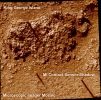
SOL1031-PIA09092-RA6-mi-king-george_annotated.jpgThe "granules" of King George Island58 visiteCaption NASA originale:"This mosaic was made from frames acquired by the MI - Microscopic Imager on NASA's MER Spirit during Spirit's 1031st Martian Day, or Sol, on the Red Planet (such as Nov. 27, 2006). It shows a rock target called "King George Island" after the target was brushed by the Rover's RAT - Rock Abrasion Tool.
The mosaic covers approx. 6 cm (2,4") across and shows the granular nature of the rock exposure. The grains are typically about 1 mm (0,04") wide.
Data from the Rover's Mössbauer Spectrometer provides evidence that they have an enhanced amount of the mineral Hematite relative to surrounding soils".
|
|

Psp_001700_2505_red-01.jpgThe "Frozen Lake" of Vastitas Borealis...is not a Lake, according to NASA (EDM - Enhanced Natural Colors; credits for the additional process. and color.: Dr Paolo C. Fienga - Lunexit Team)58 visiteThis EDM shows the Dunes and Frost boundary up-close. The Frost is largely absent over the Dunes and is more stable over the ground that does not have dune-shaped landforms.
|
|

OPP-SOL1065-1P222747324EFF78ESP2666L4M1.jpgHorizon (1) - Sol 106558 visitenessun commento
|
|

Titan-North_Polar_Regions-PIA09171.jpgStrong turbulence over Titan's North Pole58 visiteCaption NASA:"Cassini's VIMS (Visual and Infrared Mapping Spectrometer) has imaged a huge cloud system covering the North Pole of Titan.
This composite image shows the cloud, imaged at a distance of 90.000 Km (about 54.000 miles) during a Dec. 29, 2006, flyby designed to observe the limb of the moon. Cassini's VIMS scanned the limb, revealing this spectacular cloud system.
It covers the North Pole down to a Latitude of 62° North and at all observed Longitudes.
Such a cloud cover was expected, according to the atmospheric circulation models of Titan, but it had never been observed before with such details. The condensates may be the source of liquids that fill the lakes recently discovered by the radar instrument.
This image was color-coded, with blue, green and red at 2, 2,7 and 5 microns, respectively".
|
|

Orion.jpgPersian Orion...58 visitenessun commento
|
|
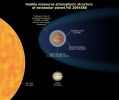
HD-209458b-01.jpgExtra-Solar Planet HD-209458b (2)58 visiteAlthough HD 209458b does not have a twin in our Solar System, it has plenty of relatives beyond our Solar System. About 10 to 15% of the more than 200 known extrasolar planets are hot Jupiters. A recent HST survey netted 16 hot Jupiter candidates in the central region of our Milky Way Galaxy, suggesting that there may be billions of these gas-giant star huggers in our galaxy.
HD 209458b is one of the most intensely studied extrasolar planets because it is one of the few known alien worlds that can be seen passing in front of, or transiting, its star, causing the star to dim slightly. In fact, the gas giant is the first such alien world discovered to transit its star.
HD 209458b is 150 LY from Earth, in the Constellation of Pegasus.
The planet's transits allow astronomers to analyze the structure and chemical makeup of the gas giant's atmosphere by sampling the starlight that passes through it. The effect is similar to finding fingerprints on a window by watching how sunlight filters through the glass.
Previous HST observatoins revealed Oxygen, Carbon and Sodium in the planet's atmosphere, as well as a huge Hydrogen upper atmosphere with a comet-like tail. These landmark studies provided the first detection of the chemical makeup of an extrasolar planet's atmosphere.
Additional observations by NASA's SST captured the infrared glow from the planet's hot atmosphere.
The new study by Ballester and her team is based on an analysis of archival observations made in 2003 with HST's Imaging Spectrograph by David Charbonneau of the Harvard-Smithsonian Center for Astrophysics in Cambridge, Mass. Ballester's team analyzed spectra from hot hydrogen atoms in the planet's upper atmosphere, a region not studied by Charbonneau's group.
|
|

HD-209458b-00.jpgExtra-Solar Planet HD-209458b (1)58 visiteThe powerful vision of NASA's HST has allowed astronomers to study for the first time the layer-cake structure of the atmosphere of a planet orbiting another star. HST discovered a dense upper layer of hot Hydrogen gas where the super-hot planet's atmosphere is bleeding off into space.
The planet, designated HD 209458b, is unlike any world in our Solar System. It orbits so close to its star and gets so hot that its gas is streaming into space, making the planet appear to have a comet-like tail. This new research reveals the layer in the planet's upper atmosphere where the gas becomes so heated it escapes, like steam rising from a boiler.
"The layer we studied is actually a transition zone where the temperature skyrockets from about 1340 deg. Fahrenheit (1000 Kelvin) to about 25.540 degrees (15.000 Kelvin), which is hotter than the Sun " said Gilda Ballester of the University of Arizona in Tucson, leader of the research team.
"With this detection we see the details of how a planet loses its atmosphere."
The findings by Ballester, David K. Sing of the University of Arizona and the Institut d'Astrophysique de Paris, and Floyd Herbert of the University of Arizona will appear Feb. 1 in a letter to the journal Nature.
The Hubble data show how intense ultraviolet radiation from the host star heats the gas in the upper atmosphere, inflating the atmosphere like a balloon. The gas is so hot that it moves very fast and escapes the planet's gravitational pull at a rate of 10,000 tons a second, more than three times the rate of water flowing over Niagara Falls. The planet, however, will not wither away any time soon. Astronomers estimate its lifetime is more than 5 billion years.
The scorched planet is a big puffy version of Jupiter. In fact, it is called a "hot Jupiter," a large gaseous planet orbiting very close to its parent star. Jupiter might even look like HD 209458b if it were close to the Sun, Ballester said.
The planet completes an orbit around its star every 3.5 days. It orbits 4.7 million miles from its host, 20 times closer than the Earth is to the Sun. By comparison, Mercury, the closest planet to our Sun, is 10 times farther away from the Sun than HD 209458b is from its star. Unlike HD 209458b, Mercury is a small ball of iron with a rocky crust.
|
|

as10-29-4288.jpgAS 10-29-4288 - Lunar Limb and "Plume Deflector"58 visitenessun commento
|
|

as14-66-9254.jpgAS 14-66-9254 - The (fragile-looking) Lunar Module58 visitenessun commento
|
|

as14-66-9259.jpgAS 14-66-9259 - The (fragile-looking) Lunar Module58 visitenessun commento
|
|

South_Polar_Regions-h0231_0000_nd3-01.jpgFrame Mars Express n. h0231_0000_nd3 (natural colors - elab. Lunexit)58 visite
|
|

The_Sun_from_SOHO_-_Coronal_Mass_Ejection.jpgCoronal Mass Ejection58 visiteCaption NASA originale:"What's happening to our Sun? Another Coronal Mass Ejection (CME)!
The Sun-orbiting SOHO spacecraft has imaged many erupting filaments lifting off the active solar surface and blasting enormous bubbles of magnetic plasma into space. Direct light from the sun is blocked in the inner part of the above image, taken in 2002, and replaced by a simultaneous image of the Sun in ultraviolet light.
The field of view extends over 2 MKM from the Solar Surface. While hints of these explosive events, called Coronal Mass Ejections or CMEs, were discovered by spacecraft in the early 70s, this dramatic image is part of a detailed record of this CME's development from the presently operating SOHO spacecraft.
Near the minimum of the Solar Activity Cycle CMEs occur about once a week, but near solar maximum rates of two or more per day are typical. Strong CMEs may profoundly influence space weather. Those directed toward our Planet can have serious effects".
|
|
| 25353 immagini su 2113 pagina(e) |
 |
|
|
|
|
1374 | |
|
|
|
|





