| Piú viste |

Orcus-GIF.gif90482 Orcus58 visiteCaption NASA:"A newly discovered object in the Outer Solar System moves like an anti-Pluto. 90482 Orcus was first discovered in 2004 and is slightly smaller than Pluto, although still one of the largest Kuiper Belt objects known.
Orcus may one day have the same IAU designation as Pluto: a dwarf planet.
Orcus and Pluto have similar orbits: each achieves nearly the same maximum and minimum distances from the Sun, each orbits on a similarly shaped ellipse, and each orbital ellipse is tilted toward the other planets' orbital ellipse by roughly the same angle. The great mass of Neptune causes each to circle the Sun twice for every three Neptune orbits.
Orcus is like an anti-Pluto, however, because the two objects always remain across the Solar System from each other. Orcus can be found as the spot near the center of these discovery frames moving slightly down from the top.
Until the end of next week, the discoverers of Orcus ask for your help in naming its newly discovered moon".MareKromium
|
|

ESP_011526_0980_RED_abrowse.jpgMonitor Seasonal Changes at a South Polar Cracked and Gullied Site (Natural Colors; credits: Lunar Explorer Italia)58 visiteMars Local Time: 17:10 (middle afternoon)
Coord. (centered): 81,7° South Lat. and 66,3° East Long.
Spacecraft altitude: 246,5 Km (such as about 154,1 miles)
Original image scale range: 49,3 cm/pixel (with 1 x 1 binning) so objects ~ 1,48 mt across are resolved
Map projected scale: 50 cm/pixel
Map projection: EQUIRECTANGULAR
Emission Angle: 2,6°
Phase Angle: 82,3°
Solar Incidence Angle: 84° (meaning that the Sun is about 6° above the Local Horizon)
Solar Longitude: 189,1° (Northern Autumn)
Credits: NASA/JPL/University of Arizona
Additional process. and coloring: Lunar Explorer ItaliaMareKromium
|
|
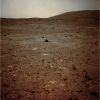
SOL1858-2N291311423EFFB0LTP0747L0M1.jpgPanorama (2) - Sol 1858 (Natural Colors; credits: Lunar Explorer Italia)58 visitenessun commentoMareKromium
|
|
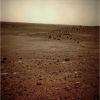
SOL1858-2N291311373EFFB0LTP0747R0M1.jpgPanorama (1) - Sol 1858 (Natural Colors; credits: Lunar Explorer Italia)58 visitenessun commentoMareKromium
|
|

SOL732-GB-LXT.jpgMedium-sized Boulders - Sol 732 (possible True Colors; credits: Dr G. Barca & Lunar Explorer Italia)58 visitenessun commentoMareKromium
|
|
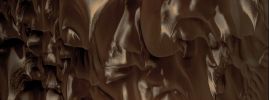
Craters-Hellespontus_Crater-1-M0201817Det.jpgFrost on the dunes of Hellespontus Crater (Natural Colors; credits for the additional process. and color.: Dr Paolo C. Fienga - Lunar Explorer Italia)58 visitenessun commentoMareKromium
|
|

ESP_011345_0950_RED_abrowse.jpgSmall Fan-like Surface Features on the South Polar Perennial Cap (Natural Colors; credits: Lunar Explorer Italia)58 visiteMars Local Time: 17:54 (late afternoon)
Coord. (centered): 84,8° South Lat. and 339,3° East Long.
Spacecraft altitude: 247,7 Km (such as about 154,8 miles)
Original image scale range: 99,1 cm/pixel (with 1 x 1 binning) so objects ~ 2,97 mt across are resolved
Map projected scale: 1 mt/pixel
Map projection: EQUIRECTANGULAR
Emission Angle: 0,9°
Phase Angle: 88,7°
Solar Incidence Angle: 89° (meaning that the Sun is about 1° above the Local Horizon)
Solar Longitude: 181,0° (Northern Autumn)
Credits: NASA/JPL/University of Arizona
Additional process. and coloring: Lunar Explorer ItaliaMareKromium
|
|

ESP_011403_1905_RED_abrowse.jpgCone at the Source of Athabasca Valles (Natural - but strongly enhanced - Colors; credits: Lunar Explorer Italia)58 visiteMars Local Time: 15:50 (middle afternoon)
Coord. (centered): 10,2° North Lat. and 157,4° East Long.
Spacecraft altitude: 278,4 Km (such as about 174,0 miles)
Original image scale range: 27,8 cm/pixel (with 1 x 1 binning) so objects ~ 84 cm across are resolved
Map projected scale: 25 cm/pixel
Map projection: EQUIRECTANGULAR
Emission Angle: 7,7°
Phase Angle: 50,7°
Solar Incidence Angle: 58° (meaning that the Sun is about 32° above the Local Horizon)
Solar Longitude: 183,6° (Northern Autumn)
Credits: NASA/JPL/University of Arizona
Additional process. and coloring: Lunar Explorer ItaliaMareKromium
|
|
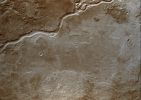
Channels-Apsus_Vallis-PIA02170-PCF-LXTT-00.jpgApsus Vallis (1 - Natural Colors; credits for the additional process. and color.: Dr Paolo C. Fienga - Lunar Explorer Italia)58 visiteThe channel in this image is called Apsus Vallis and it is located near the Elysium volcanic complex. Lava may have played a part in the formation of Apsus Vallis.
Image information: VIS instrument;
Latitude: 35,3° North;
Longitude: 134,9° East;
Resolution: 19 meter/pixelMareKromium
|
|

Hellas_Planitia-MGS~0.jpgFeatures of Hellas Planitia: the "Martian Freeways" (Saturated Absolute Natural Colors; credits for the additional process. and color: Dr Paolo C. Fienga - Lunexit Team)58 visiteCaption NASA originale:"This MGS-MOC image shows an example of the extremely odd, seemingly scrambled layered rocks exposed by erosion near the deepest part of the deepest basin on Mars: Hellas. This pattern of eroded, and perhaps deformed layers was once exposed to the martian surface, then buried, and more recently exposed again. The story behind these layers is not really understood; some members of the MOC team have — for nearly 9 years now —taken to calling these features, "taffy-pull terrain".
Location near: 43,1° South; 307,3° West
Image width: ~3 Km (~1,9 mi)
Illumination from: upper left
Season: Southern Spring
Nota Lunexit: immagini come questa, a parte la loro intrinseca bellezza e la grande suggestione che riescono ad infondere in chi le guarda, hanno un Valore immenso.
Tuttavia, di quando in quando, qualche pseudo-scienziato dice che le immagini in arrivo dallo Spazio (TUTTE le immagini, senza eccezioni) sono "sostanzialmente inutili a fini di ricerca scientifica".
Noi non comprendiamo la ratio di questa frase che - onestamente - è tanto "ad effetto", quanto vuota e stupida; però una cosa ci va di dirla: forse le immagini in arrivo dallo Spazio "non servono" alla Ricerca Scientifica. Forse.
Ma CERTAMENTE non servono alla predetta Ricerca degli pseudo-scienziati (probabilmente dei ricercatori universitari falliti o fallendi) che, quando gli "gira", proferiscono impunemente (dall'alto della loro stratosferica ignoranza) simili assurdità.
Vere e proprie bestemmie, insomma, specie se si pensa a QUANTE VITE e QUANTI SOLDI sono costate e costano le "scientificamente inutili" immagini che ci arrivano dal resto del Sistema Solare.
Morale: certa gente dovrebbe solo tacere, rivoltarsi nel proprio guano e vergognarsi.MareKromium
|
|

Craters-Wirtz_Crater-MGS~0.jpgThe Dunes of Wirtz Crater (Natural Colors; credits for the additioonal process. and color.: Dr Paolo C. Fienga - Lunexit Team)58 visitenessun commentoMareKromium
|
|
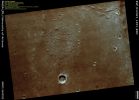
ESP_012425_1455_RED_abrowse.jpgUnusually-looking "Circular Surface Feature" (possible True Colors; credits: Dr G. Barca)58 visiteThis circular feature is a collection of hills, with some connected by ridges. The circularity suggests that perhaps there was once an impact crater here that was subsequently filled with material which was somehow more resistant to erosion than the landscape around it. Over time, as erosion stripped away the ground, the fill material was left standing higher (although it has clearly been eroded as well).
Nota Lunexit: si tratta di un "Exhumed Crater", ossìa di un cratere prima ricoperto da detriti e sedimenti e poi, a seguito di azioni prevalentemente eoliche (un vero e proprio scorticamento del suolo), è stato riportato - parzialmente - alla luce. Lo scorticamento che evidenzia il cratere sepolto è indice del fatto che i materiali i quali lo avevano ricoperto erano più resistenti e stabili dei materiali che circondano il cratere stesse (i quali, appunto, sono stati smossi dai venti). Un fenomeno similare, ma relativo ai canali, dà luogo ai cosiddetti "Inverted Channels", di cui si è già parlato in passatoMareKromium
|
|
| 25353 immagini su 2113 pagina(e) |
 |
|
|
|
|
1363 | |
|
|
|
|





