| Piú viste |
Chaotic_Terrain-Sirenum_Fossae-MO-20090625a.jpgMesa in Sirenum Fossae (natural Colors; credits: Lunar Exploter Italia)58 visitenessun commentoMareKromium
|
|

Titan-PIA11522.jpgSenkyo (Natural Colors; credits: Lunar Explorer Italia)58 visiteCaption NASA:"The Cassini Spacecraft examines the dark region of Senkyo on Saturn's largest moon, Titan. Senkyo is in the center of the image, and it lies just south of the moon's equator. For an earlier view of this Region, see PIA08231.
Lit terrain seen here is on the Saturn-facing side of Titan. North on Titan is up and rotated 6° to the left.
The image was taken with the Cassini Spacecraft narrow-angle camera on March 21, 2009 using a spectral filter sensitive to wavelengths of near-InfraRed Light centered at 938 nanometers.
The view was obtained at a distance of approx. 994.000 Km (about 618.000 miles) from Titan and at a Sun-Titan-Spacecraft, or Phase, Angle of 63°.
Image scale is roughly 6 Km (a little less than 4 miles) per pixel".MareKromium
|
|

PHOE-SOL150-PIA12107.jpgComposite View of Phoenix Trenches (approx. True Colors; credits: NASA)58 visitenessun commentoMareKromium
|
|
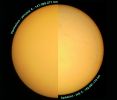
PerihelionAphelion_cervignon800.jpgPerihelion and Aphelion58 visiteDa "NASA - Picture of the Day" del giorno 3 Luglio 2009:"This year Aphelion, the point in Earth's elliptical orbit when it is farthest from the Sun, occurs tomorrow, July 4th.
Of course, that doesn't affect the seasons on our fair Planet, because those are determined by the tilt of Earth's Axis of Rotation and not Earth's distance from the Sun: so July is still Winter in the South and Summer in Northern Hemisphere. But it does mean that on July 4th the Sun will be at its smallest apparent size. This composite neatly compares two pictures of the Sun taken with the same telescope and camera on the dates of Perihelion (closest approach) and Aphelion in 2008.
The image labels include Earth's distance in kilometers from the Sun on the two dates.
Otherwise difficult to notice, the change in the Sun's apparent diameter between Perihelion and Aphelion is clear. The difference amounts to a little over 3%".MareKromium
|
|
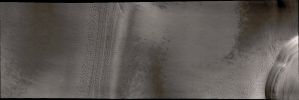
South_Polar_Features-SPLD-20090708a-PCF-LXTT.jpgSouth Polar Layered Deposits (Natural Colors; credits for the additional process. and color.: Dr Paolo C. Fienga - Lunar Explorer Italia)58 visitenessun commentoMareKromium
|
|

ESP_011878_1045_RED_abrowse.jpgSouth Polar Features (Natural Colors; credits: Lunar Explorer Italia)58 visiteThe SHARAD (Shallow Subsurface Radar) looks for liquid or frozen water in the first few hundreds of feet (up to 1 kilometer) of Mars' Crust.
SHARAD probes the subsurface using radar waves within a 15- to 25-megahertz frequency band to get the desired, high-depth resolution.
The Radar Wave Return (RWR), which is captured by the SHARAD antenna, is sensitive to changes in the electrical reflection characteristics of rock, sand and any water that may be present in the Surface and Subsurface. Water, like high-density rock, is highly conducting, and has a very strong RWR. Changes in the reflection characteristics of the Subsurface, caused by layers deposited by geological processes in the ancient history of Mars, are also visible.MareKromium
|
|

ESP_013089_2040_RED_abrowse.jpgTooting Crater (Natural Colors; credits: Lunar Explorer Italia)58 visiteThis image is of the Ejecta Blanket of the Tooting Crater in the Northern Hemisphere of Mars.
Tooting is a "rampart" crater that is roughly 29 Km (about 18 miles) in diameter and appears to be one of the youngest craters of this size.
A "rampart crater" is one where the material ejected from the crater during impact forms lobes that end with a low ridge, or rampart. One indication of Tooting Crater's youth is its ratio of depth to width.
As a crater ages, the walls of the crater will tend to erode and debris will accumulate in the crater's floor making its apparent depth less, while also making its width larger.
One of the major features of Tooting Crater are its multiple ejecta layers that build a sequence of ramparts. The shapes of these ramparts suggest that the ejected material acted as a fluid (like mud) as it moved across the surface.
Most researchers think that such fluid ejecta indicates that there was ice in the ground when the crater formed.MareKromium
|
|

New_View_of_Dark_Pit_on_Arsia_Mons_(PSP_004847_1745)-2.jpgCollapse Pit on Arsia Mons (Natural Colors; credits: Lunar Explorer Italia)58 visitenessun commentoMareKromium
|
|

ISS-011e12343.jpgAtmospherical Hole58 visitenessun commentoMareKromium
|
|

Prometheus-PIA11531.jpgPrometheus58 visiteCaption NASA:"The moon Prometheus and a bit of Saturn's Northern Hemisphere are both brilliantly lit by the Sun here, making the A-Ring seem dim in comparison.
The bright limb of Saturn's Northern Hemisphere can be seen through the A-Ring in the lower left of the image.
Prometheus (about 86 Km, or approx. 53 miles across) orbits in the Roche Division between Saturn's A and F-Ring.
For a similar view of Pandora, another of the F-Ring's Shepherding Moons, see PIA09899.
This view looks toward the sunlit side of the Rings, from about 20° below the Ring-Plane.
The image was taken in Red Light with the Cassini Spacecraft narrow-angle camera on May 25, 2009. The view was acquired at a distance of approx. 694,000 Km (about 431.000 miles) from Prometheus and at a Sun-Prometheus-Spacecraft, or Phase, Angle of 49°.
Image scale is roughly 3,6 Km (about 2,2 miles) per pixel".MareKromium
|
|

LRO-0008b-369444main_lroc_apollo17_lrg.jpgTaurus-Littrow Highlands: the Apollo 17 Landing Site (edm)58 visitenessun commentoMareKromium
|
|
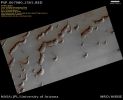
PSP_007080_2565_RED_abrowse.jpgSouth Polar Dunes (Natural Colors; credits: Lunar Explorer Italia)58 visitenessun commentoMareKromium
|
|
| 25353 immagini su 2113 pagina(e) |
 |
|
|
|
|
1361 | |
|
|
|
|





