| Piú viste |
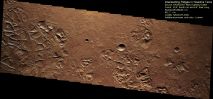
Polygonal_Ridges-NoachisTerra-20080502a-PCF-LXTT.jpgPolygonal and Linear Ridges in Noachis Terra (Enhanced Natural Colors; credits for the additional process. and color.: Dr Paolo C. Fienga - Lunexit Team)219 visitenessun commentoMareKromium
|
|

South_Polar_Features-Defrosting_Dunes-A-M0702775-PCF-LXTT.jpgSouth Polar Features: Defrosting Dunes (Absolute Natural Colors; credits for the additional process. and color.: Dr Paolo C. Fienga - Lunexit Team)219 visitenessun commentoMareKromium
|
|

Craters-Buried_Crater-01.jpgUnder the Sand (Absolute Natural Colors; credits for the additional process. and color.: Dr Paolo C. Fienga - Lunexit Team)219 visiteCaption NASA originale:"This MGS-MOC image shows a partially-buried crater in the North Polar Region of Mars.
The circular feature is surrounded and partly overlain by some of the many, many sand dunes in the area. The steepest slopes on each dune — their "slip faces" — face toward the SouthEast, indicating that the dominant winds responsible for sand transport in this Region come from the NorthWest".
Location near: 76,0° North; 82,2° West
Image width: ~3 Km (~1,9 mi)
Illumination from: lower left
Season: Northern SpringMareKromium
|
|
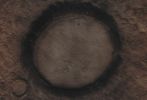
Craters-Unnamed_Impact_Crater-PIA07836-PCF-LXTT.jpgUnnamed Impact Crater wth "Black Rim" in Vastitas Borealis (Absolute Natural Colors; credits for the additional process. and color.: Dr Paolo C. Fienga - Lunexit Team)219 visiteCaption NASA originale:"This MGS-MOC image shows a nearly-filled (and very old) impact crater on the Northern Plains".
Location near: 47,3° North Lat. and 294,0° West Long.
Image width: ~3 Km (~1,9 mi)
Illumination from: lower left
Season: Northern Summer MareKromium
|
|

Hyperion-PIA14580-PCF-LXTT.jpgFeatures of Hyperion (Absolute Natural Colors; credits for the additional process. and color.: Dr Paolo C. Fienga - Lunexit Team) 219 visiteCaption NASA:"The sponge-like Surface of Saturn's moon Hyperion is highlighted in this Cassini portrait, captured during the Spacecraft's Sept. 16, 2011, Fly-By. Hyperion (which is about 168 miles, or approx. 270 Km across) has an irregular shape, and it tumbles through its orbit: that is, it does not spin at a constant rate or in a constant orientation. (A standard reference latitude-longitude system has not yet been devised for this moon.)
Images such as this one extend previous coverage and allow a better inventory of the surface features, the satellite's shape and changes in its spin.
The image was taken in Visible Blue Light with the Cassini Spacecraft narrow-angle camera. The view was obtained at a distance of approx. 55.000 miles (such as about 88.000 Km) from Hyperion and at a Sun-Hyperion-Spacecraft, or Phase, Angle of 37°.
Image scale is roughly 1720 feet (524 meters) per pixel".MareKromium
|
|

Craters-Unnamed_Crater_in_Sirenum_Fossae-PIA14985-PCF-LXTT-00.jpgUnnamed Crater and Graben in Sirenum Fossae (Natural Colors; credits for the additional process. and color.: Dr Paolo C. Fienga - Lunexit Team)219 visiteOrbit Number: 43136
Latitude: 34,132° South
Longitude: 200,730° East
Instrument: VIS
Captured: September, 5th, 2011MareKromium
|
|
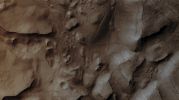
ESP_024074_1425-PCF-LXTT-00.jpgFeatures of Electris Region (CTX "A" - Enhanced Absolute Natural Colors; credits for the additional process. and color.: Dr Paolo C. Fienga - Lunexit Team) 219 visiteMars Local Time: 14:27 (Early Afternoon)
Coord. (centered): 37,1° South Lat. and 189,4° East Long.
Spacecraft altitude: 255,3 Km (such as about 159,6 miles)
Original image scale range: 25,5 cm/pixel (with 1 x 1 binning) so objects ~ 77 cm across are resolved
Map projected scale: 25 cm/pixel
Map projection: EQUIRECTANGULAR
Emission Angle: 6,3°
Sun-Mars-Spacecraft (or "Phase") Angle: 46,6°
Solar Incidence Angle: 51° (meaning that the Sun is about 39° above the Local Horizon)
Solar Longitude: 0,9° (Northern Spring)
Credits: NASA/JPL/University of Arizona
Additional process. and coloring: Dr Paolo C. Fienga - Lunar Explorer ItaliaMareKromium
|
|
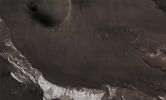
ESP_024029_1765-PCF-LXTT-01.jpgFeatures of Aureum Chaos (CTX "B" - Enhanced Absolute Natural Colors; credits for the additional process. and color.: Dr Paolo C. Fienga - Lunexit Team) 219 visiteMars Local Time: 14:15 (Early Afternoon)
Coord. (centered): 3,6° South Lat. and 332,6° East Long.
Spacecraft altitude: 270,4 Km (such as about 169,0 miles)
Original image scale range: 27,1 cm/pixel (with 1 x 1 binning) so objects ~ 81 cm across are resolved
Map projected scale: 25 cm/pixel
Map projection: EQUIRECTANGULAR
Emission Angle: 5,6°
Sun-Mars-Spacecraft (or "Phase") Angle: 39,4°
Solar Incidence Angle: 34° (meaning that the Sun is about 56° above the Local Horizon)
Solar Longitude: 359,1° (Northern Winter)
Credits: NASA/JPL/University of Arizona
Additional process. and coloring: Dr Paolo C. Fienga - Lunar Explorer ItaliaMareKromium
|
|

Phobos-Phobos_Monolith-07.jpgThe "Phobos' Monolith" (HD/CTX Frame, vers. "A" - credits for the additional process.: Dr Marco Faccin - Lunexit Team) 219 visitenessun commentoMareKromium
|
|

SOL3872-raw_images_1226579_site3Dmsl.jpgPanorama - Sol 3872219 visitenessun commentoMareKromium
|
|

APOLLO 11 AS 11-37-5477.jpgAS 11-37-5477 - The Horizon (1)218 visiteNessun commento
|
|

APOLLO 11 AS 11-37-5554.jpgAS 11-37-5554 - The Flag and the Working Area (4)218 visiteGli astronauti, come dicevamo commentando il frame precedente, sono uomini certamente "eccezionali", ma proiettati in circostanze altrettanto certamente "eccezionali". Viene molto difficile pensare che tutti questi scatti alla stessa area (tutte foto identiche, in altre parole) siano il frutto di una procedura malintesa o di un momento di "paranoia spaziale", se possiamo usare questa espressione... Noi pensiamo che queste riprese siano state fatte con uno scopo preciso.
|
|
| 25353 immagini su 2113 pagina(e) |
 |
|
|
|
|
136 | |
|
|
|
|





