| Piú viste |

Saturn-N00092694.jpgSaturnian Turbulence (Enhanced Natural Colors; credits for the additional process. and color.: Dr Paolo C. Fienga - Lunexit Team)58 visiten.a.d.MareKromium
|
|

The_Coronet_Cluster.jpgThe "Coronet Cluster"58 visite"...Non invidio chi ha potuto frequentare tante scuole,
Ed ha Assorbito l'imposizione di troppi saccenti,
Divenendo vittima di presuntuosi scienziati,
Di errate e fallaci ideologie politiche,
Succube di dogmatiche imposizioni religiose.
Certo! Non conosco le lingue e le formule chimiche,
Non conosco il computer e gli astronomici conti bancari
Per togliere denaro alle masse senza che se ne accorgano.
Non sarò un importante manager dominante,
Un gongolante politico dalla poltrona dorata,
Un giornalista enfatizzante cronache nere e rosa.
Non invidio tutti questi o altri più fortunati,
Anche se ho fatto una vita molto dura,
Poichè ho fatto e sono rimasto un contadino.
Ho amato la Terra, le Piante, gli Animali e la Natura.
Ho amato e quando ho potuto ho aiutato i miei simili.
Mi sono sentito partecipe alla Vita con Dio Sole,
Con la sublime Aria e la Santa Acqua nell'eterna Creazione.
Ora, anziano, sono orgoglioso di avere obbedito
Soltanto al mio Sè Interiore:
Piccola Luce della Grande Luce..."
Giuseppe Gasparotto - "Insieme verso l'Approdo" (2007)MareKromium
|
|
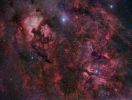
NGC-7000.jpgNGC 7000 - The "Cygnus Nebula"58 visite"...Fama in novis coeptis validissima est..."
(Tacito)
"...La Pubblica Opinione è di grandissimo supporto alle Nuove Imprese..."MareKromium
|
|

OPP-SOL1298-1N243420123EFF86L0P1909L0M1.jpgFrom inside Victoria: the Beautiful Martian Paving (again!) - Sol 1298 (False Colors; credits: Lunar Explorer Italia)58 visiteCome mai? Probabilmente il motivo maggiore deve essere ricondotto alla diversa dimensione, struttura e composizione dell'impactor che creò i due Crateri (se crediamo che si tratti, in entrambi i casi, di crateri da impatto). Se invece la Teoria dei Crateri da Impatto non piace, allora potremmo anche trovare diverse spiegazioni al perchè i dintorni di Victoria sono alquanto "mossi" mentre i dintorni di Endurance non lo sono.
Ma ne parleremo - forse - in futuro.
Per adesso speriamo solo che l'idea di far entrare Opportunity all'interno di Victoria non sia stata - come noi temiamo - un'idea davvero pessima...MareKromium
|
|
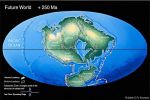
PangeaUltima_scotese_big.jpgA VERY far, distant and yet possible Future: Pangea Ultima58 visiteIs this what will become of the Earth's surface? The surface of the Earth is broken up into several large plates that are slowly shifting.
About 250 MY ago, the plates on which the present-day continents rest were positioned quite differently, so that all the landmasses were clustered together in one supercontinent now dubbed Pangea. About 250 MY from now, the plates are again projected to reposition themselves so that a single landmass dominates.
The above simulation from the PALEAOMAP Project shows this giant landmass: Pangea Ultima.
At that time, the Atlantic Ocean will be just a distant memory, and whatever beings inhabit Earth will be able to walk from North America to Africa.MareKromium
|
|

PSP_003639_1345_RED_browse-02.jpgDebris Apron South of Euripus Mons (extra-detail mgnf - possible natural colors; elab. NASA)58 visiteAt full resolution, Polygonal Features can be observed (see here), which are characteristic of Periglacial Terrains. These polygons form by the contraction and expansion of the ground due to freezing and thawing of ice just below the surface during seasonal changes.
All of these features provides evidence that ice was or is present just below the surface at this location. This apron is not pockmarked with craters, suggesting it is relatively young in age.MareKromium
|
|
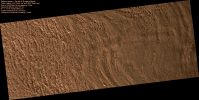
PSP_003639_1345_RED_browse-00.jpgDebris Apron South of Euripus Mons (context image - possible natural colors; elab. Lunexit)58 visiteEuripus Mons is located to the east of Hellas impact basin in the southern mid-latitudes of Mars.
The overall wavy, curved surface pattern of this debris apron suggests that material flowed out from the isolated flat-top ridge. This mass movement of debris probably involved ice flow (possibly forming rock glaciers) and potentially liquid water.MareKromium
|
|

OPP-SOL1305-1F244039030EFF8700P1151L0M1.jpgBright Band - Sol 130558 visiteCaption NASA:"A layer of light-toned rock exposed inside Victoria Crater in the Meridiani Planum Region of Mars appears to mark where the surface was at the time, many millions of years ago, when an impact excavated the Crater.
NASA's MER Opportunity drove to this bright band as the science team's first destination for the Rover during investigations inside the Crater.
Opportunity's Left Front Hazard-Identification Camera (HazCam) took this image just after the Rover finished a drive of 2,25 meters (7 feet and 5 inches) during the Rover's 1.305th Sol (such as Sept. 25, 2007). The rocks beneath the Rover and its extended Robotic Arm (RA) are part of the bright band.
Victoria Crater has a scalloped shape of alternating alcoves and promontories around the Crater's circumference. Opportunity descended into the Crater 2 weeks earlier, within an alcove called "Duck Bay".
Counterclockwise around the Rim, just to the right of the arm in this image, is the promontory called "Cabo Frio".MareKromium
|
|

MATHILDE_FLY-BY.gifMathilde (NEAR Probe Fly-By)58 visiteGuardate bene: osservate il "main crater" di Mathilde, così (enorme-mente) simile allo Stickney Crater di Phobos e poi, se volete, provate a pensare...Crateri troppo grandi, per mondi troppo piccoli!
Che ne dite?MareKromium
|
|

EnckeCometTailRipoff_movie_short.gifComet Encke encounters a CME58 visiteCaption NASA:"Swinging inside the orbit of Mercury, on April 20th, 2007, periodic comet Encke encountered a blast from the Sun in the form of a Coronal Mass Ejection (CME). When CMEs, enormous clouds of energetic particles ejected from the Sun, slam into Earth's magnetosphere, they often trigger auroral displays.
But in this case, the collison carried the tail of the comet away.
The tail was likely ripped off by interacting magnetic fields rather than the mechanical pressure of the collision.
This a GIF-movie showing the remarkable event as recorded by the Heliospheric Imager onboard the STEREO A spacecraft. In the movie, the time between frames is about 45 minutes, while the frames span about 14x20 MKM at the distance of the comet. Of course, similar collisions have happened before as the ancient comet loops through its 3,3 year solar orbit. So don't worry, Encke's tail will grow back!".MareKromium
|
|
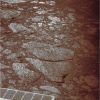
OPP-SOL1308-1P243064411EFF86JZP2365R1M1-0.jpgVictoria's Paving (interpret. n° 1 - possible natural colors; elab. Lunexit) - Sol 130858 visiteCome il nostro Caro Amico e Socio, Dr Marco Faccin, ci ha ricordato in una Sua recente e gentilissima missiva, "...le variabili da considerare ai fini dell'ottenimento di una colorizzazione naturale, razionale e credibile dei frames NASA (sia quelli ottenuti dall'orbita, sia quelli ottenuti dal suolo) sono innumerevoli...".
E' vero, e siamo felici che, oltre al bravissimo Marco, se ne sìano accorti anche tanti altri Lettori. Vi scriviamo queste poche note poichè noi siamo i primi a rammaricarci per il fatto che, nonostante tutti i nostri sforzi, ancora non siamo venuti a capo della questione relativa ai "Colori Naturali di Marte"; tuttavia, come avete notato, i nostri processi di colorizzazione si stanno evolvendo e razionalizzando. Insomma: stanno migliorando.
E se la perfezione, come sanno tutti, è irraggiungibile, è pur vero che l'ottenimento di un risultato valido passa attraverso un cammino - alle volte - molto lungo.
Grazie, quindi, per la Vostra comprensione ed il Vostro costante supporto!
Lo STAFF di Lunar Explorer ItaliaMareKromium
|
|
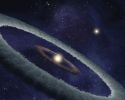
HD-113766-PIA09931.jpgHD 11376658 visiteThis artist's conception shows a binary-star, or two-star, system, called HD 113766, where astronomers suspect a rocky Earth-like planet is forming around one of the stars. At approximately 10 to 16 MY old, astronomers suspect this star is at just the right age for forming rocky planets. The System is located approx. 424 LY away from Earth.
The two yellow spots in the image represent the System's two stars. The brown ring of material circling closest to the central star depicts a huge belt of dusty material, more than 100 times as much as in our asteroid belt, or enough to build a Mars-size planet or larger. The rocky material in the belt represents the early stages of planet formation, when dust grains clump together to form rocks, and rocks collide to form even more massive rocky bodies called planetesimals. The belt is located in the middle of the system's terrestrial Habitable Zone, or the region around a star where liquid water could exist on any rocky planets that might form.
Earth is located in the middle of our sun's terrestrial habitable zone.
Using NASA's Spitzer Space Telescope, astronomers learned that the belt material in HD 113766 is more processed than the snowball-like stuff that makes up infant solar systems and comets, which contain pristine ingredients from the early solar system. However, it is not as processed as the stuff found in mature planets and asteroids. This means that the dust belt is made out of just the right mix of materials to be forming an Earth-like planet. It is composed mainly of rocky silicates and metal sulfides (like fool's gold), similar to the material found in lava flows.
The white outer ring shows a concentration of icy dust also detected in the system. This material is at the equivalent position of the asteroid belt in our solar system, but only contains about one-sixth as much material as the inner ring. Astronomers say it is not clear from the Spitzer observations if anything is occurring in the icy belt, but they believe it could be a source of water later on for the planet that grows from the inner warm ring.
MareKromium
|
|
| 25353 immagini su 2113 pagina(e) |
 |
|
|
|
|
1349 | |
|
|
|
|





