| Piú viste |
PHOE-SOL144-lg41034-41035-41036-2.jpgMicroscopic Vastitas: Numbers - Sol 144 (Superdefinition and possible True Colors; credits: Dr G. Barca)58 visitenessun commentoMareKromium
|
|
PHOE-SOL144-lg41031-41032-41033-3.jpgMicroscopic Vastitas: Numbers - Sol 144 (Perspective View - Superdefinition and possible True Colors; credits: Dr G. Barca)58 visitenessun commentoMareKromium
|
|
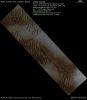
PSP_009739_2580_RED.JPGLinear Dunes in the North Polar Region (possible natural colors; credits: Lunexit)58 visiteThis observation shows linear dunes in the north polar region of Mars. Linear or longitudinal sand dunes are elongated, sharp crested ridges that are typically separated by a sand–free surrounding surface.
These features form from bi-directional winds and extend parallel to the net wind direction. In this case, the net wind direction appears to be from the west-southwest. Linear sand dunes are found in many different locations on Earth and commonly occur in long parallel chains with regular spacing.
Superimposed on the surface of the linear dunes are smaller secondary dunes or ripples. This is commonly observed on terrestrial dunes of this size as well. Polygons formed by networks of cracks cover the substrate between the linear dunes and may indicate that ice-rich permafrost (permanently frozen ground) is present or has been present geologically recently in this location.MareKromium
|
|
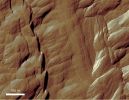
PSP_009927_1750_RED_abrowse-01.jpgExposed Layers in Gale Crater (EDM- Enhanced Natural Colors; credits: Lunexit)58 visiteThis edm is a small portion of a HiRISE image detailing the fine-scale layering evident in the upper mound. The layered deposits can be divided into 2 types: a lower mound with near-horizontal, flat layers, and an upper mound with more numerous, thinner layers (some of which have greater degree of tilt than the lower layers).
The origin of these thin, repetitive layers is unknown, but they likely reflect environmental changes that occurred while the layers were being deposited.
Today, erosion by wind scour has shaped them into the stair-step pattern that is reminiscent of parts of the American South-West.MareKromium
|
|
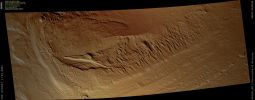
PSP_009927_1750_RED_abrowse-00.jpgExposed Layers in Gale Crater (Enhanced Natural Colors; credits: Lunexit)58 visiteGale Crater contains a massive central mound of layered material that has an average vertical thickness of almost 4 Km (about 2,4 miles), making it more than twice as thick as the layers exposed along the Grand Canyon on Earth.
Gale Crater is approximately 152 Km in diameter.MareKromium
|
|
OPP-SOL1671-1P276536128ESF90__P2456L7M2.jpgUnusually-looking small rock, near Victoria's Outer Rim (natural colors; credits: Lunexit)58 visitenessun commentoMareKromium
|
|

OPP-SOL0014-3DMICRO-2.jpgBerries... - Sol 14 (Hi-Def3-D - Natural Colors; credits and Copyright: Dr G. Barca and Lunar Explorer Italia)58 visitenessun commentoMareKromium
|
|

Enceladus-PIA11121.jpgEnceladus Oct. 9, 2008 Flyby58 visiteCaption NASA:"The image was taken with the Cassini Spacecraft narrow-angle camera on Oct. 9, 2008, a distance of approx. 42.000 Km (about 26.000 miles) from Enceladus.
Image scale is 503 meters (1650 feet) per pixel".MareKromium
|
|

PHOE-SOL150-lg42375-42376-42377-2.jpgFrost on the Rocks... - Sol 150 (Superdefinition and natural colors; credits: Dr G. Barca)58 visitenessun commentoMareKromium
|
|
|
|
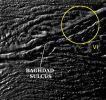
Enceladus-PIA11134.jpgBaghdad Sulcus58 visiteCaption NASA:"Like hunters sighting a clay duck flying fast in the sky, this mosaic of Cassini images was made from 'skeet shoot' narrow-angle images 1, 2, 3 and 4, all captured during the Oct. 31, 2008, flyby of Saturn's moon Enceladus.
The resolution of this mosaic is 12,3 meters (41 feet) per pixel and jet source VI (see also PIA08385) is identified in the upper right".MareKromium
|
|
| 25353 immagini su 2113 pagina(e) |
 |
|
|
|
|
1348 | |
|
|
|
|





