| Piú viste |

as15-85-11474.jpgAS 15-85-11474 - Silver Spur58 visiteCaption NASA:"143:38:21 MT - Rightward of 11473, showing Silver Spur and some of the craters on the flank of Mt. Hadley Delta".MareKromium
|
|

Spectrum-PIA09198.jpgSpectrum of an Alien World58 visiteThis infrared data from NASA's Spitzer Space Telescope - called a spectrum - tells astronomers that a distant gas planet, a so-called "hot Jupiter" called HD 209458b, might be smothered with high clouds. It is one of the first spectra of an alien world.
A spectrum is created when an instrument called a spectrograph spreads light from an object apart into a rainbow of different wavelengths. Patterns or ripples within the spectrum indicate the presence, or absence, of molecules making up the object.
Astronomers using Spitzer's spectrograph were able to obtain infrared spectra for two so-called "transiting" hot-Jupiter planets using the "secondary eclipse" technique. In this method, the spectrograph first collects the combined infrared light from the planet plus its star, then, as the planet is eclipsed by the star, the infrared light of just the star. Subtracting the latter from the former reveals the planet's own rainbow of infrared colors.
When astronomers first saw the infrared spectrum above, they were shocked. It doesn't look anything like what theorists had predicted. Theorists though the spectra for hot, Jupiter-like planets like this one would be filled with the signatures of molecules in the planets' atmospheres. But the spectrum doesn't show any molecules. It is what astronomers call "flat." For example, theorists thought there'd be signatures of water in the wavelength ranges of 8 to 9 microns. The fact that water is not seen there might indicate that the water is hidden under a thick blanket of high, dry clouds.
This spectrum was produced by Dr. Mark R. Swain of NASA's Jet Propulsion Laboratory in Pasadena, Calif., using a complex set of mathematical tools. It was derived using two different methods, both of which led to the same result. The data were taken on July 6 and 13, 2005, by Dr. Jeremy Richardson of NASA's Goddard Space Flight Center and his team using Spitzer's infrared spectrograph.
|
|
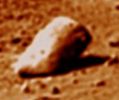
SOL1114-2P225265995EFFASPXP2426R1M1-01.jpgPossible Surface Anomaly? (extra-detail mgnf/red scale) - Sol 111458 visitenessun commento
|
|

Psp_001481_2410_red-00.jpgEolian and Periglacial Activities in Vastitas Borealis (DD Tracks and Polygons)58 visiteThis image shows a region of approximately 7 x 7 km (4.4-by-4.4 miles) located in Vastitas Borealis, part of the Northern Plains.
The surface imaged is relatively young, as indicated by the lack of recent impact craters.
Eolian and Periglacial activity seem to be the dominant geological processes at work, as shown by numerous crisscrossing DD Tracks and ubiquitous polygonal features, respectively.
Dust Devils form when the sun warms up the air near a flat, dry surface. Warm air then rises quickly through the cooler air above and starts spinning, causing a forward motion. The spinning, forward-moving cell may pick up dust and sand as it advances, thus leaving behind a "clean" track. We infer from this image that a thin veneer of light-colored particles of dust and/or fine-grained sand cover relatively darker materials, apparent in the dust devil tracks.
The tracks pictured in this image are in many cases more than 30 mt (27 yards) wide and over 4 Km (2,5 miles) long, surpassing the dimensions of average terrestrial DD tracks.MareKromium
|
|

as16-113-18289.jpgAS 16-113-18289 - Earthrise, Lunar Horizon and Casper58 visiteCaption NASA:"Pre-landing photo of Earthrise, with the Command Module visible just above the Lunar Horizon to the left of Earth".MareKromium
|
|

OPP-SOL1096-1N225494166EFF79TVP1962L0M1.jpgMartian Horizon (1) - Sol 109658 visitenessun commentoMareKromium
|
|
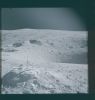
as16-114-18421.jpgAS 16-114-18421 - The interior of Plum Crater (1)58 visitenessun commentoMareKromium
|
|

as16-114-18468.jpgAS 16-114-18468 - The "UV" Astronomy Camera58 visitenessun commento
|
|

Jupiter-NO-00-022807_3.jpgJupiter! (after New Horizons' Fly-By)58 visitenessun commentoMareKromium
|
|

Jupiter_s_Aurorae.jpgJovian Aurorae58 visiteNASA's HST has recently taken images of Jupiter in support of the New Horizons Mission. The images were taken with Hubble's Wide Field Planetary Camera 2 and the Advanced Camera for Surveys. Hubble will continue to photograph Jupiter, as well as its volcanically active moon, Io, over the next month as the New Horizons spacecraft flies past Jupiter. New Horizons is en route to Pluto, and made its closest approach to Jupiter on February 28, 2007. Through combined remote imaging by Hubble and in situ measurements by New Horizons, the two missions will enhance each other scientifically, allowing scientists to learn more about the Jovian atmosphere, the Aurorae, and the charged-particle environment of Jupiter and its interaction with the Solar Wind.
For this photo, the combined ultraviolet- and visible-light images of Jupiter were taken with Hubble from February 17-21. The image segments in the boxes, obtained using the Advanced Camera for Surveys's ultraviolet camera, show auroral emissions that are always present in Jupiter's polar regions. The equatorial regions of Jupiter were imaged in blue light by the Wide Field Planetary Camera 2. Cloud features in Jupiter's main atmosphere are revealed. In the ultraviolet views, the atmosphere looks more hazy because sunlight is reflected from higher in the atmosphere.MareKromium
|
|

OPP-SOL1103-1M226103347EFF798DP2936M2M1-01.jpgAfter the removal of a "Berry" (2 - extra-detail mgnf) - Sol 110258 visiteL'ingrandimento che Vi proponiamo è (a nostro parere) piuttosto buono, ma ancora lontano dall'essere definitivamente illuminante: quello che si vede è una superficie a matrice granulare, piena di spazi vuoti (come delle "sacche" o dei "pori") e con al suo interno qualcosa che sembrano dei "filamenti" di colore chiaro, disposti a matassa nella porzione centrale del dettaglio.
La domanda, ovvia, è solo una: stiamo parlando del residuo di un rilievo avente natura "organica"? Ai posteri l'ardua sentenza...
|
|

as10-27-3905.jpgAS 10-27-3905 - Landing Site n. 358 visitenessun commento
|
|
| 25353 immagini su 2113 pagina(e) |
 |
|
|
|
|
1347 | |
|
|
|
|





