| Piú viste |
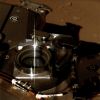
PHOE-SOL108-lg31333-31334-31351-2.jpgDetails of the Phoenix Lander - Sol 108 (Superdefinition and natural colors; credits: Dr G. Barca)58 visitenessun commentoMareKromium
|
|

ZZ-Mercury-Craters-Sveinsdottir_Crater-PIA11078.jpgSveinsdóttir Crater in 3D58 visiteThis graphic shows a portion of the fault scarp Beagle Rupes cutting through the highly elliptical crater Sveinsdóttir in a three-dimensional (3D) representation.
By combining information from multiple images of the same portion of Mercury's surface taken under different viewing angles, the topography of the surface was determined. A high-resolution image was then overlaid on the topography map, resulting in this 3D image.
In total, over 80 MESSENGER images were used to create this 3D view of Mercury's surface.
As the MESSENGER mission continues, many more images will be acquired, and these additional images will provide views of Mercury's surface from a variety of illumination conditions and viewing geometries. These myriad views, anchored by topographic profiles to be acquired by MESSENGER's laser altimeter, will enable large portions of the surface of Mercury to be studied in 3D.
Date Acquired: January 14, 2008
Image Mission Elapsed Time (MET) : NAC image from 108830230 resampled on a topographic map made from more than 80 NAC and WAC images.
Instrument: Narrow Angle Camera (NAC) and Wide Angle Camera (WAC) of the Mercury Dual Imaging System (MDIS)
Scale: Sveinsdóttir Crater is about 120 by 220 Km (approx. 75 by 140 miles). MareKromium
|
|
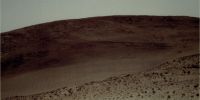
SOL1602-1.jpgTwilights over El Dorado - Sol 1602 (natural colors; credits: Dr G. Barca & Lunexit)58 visitenessun commentoMareKromium
|
|
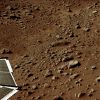
PHOE-SOL107-lg31078-31079-31085-2.jpgSolar Panels and Surface - Sol 107 (Superdefinition and natural colors; credits: Dr G. Barca)58 visitenessun commentoMareKromium
|
|
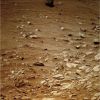
SOL1630-1.jpgDetails of Gusev Surface - Sol 1630 (natural colors; credits: Dr G. Barca)58 visitenessun commentoMareKromium
|
|
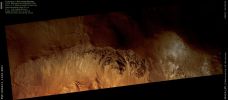
PSP_006672_1420_RED_abrowse~0.jpgFeatures of the Hellas Montes (MULTISPECTRUM; credits: Lunexit)58 visiteThe Hellas Montes are a group of mountains along the western rim of the giant Hellas Basin on Mars.
The Hellas Basin is the largest of the obvious impact craters on the Red Planet. It is very ancient and has been partially filled by sediments. The Hellas Montes are part of the eroded crater rim.
In the central part of this HiRISE image, we can see steep slopes where landslides have exposed a variety of rocks. The jumble of blocks, rather than stacks of layered sediments or lavas, is consistent with impact crater ejecta. On flatter slopes, the ground is covered with a mantling deposit that is generally considered to be ice-rich dust.
In the southern part of the image (Dx), a large circular depression — rimmed by a zone with many large boulders — is (barely) visible. This is an impact crater with a relatively thin mantling deposit on its rim.
MareKromium
|
|
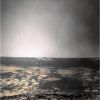
OPP-SOL1512-1.jpgVictoria's Paving - Sol 1512 (natural Colors; credits: Dr G. Barca)58 visitenessun commentoMareKromium
|
|

NGC-1316.jpgNGC 1316 - Spiral Galaxy58 visite"...Hell, is just a word; reality, is much, much worse..."
(dal film "Event Horizon")MareKromium
|
|

Sunspot-1002.jpgActive Region 100258 visiteCaption NASA:"Why has the Sun been so quiet recently? No one is sure. Our Sun has shown few active regions -- that house even fewer associated sunspots -- for over a year now, and such a period of relative calm is quite unusual.
What is well known is that our Sun is in a transitional period between solar cycles called a Solar Minimum, where solar activity has historically been reduced.
The stark lack of surface tumult is unusual even during a Solar Minimum, however, and activity this low has not been seen for many decades. A few days ago, however, a "Bona-Fide Active Region! -- complete with Sunspots --appeared and continues to rotate across the Sun's face. Visible above, this region, dubbed "Active Region 1002" (AR 1002), was imaged in ultraviolet light yesterday by the SOHO Spacecraft, which co-orbits the Sun near the Earth.
Besides the tranquility on the Sun's surface, recent data from the Ulysses Spacecraft, across the Solar System, indicate that the intensity of the Solar Wind blowing out from the Sun is at a 50 year low. Predictions hold, however, that our Sun will show more and more active regions containing more and more Sunspots and Flares until Solar Maximum occurs in about 4 years from now (such as in the year 2012)".MareKromium
|
|
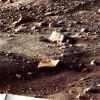
PHOE-SOL119-MF-LXT.jpgMorning Frost over Vastitas - Sol 119 (natural colors; credits: Dr M. Faccin)58 visitenessun commentoMareKromium
|
|

PHOE-SOL122-lg36292-36293-36294-2.jpgMicroscopic Vastitas - Sol 122 (Superdefinition and possible True Colors; credits: Dr G. Barca & Lunexit)58 visitenessun commentoMareKromium
|
|
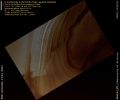
Psp_009390_2595_red.jpgUnconformity in North Polar Layered Deposits (natural colors; credits: Lunexit)58 visiteThis image features the North Polar Layered Deposits. The flat tongue-shaped feature at the bottom of the image is the surface of the cap.
The bright textured region near the top of the image is polygonal ground, which is commonly found in the Martian High-Latitudes. Polygonal ground formation is thought to relate to temperature cycles in ice-rich soil.
Just south of the polygonal ground, a bright layer within the cap can be seen eroding in the form of landslides, particularly near the center of the image.
The most noticeable part of the polar cap is visible in an unconformity, the horizontal break in the cap layers. An unconformity is caused by non-uniform erosion or deposition. In this case, non-uniform erosion or deposition might have occurred due to variable climate over geologic time.
MareKromium
|
|
| 25353 immagini su 2113 pagina(e) |
 |
|
|
|
|
1345 | |
|
|
|
|





