| Piú viste |

Volcanic_Features-Lava_Flows-PIA08463-00.jpgThe "End" of Lethe Vallis (Original NASA/JPL/ASU b/w Frame)58 visiteImage information: VIS instrument;
Latitude: 4,8° North;
Longitude: 156,1° East;
Resolution: 18 meter/pixel.
|
|
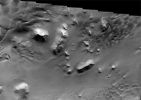
Juventae_Chasma-PIA08444-2.jpgUnusually-looking Landforms in Juventae Chasma (Original NASA-2001 Mars Odyssey Orbiter b/w Frame)58 visiteImage information: VIS instrument;
Latitude: 3,9° South;
Longitude: 299,2° East;
Resolution: 18 meter/pixel.
|
|
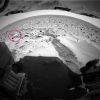
SOL066-2R132225207EFF1700P1310L0M1.jpgWhat's underneath? - Sol 6658 visitenessun commento
|
|

Clouds-Hellas_Planitia-MGS.JPGHeavy Dusty Clouds obscuring Hellas Planitia (Original NASA/MGS/MSSS b/w Frame)58 visiteCaption NASA originale:"This MGS-MOC image shows billowing clouds of dust rising from a storm South-East of Hellas Planitia.
The dust storm in this case obscured the Mars Orbiter Camera's view of the Martian Surface".
Location near: 62,2° South; 259,0° West
Image width: ~3 Km (~1,9 mi)
Illumination from: upper left
Season: Southern Autumn
|
|
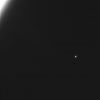
Earth-N00061732-c.jpgEarth and Moon...maybe? (1)58 visiteLa nostra impressione è che, in questo frame (apparentemente del tutto insignificante) ci sia una ripresa - molto suggestiva - della nostra Terra (e della Luna).
Ci sbagliamo? Forse no. La NASA, purtroppo, non ci è di aiuto e questa è la caption che riserva al frame:"N00061732.jpg was taken on May 22, 2006 and received on Earth on the same date. The camera was pointing toward Saturn that, at the time, was approximately 384.937 Km away.
The image was taken using the BL1 and CL2 filters".
|
|
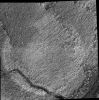
OPP-SOL819-PIA08499.jpgCheyenne - Sol 81958 visiteCaption originale:"As NASA's MER Opportunity is traversing southward toward Victoria Crater, it is periodically stopping to characterize exposed bedrock, using the contact instrument suite on the RA.
Between Soles 818 and 821 of the mission (such as from May 13 up to May 16), one such characterization was carried out on a rock target called Cheyenne. The target was brushed by the RAT, analyzed by the Alpha Particle X-ray Spectrometer and Moessbauer Spectrometer and photographed by the MI.
This image is a mosaic of 4 frames taken by the MI after the brush had removed dust and sand grains from most of the area shown, exposing the underlying bedrock. The resolution is 30 microns per pixel and the entire mosaic is 6 cm (about 2,4") square. Opportunity acquired the images on Sol 819 (May 14, 2006) while the target was fully shadowed.
This rock surface exhibits relatively small spherical concretions compared to those observed in the vicinity of "Eagle Crater" and "Endurance Crater." Such small concretions, and in places apparent absence of concretions, have characterized the outcrops south of "Vostok Crater." Also visible in this image are small pits and grooves in the rock surface, including narrow, elongated void spaces different from any previously observed by Opportunity. Crystal-shaped and elongated void spaces that were seen in the vicinity of Eagle and Endurance Craters are interpreted as spaces left by dissolving of soluble salts. However, these features at Cheyenne have a significantly different appearance and the science team is considering a number of alternative hypotheses for their origin.
|
|
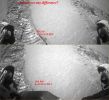
OPP-SOL837-1F202491816EFF71GQP1214L0M1.jpgMoving out... - Sol 836/83758 visiteCaption NASA originale del Sol 836:"Left Front HazCam Non-linearized Full frame EDR acquired on Sol 836 of Opportunity's mission to Meridiani Planum at approximately 12:33:15 MLT".
Caption NASA originale del Sol 837:"Left Front HazCam Non-linearized Full frame EDR acquired on Sol 837 of Opportunity's mission to Meridiani Planum at approximately 13:15:59 MLT".
|
|

Aeolian_Features-Windstreak-MGS.JPGWindstreak in Cyane Fossae58 visiteCaption NASA originale:"This MGS-MOC image shows a light-toned wind streak created in the lee — such as the downwind side — of an impact crater in the Cyane Fossae Region of Mars. Winds blowing from the bottom (South) toward the top (North) swept this scene clean of fine, bright dust except for the dust that had accumulated in a few protected areas such as that in the lee of this crater".
Location near: 42,0° North; 125,8° West
Image width: ~3 Km (~1,9 mi)
Illumination from: lower left
Season: Northern Spring
|
|

Craters-Galle_Crater-3D.jpgLayers of Galle Crater (3D - credits: NASA/JPL/MSSS)58 visiteCaption NASA:"This is a 3-D stereo anaglyph showing layers in Galle Crater. This anaglyph uses two MGS-MOC images acquired at slightly different viewing angles: MOC images E22-01557 and M14-02055. Owing to the specifics of the viewing geometry, the image is tilted on its side, relative to the mosaic shown in the 15 June 2006 release. In other words, in this image, North is toward the right and West is up. This anaglyph, when viewed in conjunction with the 15 June 2006 mosaic of these layers, provides a more complete sense of the cross-cutting relations between layers in the mound located in southern Galle (Happy Face) Crater. The layers are part of a mound of sedimentary rock in southern Galle — a remnant of a once more-extensive deposit of sedimentary material in this south mid-latitude impact basin.
Location near: 52,3° South Lat. and 30,1° West Long.
Image width: ~7,3 Km (~4,5 mi)
Illumination from: upper right
Anaglyph from MOC images: E22-01557 and M14-02055
|
|
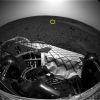
SOL011-2F127354635EFF0234P1003L0M1.jpgLittle Spark... (1) - Sol 1158 visiteDai frames meno "taroccati" della Saga del MER Spirit, il nostro Dr Barca ci segnala l'occorrere di un evento che, nella sua (apparente inusualità), si sarebbe poi ripetuto tante altre volte, sia in Area Gusev Crater, sia in Area Meridiani Planum.
Di che cosa si tratta?
Di una piccola "scintilla" (spark) che si accende sulla superficie Marziana e che poi, improvvisamente come era apparsa, scompare.
Ma se in svariati frangenti (specie in Area Meridiani) la possibile Anomalìa di Superficie poteva anche risolversi in un photoartifact, in questo caso specifico la sua nitidezza e ripetitività (per ben tre frames consecutivi) ci convince del fatto che si sia trattato di qualcosa che non è solo "strano", ma anche (ed estremamente) reale.
|
|

Craters-Unnamed_Craters-MGS.JPGMartian "Spectacles"! (Original NASA/MGS/MSSS b/w Frame)58 visiteCaption NASA originale:"This MGS-MOC image shows a pair of partially-buried impact craters which are being exhumed on a plain east of Hellas in the Promethei Terra Region Mars".
Location near: 45,5° South; 256,5° West
Image width: ~3 Km (~1,9 mi)
Illumination from: upper left
Season: Southern Autumn
Nota: "spectacles"---> occhiali
|
|

North_Polar_Features-Dunes-MGS-00.jpgNorth Polar Dunes (Original NASA/MGS/MSSS b/w Frame)58 visiteCaption NASA originale:"This MGS-MOC image shows dunes in the North Polar Region of Mars. In this Springtime view, the dunes are largely covered by frozen Carbon Dioxide (CO2) that was deposited during the Winter months in the Northern Hemisphere. Dark spots indicate areas where the frost has begun to either sublime away, acquire a roughened texture, or both".
Location near: 77,3° North; 95,4° West
Image width: ~3 Km (~1,9 mi)
Illumination from: lower left
Season: Northern Spring
|
|
| 25353 immagini su 2113 pagina(e) |
 |
|
|
|
|
1342 | |
|
|
|
|





