| Piú viste |
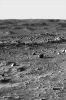
SOL813-PIA08423-7.jpgWhen the Sun goes down... (7) - Sol 81358 visitenessun commento
|
|
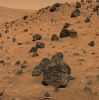
SOL810-PIA08440.jpgBoulders (approx. true colors) - Sol 81058 visiteCaption NASA originale:"As NASA's MER Spirit began collecting images for a 360° panorama of new terrain, the Rover captured this view of a dark boulder with an interesting surface texture. The boulder sits about 40 cm(approx. 16" - inches) tall on Martian sand about 5 mt (approx. 16 feet) away from Spirit. It is one of many dark, volcanic rock fragments - many pocked with rounded holes called vesicles - littering the slope of "Low Ridge." The rock surface facing the rover is similar in appearance to the surface texture on the outside of lava flows on Earth.
Spirit took this approximately true-color image with the PanCam on the rover's 810th Sol of exploring Mars (such as April, 13, 2006), using the camera's 753-, 535- and 432-nanometer filters".
|
|

OPP-SOL811-1M200179278EFF69__P2957M2M1.jpgGranules (1) - Sol 81158 visitenessun commento
|
|
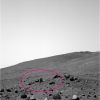
SOL777-2P195341245EFFAPGBP2383L7M1.jpgThe "Totem", on Sol 77758 visite...Stesso scorcio, stesso Totem, ma qualche cambiamento (imprevisto) del paesaggio sembra essere evidente.
O no?!?
|
|

South_Polar_Features-Swiss_Cheese_Terrain-03.jpgThe "drawings" of the South Polar Residual Cap (1)58 visiteCaption NASA originale:"This MGS-MOC image shows a Summertime view of the South Polar Residual Cap of Mars. In this image, mesas composed largely of solid Carbon Dioxide are separated from one another by irregularly-shaped depressions. The variation in brightness across this scene is a function of several factors including, but not limited to, varying proportions of dust and solid Carbon Dioxide, undulating topography, and differences in the roughness of the slopes versus the flat surfaces".
Location near: 86,7° South; 343,3° West
Image width: ~3 Km (~1,9 mi)
Illumination from: upper left
Season: Southern Summer
|
|
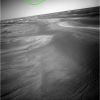
OPP-SOL815-1N200539616EFF70LYP0695L0M1.jpgA "spark" in the sky, or another artifact? - Sol 81558 visiteCaption NASA originale:"Left NavCam Non-linearized Full frame EDR acquired on Sol 815 of Opportunity's mission to Meridiani Planum at approximately 13:23:32 MLT".
|
|

Volcanic_Features-Lava_Flows-PIA08463-00.jpgThe "End" of Lethe Vallis (Original NASA/JPL/ASU b/w Frame)58 visiteImage information: VIS instrument;
Latitude: 4,8° North;
Longitude: 156,1° East;
Resolution: 18 meter/pixel.
|
|
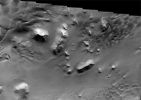
Juventae_Chasma-PIA08444-2.jpgUnusually-looking Landforms in Juventae Chasma (Original NASA-2001 Mars Odyssey Orbiter b/w Frame)58 visiteImage information: VIS instrument;
Latitude: 3,9° South;
Longitude: 299,2° East;
Resolution: 18 meter/pixel.
|
|
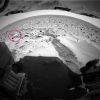
SOL066-2R132225207EFF1700P1310L0M1.jpgWhat's underneath? - Sol 6658 visitenessun commento
|
|

Clouds-Hellas_Planitia-MGS.JPGHeavy Dusty Clouds obscuring Hellas Planitia (Original NASA/MGS/MSSS b/w Frame)58 visiteCaption NASA originale:"This MGS-MOC image shows billowing clouds of dust rising from a storm South-East of Hellas Planitia.
The dust storm in this case obscured the Mars Orbiter Camera's view of the Martian Surface".
Location near: 62,2° South; 259,0° West
Image width: ~3 Km (~1,9 mi)
Illumination from: upper left
Season: Southern Autumn
|
|
Earth-N00061732-c.jpgEarth and Moon...maybe? (1)58 visiteLa nostra impressione è che, in questo frame (apparentemente del tutto insignificante) ci sia una ripresa - molto suggestiva - della nostra Terra (e della Luna).
Ci sbagliamo? Forse no. La NASA, purtroppo, non ci è di aiuto e questa è la caption che riserva al frame:"N00061732.jpg was taken on May 22, 2006 and received on Earth on the same date. The camera was pointing toward Saturn that, at the time, was approximately 384.937 Km away.
The image was taken using the BL1 and CL2 filters".
|
|
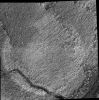
OPP-SOL819-PIA08499.jpgCheyenne - Sol 81958 visiteCaption originale:"As NASA's MER Opportunity is traversing southward toward Victoria Crater, it is periodically stopping to characterize exposed bedrock, using the contact instrument suite on the RA.
Between Soles 818 and 821 of the mission (such as from May 13 up to May 16), one such characterization was carried out on a rock target called Cheyenne. The target was brushed by the RAT, analyzed by the Alpha Particle X-ray Spectrometer and Moessbauer Spectrometer and photographed by the MI.
This image is a mosaic of 4 frames taken by the MI after the brush had removed dust and sand grains from most of the area shown, exposing the underlying bedrock. The resolution is 30 microns per pixel and the entire mosaic is 6 cm (about 2,4") square. Opportunity acquired the images on Sol 819 (May 14, 2006) while the target was fully shadowed.
This rock surface exhibits relatively small spherical concretions compared to those observed in the vicinity of "Eagle Crater" and "Endurance Crater." Such small concretions, and in places apparent absence of concretions, have characterized the outcrops south of "Vostok Crater." Also visible in this image are small pits and grooves in the rock surface, including narrow, elongated void spaces different from any previously observed by Opportunity. Crystal-shaped and elongated void spaces that were seen in the vicinity of Eagle and Endurance Craters are interpreted as spaces left by dissolving of soluble salts. However, these features at Cheyenne have a significantly different appearance and the science team is considering a number of alternative hypotheses for their origin.
|
|
| 25353 immagini su 2113 pagina(e) |
 |
|
|
|
|
1341 | |
|
|
|
|





