| Piú viste |

NGC-2237_and_NGC-2244-2.jpgNGC 2237 - Inside the "Rosette Nebula"58 visite"...Duos parietes de eadem fidelia dealbare..."
(Cicerone)
"...Imbiancare due pareti con la tinta dello stesso vaso..."
(detto riferito a coloro che, pur di mantenere la posizione e lo status conseguiti, si barcamenano fra opposte rive, ora assecondando una corrente ed ora l'altra)
|
|
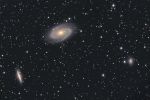
M-081-4.jpgM 81 and M 8258 visite"...Mus uni non fidit antro..."
(Plauto)
"...Il topo non si fida di un solo rifugio..."
|
|

Uranus-Hurricane02.jpgUranian Hurricane (detail 2)58 visitenessun commento
|
|

The Sun-C2helixG.jpgOur "restless" Sun... (4)58 visitenessun commento
|
|

The Sun-CropplumeG.jpgOur "restless" Sun... (6)58 visitenessun commento
|
|

The Sun-Eit002G_b.jpgOur "restless" Sun... (7)58 visitenessun commento
|
|

The Sun-EIT99promcloseG.jpgOur "restless" Sun...and Us!58 visitenessun commento
|
|

The Sun-Suncombo1G.jpgOur "restless" Sun... (10)58 visitenessun commento
|
|

IC-1805~0.jpgIC 1805 (alias "The Heart Nebula")58 visite"...You have pain now; but I will see you again, and your hearts will rejoice, and no one will take your joy from you..."
- John 16:22
|
|

S-PIA08816.jpgCape Verde and Cabo Frio (2)58 visiteThis image from the High Resolution Imaging Science Experiment on NASA's Mars Reconnaissance Orbiter shows the Mars Exploration Rover Opportunity near the rim of "Victoria crater." Victoria is an impact crater about 800 meters (half a mile) in diameter at Meridiani Planum near the equator of Mars. Opportunity has been operating on Mars since January, 2004. Five days before this image was taken, Opportunity arrived at the rim of Victoria crater, after a drive of more than 9 kilometers (over 5 miles). It then drove to the position where it is seen in this image.
Shown in the image are "Duck Bay," the eroded segment of the crater rim where Opportunity first arrived at the crater; "Cabo Frio," a sharp promontory to the south of Duck Bay; and "Cape Verde," another promontory to the north. When viewed at the highest resolution, this image shows the rover itself, wheel tracks in the soil behind it, and the rover's shadow, including the shadow of the camera mast. Since this image was taken, Opportunity has moved to the very tip of Cape Verde to perform more imaging of the interior of the crater.
This view is a portion of an image taken by the High Resolution Imaging Science Experiment (HiRISE) camera onboard the Mars Reconnaissance Orbiter spacecraft on Oct. 3, 2006. The complete image is centered at minus7.8 degrees latitude, 279.5 degrees East longitude. The range to the target site was 297 kilometers (185.6 miles). At this distance the image scale is 29.7 centimeters (12 inches) per pixel (with 1 x 1 binning) so objects about 89 centimeters (35 inches) across are resolved. The image shown here has been map-projected to 25 centimeters (10 inches) per pixel and north is up. The image was taken at a local Mars time of 3:30 PM and the scene is illuminated from the west with a solar incidence angle of 59.7 degrees, thus the sun was about 30.3 degrees above the horizon. At a solar longitude of 113.6 degrees, the season on Mars is northern summer.
Images from the High Resolution Imaging Science Experiment and additional information about the Mars Reconnaissance Orbiter are available online at: http://www.nasa.gov/mro or http://HiRISE.lpl.arizona.edu.
|
|

T-TRA_000828_1805_RED.jpgYardangs in Medusa Fosse58 visiteThis image covers a portion of an outcrop of the Medusae Fossae Formation, a series of light-toned terrains in the Martian mid-latitudes. The Medusae Fossae has been and remains one of the most enigmatic features on Mars. The unit is characterized by wind-sculpted landforms, most notably eroded ridges known as yardangs. The composition of the Medusae Fossae is not known, but candidates include indurated (hardened) volcanic ash or remnants of dust-ice mixtures that formed in a different Martian climate. This HiRISE image reveals new details of the Medusae Fossae.
Three prominent yardangs are seen, at upper right, lower center right, and partially at lower right. They are aligned with their long axes pointing NW-SE, with tapered ends on the NW, consistent with erosion from a southeasterly wind. One or more hard rocky layers within the yardangs are visible, with the layers commonly segregated into discreet boulders. Isolated rocks are seen on the slopes and at the base of the yardangs, indicating that some formed from breakup of the layers. The rocks may be similar in composition to the softer, non-rocky parts of the yardangs, but simply more indurated. Alternatively, they may be compositionally distinct, challenging current hypotheses for the origin of the Medusae Fossae.
Light-toned ridges at center left have a gross morphology similar to that of barchanoid dunes, formed from wind-blown sand. If these are dunes or ripples, their orientation is consistent with the presumed wind direction that carved the yardangs. However, zooming in to full resolution reveals flat tops, grooves, and smaller, darker ripple forms to the northwest of the ridges. Therefore if these are dunes, they seem indurated.
|
|

T-TRA_000836_1740_RED_CandorChasma_01.jpgCandor Chasma58 visiteCandor Chasma is one of several large troughs that make up Valles Marineris, the largest canyon system in the Solar System. Much of Candor Chasma is filled with layered deposits, like those shown in this HiRISE sub-image. Layers only 1-2 meters thick can be resolved by HiRISE and provide details on the processes that emplaced and modified these sediments. The layered deposits could be volcanic, lacustrine, or eolian sediments that filled in some portions of the trough of Valles Marineris. The variations in brightness of the layers could represent compositional differences in the layers or the thickness of overlying debris, such as sand or dust. This area was targeted because minerals rich in sulfur were detected here by the OMEGA instrument on Mars Express. By using HiRISE images to look at specific geologic units that correspond to these locations of sulfate, it may be possible to determine the origin of the sediments, particularly those that contain the sulfates. The paucity of impact craters on the layered deposits suggests either a young age for the sediments or erosion has removed much of the upper layers to reveal a fresher-looking surface. Dark dunes and ripples indicate that wind has been, and still may be, moving debris across the sedimentary deposits.
|
|
| 25353 immagini su 2113 pagina(e) |
 |
|
|
|
|
1336 | |
|
|
|
|





