| Piú viste |

OPP-SOL1412-1N253534999EFF8826F0006L0M1.jpgThe Sky over Opportunity... - Sol 1412 (MULTISPECTRUM; credits: Lunexit)58 visiteElaborazione del Cielo di Marte in versione multispettrale, senza applicazione di filtri rossi o arancio/gialli.
Frame da osservare in congiunzione alla coppia di immagini Spirit relative al Cielo di Gusev nel Sol 1432.
(notare le pessime condizioni dell'ottica utilizzata la quale sembra essere abbondantemente cosparsa di polvere)MareKromium
|
|

ZO-Mercury03_Messenger-208855main_half_merc_350.jpgCrescent Mercury58 visiteAs NASA’s MESSENGER neared Mercury on January 14, 2008, the Spacecraft took this image of the Planet’s full crescent.
The image shows portions of Mercury previously seen by Mariner 10, but when Mariner 10 flew by the Planet at each of its encounters, the Sun was nearly overhead. For this MESSENGER flyby, in contrast, the Sun is shining obliquely on Regions near the day/night boundary (called the Terminator) on the right-hand side of the crescent, revealing the surface topography.
This image illustrates how MESSENGER, during its future flybys and subsequent orbital mission, will teach scientists much about the portion of Mercury already imaged by Mariner 10.MareKromium
|
|

as15-96-13089.JPGAS 15-96-13089 - Lyot and Rima Schroedinger on the Lunar Terminator58 visiteImage Collection: 70mm Hasselblad
Mission: 15
Magazine: 96
Magazine Letter: Q
Latitude: approx. 27,0° South
Longitude: approx. 82,0° East
Film Type: SO-368
Film Width: 70 mm
Film Color: color
Feature(s): LYOT CRATER and VALLIS SCHRODINGERMareKromium
|
|

SOL426-3.jpgMartian Moss...and "something" else - Sol 426 (true colors; credits: Dr M. Faccin)58 visiteEd infine - ad abundantiam - qui non abbiamo solo da ragionare sulla problematica dei possibili Muschi Marziani, ma anche sul "che cosa" potrebbe rappresentare il dettaglio estrapolato da questo incredibile frame e quindi magnificato (in basso a Dx) dal Dr Faccin...
Su Marte - come sulla Terra, in fondo... - "Gli esami e le sorprese non finiscono davvero mai"!...MareKromium
|
|

ZO-Mercury13_Messenger-209132main_color_mercury.jpgMercury in False Colors (credits: NASA)58 visiteOne week ago, the MESSENGER Spacecraft transmitted to Earth the first HR image of Mercury by a spacecraft in over 30 years, since the 3 Mercury flybys of Mariner 10 in 1974 and 1975. MESSENGER's Wide Angle Camera (WAC), part of the Mercury Dual Imaging System (MDIS), is equipped with 11 narrow-band color filters, in contrast to the two visible-light filters and one ultraviolet filter that were on Mariner 10's vidicon camera. By combining images taken through different filters in the visible and infrared, the MESSENGER data allow Mercury to be seen in a variety of high-resolution color views not previously possible. MESSENGER’s eyes can see far beyond the color range of the human eye, and the colors seen in the accompanying image are somewhat different from what a human would see.
The color image was generated by combining three separate images taken through WAC filters sensitive to light in different wavelengths; filters that transmit light with wavelengths of 1000, 700, and 430 nnmts (infrared, far red, and violet, respectively) were placed in the red, green, and blue channels, respectively, to create this image. The human eye is sensitive across only the wavelength range 400 to 700 nanometers. Creating a false-color image in this way accentuates color differences on Mercury's surface that cannot be seen in the single-filter, black-and-white images released last week.
MareKromium
|
|
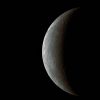
ZO-Mercury14_Messenger-209132main_color_mercury.jpgMercury in Natural Colors (credits: Lunexit)58 visitenessun commentoMareKromium
|
|

OPP-SOL1423-1P254512937EFF8884P2419R2M1.jpgAntenna Mast ad Victoria's Paving - Sol 1423 (MULTISPECTRUM; credits: Lunexit)58 visitenessun commentoMareKromium
|
|

Kaguya-018-hdtv_001_2c_l.jpgSome Lunar Geography from Kaguya: Lavoisier and Ulugh Beigh58 visiteOceanus Procellarum RegionMareKromium
|
|

Rho_Ophiuci-PIA10182.jpgRho Ophiuci58 visiteNewborn stars peek out from beneath their natal blanket of dust in this dynamic image of the Rho Ophiuchi dark cloud from NASA's Spitzer Space Telescope. Called "Rho Oph" by astronomers, it's one of the closest star-forming regions to our own solar system. Located near the constellations Scorpius and Ophiuchus, the nebula is about 407 light years away from Earth.
Rho Oph is a complex made up of a large main cloud of molecular hydrogen, a key molecule allowing new stars to form from cold cosmic gas, with two long streamers trailing off in different directions. Recent studies using the latest X-ray and infrared observations reveal more than 300 young stellar objects within the large central cloud. Their median age is only 300,000 years, very young compared to some of the universe's oldest stars, which are more than 12 billion years old.
This false-color image of Rho Oph's main cloud, Lynds 1688, was created with data from Spitzer's infrared array camera, which has the highest spatial resolution of Spitzer's three imaging instruments. Blue represents 3.6 micron light, green is 4.5 micron light, orange is 5.8, and red is 8.0. The multiple wavelengths reveal different aspects of the dust surrounding and between the embedded stars, yielding information about the stars and their birthplace.
The colors in this image reflect the relative temperatures and evolutionary states of the various stars. The youngest stars are surrounded by dusty disks of gas from which they, and their potential planetary systems, are forming. These young disk systems show up as yellow-green tinted stars in this image. Some of these young stellar objects are surrounded by their own compact nebulae. More evolved stars, which have shed their natal material, are blue-white.
The extended white nebula in the center right of the image is a region of the cloud which is glowing in infrared light due to the illumination of dust by bright young stars near the right edge of the cloud. Red and pink diffuse emission from carbon-rich dust molecules fills the image. Most of the stars forming now are concentrated in a filament of cold, dense gas that shows up as a dark cloud in the lower center and left side of the image against the bright background of the warm dust. Although infrared radiation at 8 microns pierces through dust easily, this dark filament is incredibly opaque, appearing dark even at the longest wavelengths in the image.
MareKromium
|
|
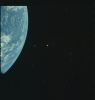
as16-118-18874.jpgAS 16-118-18874 - Trans-Lunar Injection!58 visitenessun commentoMareKromium
|
|
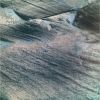
OPP-SOL1433-B_P2423_2_False_L257_pos_2.jpgOpportunity View of 'Lyell' Layer (False Color; credits: NASA/JPL-Caltech/Cornell University)58 visiteCaption NASA:"This view from NASA's Mars Exploration Rover Opportunity shows bedrock within a stratigraphic layer informally named "Lyell", which is the lowermost of three layers the Rover has examined at a bright band around the inside of Victoria Crater.
Opportunity used its Panoramic Camera (PanCam) to capture this image with low-Sun angle at a Mars Local Solar Time of 15:21, during the Rover's 1433rd Martian day, of Sol (Feb. 4, 2008).
This view combines separate images taken through the Pancam filters centered on wavelengths of 753, 535 and 432 nanometers.
It is presented in a false-color stretch to bring out subtle color differences in the scene".MareKromium
|
|

as16-113-18313.JPGAS 16-113-18313 - My Shadow...58 visiteCaption NASA:"119:33:46 MT - Charlie starts a pan at the LM with this down-Sun picture. He is standing at about the 4 o'clock position, North-East of the Spacecraft".MareKromium
|
|
| 25353 immagini su 2113 pagina(e) |
 |
|
|
|
|
1325 | |
|
|
|
|





