| Piú viste |

NGC-2736.jpgNGC 2736 - The "Pencil Nebula"58 visite"...Quod Natura negavit, reddere nemo potest..."
(antico proverbio)
"...Nessuno può restituire ciò che la Natura stessa ha tolto..." (trad. libera)MareKromium
|
|

MonocerosSkyscape.jpgSkyscape in Monoceros58 visite"...Facilius Natura intelligitur, quam enarratur..."
(Seneca)
"...E' molto più semplice arrivare a comprendere le Leggi della Natura, piuttosto che (una volta comprese) spiegarle ad altri..." (trad. libera)MareKromium
|
|
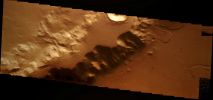
Landslides-Tiu_Valles-PCF-LXTT.jpgLandslides in Tiu Valles (Enhanced Natural Colors; credits: Dr Paolo C. Fienga - Lunar Explorer Italia)58 visiteCoord.: 10,4° North Lat. and 326,6° East Long.MareKromium
|
|

SOL0725-MF.JPGIntersting Rock - Sol 725 (Hi-Def3-D - b/w; credits and Copyright: Dr M. Faccin and Lunar Explorer Italia)58 visitenessun commentoMareKromium
|
|

Comets-Comet_Lulin-00.jpgComet Lulin is approaching...58 visiteDa "NASA - Picture of the Day", del giorno 2 Febbraio 2009:"How bright will Comet Lulin become? No one knows for sure. Although it is notoriously difficult to accurately predict the brightness of newly discovered comets, Comet Lulin could well become visible to the unaided eye later this month (such as February 2009).
As Comet Lulin moves into the Northern Sky in mid February to rise around midnight, it should at least be spotted by comet watchers with binoculars and a good sky chart. Tracking observations indicate that the comet officially designated C/2007 N3 (Lulin) has now swung by the Sun and is approaching Earth on a trajectory that will bring it within half the Earth-Sun distance in late February.
Comet Lulin's orbit indicates that this is likely the comet's first trip into the Inner Solar System. The comet was discovered by Quanzhi Ye of Sun Yat-sen University, on images obtained by Chi-Sheng Lin at the Lu-Lin Observatory of National Central University.
In this picture, taken from Italy last Friday, are Comet Lulin's coma and tails, one tail pointing away from the Sun, and an anti-tail - dust that trails the comet in its orbit and may appear to point toward the Sun".MareKromium
|
|

SOL414-1-GB.jpgRecent Activity - Sol 414 (possible True Colors; credits: Dr G. Barca & Lunar Explorer Italia)58 visitenessun commento MareKromium
|
|

PSP_001501_2280_RED_abrowse-00.jpgThe Viking Lander 2 Landing Site - Gerald Soffen Memorial Station (ctx frame - Natural Colors; credits: Lunar Explorer Italia)58 visiteViking Lander 2 (VL2) landed on Mars on 3 September 1976, in Utopia Planitia. The Lander, which has a diameter of about 3 meters, has been precisely located in the HiRISE image, and likely locations have been found for the Heat-Shield and Backshell.
The Lander location has been confirmed by overlaying the lander-derived topographic contours on the HiRISE image, which provides an excellent match.
VL2 was one element of an ambitious mission to study Mars, with a 4-spacecraft flotilla consisting of 2 Orbiters and 2 Landers.
Large Boulders, Dunes and other features visible in Lander images can be located in the HiRISE image. The polygonal pattern of the Surface is typical at these latitudes and may be due to the presence of deep subsurface ice.
As chance would have it, this image is blurred in some places due to the abrupt motion associated with the restart of the High Gain Antenna tracking during the very short image exposure. This is the first time after acquiring hundreds of pictures that an image has been unintentionally smeared, but the overall performance has been excellent.
A prime motivation for early viewing of these Viking sites is to calibrate what we see from space with the data previously acquired by the Landers. In particular, determining what sizes of rocks can be seen from MRO aids the interpretation of data now being taken to characterize sites for future landers.MareKromium
|
|

ESP_011289_1950_RED_abrowse.jpgMeander and Tributaries in Scamander Vallis (Enhanced Natural Colors; credits: Lunar Explorer Italia)58 visiteMars Local Time: 15:48 (middle afternoon)
Coord. (centered): 14,6° North Lat. and 29,1° East Long.
Spacecraft altitude: 278,2 Km (such as about 173,9 miles)
Original image scale range: 55,7 cm/pixel (with 1 x 1 binning) so objects ~1,67 mt across are resolved
Map projected scale: 50 cm/pixel
Map projection: EQUIRECTANGULAR
Emission Angle: 5,7°
Phase Angle: 52,4°
Solar Incidence Angle: 58° (meaning that the Sun is about 32° above the Local Horizon)
Solar Longitude: 178,5° (Northern Summer)
Credits: NASA/JPL/University of Arizona
Additional process. and coloring: Lunar Explorer ItaliaMareKromium
|
|

SOL477-2P168728047EDNAAACP2618L7M1.jpgClouds over Gusev Crater - Sol 477 (possible Natural Colors; credits: Lunar Explorer Italia)58 visiteQuesta colorizzazione è stata fatta solo per rispondere ad un nostro Lettore e quindi dimostrare che il nostro Processing Multispettrale opera sull'immagine A PRESCINDERSI dalle dimensioni della medesima.MareKromium
|
|

Miranda-B.JPGThe "Chevron Grooves" of Miranda (perspective view)58 visitenessun commentoMareKromium
|
|

PSP_006984_1840_RED_abrowse~0.jpgLayers in Gordii Dorsum (MULTISPECTRUM; credits: Lunexit)58 visiteThis image shows distinctive differences in the texture of the ground surface in an area of Mars called Gordii Dorsum.
The upper right part of the image contains many subparallel ridges. These ridges are geological features called yardangs (long irregular ridges carved by wind erosion). The lower half of the image is smoother and contains a few small knobs and ridges. This area of Mars contains extensive outcroppings of layered sedimentary rocks that may have formed by the accumulation of sand and dust either blown in by the wind, transported by water, or some combination of processes such as these.
The distinctive surface textures may be due to differences in the rock structure and formation process. Mapping differences in the surface textures such as these may help to reveal how these rocks formed and advance our understanding of the geologic history of Mars.MareKromium
|
|

PSP_005574_1720_RED_abrowse-00~0.jpgLayers and Slope-Streaks within Valleys along the Highland-Lowland Boundary (context frame - MULTISPECTRUM; credits: Lunexit)58 visiteThis image shows Slope Streaks and Layering on the walls of a valley along the border between the Martian Southern Highlands and Northern Lowlands (see the extra-detail mgnf. At the bottom of the valley and in the lower portion of the valley walls are many large dunes.
The Slope Streaks generally start at a point source and widen downslope as a single streak or branch into multiple streaks. Some of the Slope Streaks show evidence that downslope movement is being diverted around obstacles, such as large boulders. In particular, several of the Slope Streaks in this image appear to be diverting around individual dunes, with downslope movement occurring in the low troughs between the dunes. The darkest Slope Streaks are youngest and cross cut and lie on top of the older and lighter-toned Streaks.
The lighter-toned Streaks are believed to be dark streaks that are lightening with time as new dust is deposited on their surface.MareKromium
|
|
| 25353 immagini su 2113 pagina(e) |
 |
|
|
|
|
1321 | |
|
|
|
|





