| Piú viste |

ZQ-Mercury-PIA10984.jpgCraters "Deformed" and "Shortened" on Mercury58 visiteNumerous examples of craters that have been deformed and shortened by younger faults have been identified on images returned from MESSENGER’s first flyby of Mercury. In three cases shown here (arrows), portions of the floor and rim of a crater were buried when a large block of crust was thrust over the crater during the formation of a prominent fault scarp or cliff. By comparing the estimated size and shape of the original, undeformed crater with the crater’s current geometry, scientists can infer the amount of movement between the two crustal blocks on either side of the fault. This figure was recently published in Science magazine.
For each of the three examples of deformed and shortened craters shown here, movement on the faults buried at least a kilometer of the original crater. A: 17-Km (11-mile) diameter crater (arrows) shortened by Beagle Rupes. B: 5-Km (3-mile) diameter crater deformed near the rim of an older, larger crater, shown enlarged in the box on the lower left. C: 11-Km (7-mile) diameter crater (arrows) shortened by a North/West-South/East-trending fault scarp.MareKromium
|
|

ZQ-Mercury-PIA10942.jpgShield-Volcano on Mercury58 visiteAs reported in the July 4, 2008 issue of Science magazine, volcanoes have been discovered on Mercury’s Surface from images acquired during MESSENGER’s first Mercury flyby. This image shows the largest feature identified as a volcano in the upper center of the scene. The volcano has a central kidney-shaped depression, which is the vent, and a broad smooth dome surrounding the vent. The volcano is located just inside the rim of the Caloris Impact Basin. The rim of the Basin is marked with hills and mountains, as visible in this image. The role of volcanism in Mercury’s history had been previously debated, but MESSENGER’s discovery of the first identified volcanoes on Mercury’s surface shows that volcanism was active in the distant past on the innermost Planet.
Date Acquired: January 14, 2008
Image Mission Elapsed Time (MET:108826877
Instrument: Narrow Angle Camera (NAC) of the Mercury Dual Imaging System (MDIS)
Resolution: 270 meters/pixel (0,17 miles/pixel)
Scale: This image is about 270 Km across (approx. 170 miles)
Spacecraft Altitude: approx. 10.500 Km (about 6500 miles)MareKromium
|
|
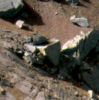
OPP-SOL975-3.jpgUnusual Surface Feature inside Victoria - Sol 975 (True Colors; credits: Dr G. Barca)58 visitenessun commentoMareKromium
|
|

OPP-SOL1136-1.jpgRover Tracks and Berries - Sol 1136 (True Colors; credits: Dr G. Barca)58 visitenessun commentoMareKromium
|
|

OPP-SOL1109-1.jpgBi-colored pebble and Berries - Sol 1109 (True Colors; credits: Dr G. Barca)58 visitenessun commentoMareKromium
|
|

Darkness-1.jpgMidnight-Sun over Vastitas (by Dr Marco Faccin)58 visitenessun commentoMareKromium
|
|
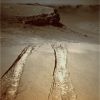
OPP-SOL1634-1N273249874EFF90NVP1937R0M1.jpgOut of Victoria! - Sol 1634 (tri-chromatic version; credits: Lunexit)58 visitenessun commentoMareKromium
|
|
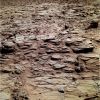
SOL1332-1.jpgLayers... - Sol 1322 (natural colors; credits: Dr G. Barca)58 visitenessun commentoMareKromium
|
|

APOLLO_16_AS_16-113-18325.jpgAS 16-113-18325 - EVA-1 : Panorama (natural colors; credits: Lunexit)58 visiteRightward of 18324, toward Stone Mountain. This picture also shows the brightly-lit Western Wall of the crater behind the LM.
MareKromium
|
|
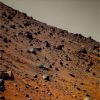
SOL1651-MF-LXT.jpgColours' Variety... - Sol 1651 (True - but enhanced - Colors; credits: Dr M. Faccin)58 visitenessun commentoMareKromium
|
|
OPP-SOL1430-1_copia2.jpgThe Human Mark, inside Victoria - Sol 1430 (Natural Colors; credits: Dr G. Barca)58 visitenessun commentoMareKromium
|
|

Prometheus-PIA08947~0.jpgCosmic "Through-and-Through"!58 visiteCaption NASA:"Prometheus pulls away from an encounter with Saturn's F-Ring, leaving behind a reminder of its passage.
Prometheus (about 102 Km, or 63 miles across) approaches closely to the F-Ring once during each circuit around Saturn, disturbing the orbits of the small particles in the Ring and creating a streamer of material that then shears out, following the moon as it speeds off.
This view looks toward the unilluminated side of the Rings from about 37° above the Ring-Plane. Prometheus is brightly lit by the Sun on one side and lit more modestly by Saturn's reflected light on the other side.
The image was taken in visible light with the Cassini spacecraft narrow-angle camera on April 18, 2007 at a distance of approx. 2 MKM (about 1,2 MMs) from Prometheus and at a Sun-Prometheus-spacecraft, or phase angle of 87°. Image scale is roughly 12 Km (about 7 miles) per pixel".
MareKromium
|
|
| 25353 immagini su 2113 pagina(e) |
 |
|
|
|
|
1318 | |
|
|
|
|





