| Piú viste |
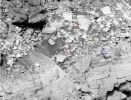
OPP-SOL1213-1P235878503EFF8.jpgWhat's in the Walls of Victoria? - Sol 121358 visiteUn bellissimo lavoro di scoperta, intuizione ed immaginazione del nostro Caro Amico (ed ormai Socio Storico) Lorenzo Leone. Lasciamo quindi che sia lui a parlare ed a suggerirci qualche possibile (e plausibile) interpretazione circa i "Segreti di Marte" (in generale) e di "Victoria Crater" (in particolare)...
"Ancora una volta un gioco di luci ed ombre? Chi può saperlo...Quello che io so è che Marte affascina sempre. Con i suoi colori, la sua geologia ignota e bizzarra.
Nel cerchio blu un possibile fossile; i cerchi rossi evidenziano rilievi circolariformi che sembrano lavorati a mano. Nel cerchio giallo troviamo inconsueti e perfetti angoli di 90° ma...Sappiamo che la Natura non ha né limiti, né confini.
Certo analizzando le cose dal un punto di vista logico e statistico, potremmo dire (sempre e comunque) che tutto è solo un gioco di luci, ombre e oggetti dalla forma bizzarra...Ma se si catalogassero tutte le rocce apparentemente "strane", forse non basterebbero 10 grossi volumi!
Noi, come sempre, possiamo solo ipotizzare, supporre, investigare, a volte sognare (che male non fa...) in attesa di una risposta o di una soluzione concreta.
Speriamo di esserci per quel giorno...".
MareKromium
|
|
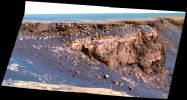
OPP-SOL1167-PIA09695.jpgCape St Vincent - Sol 1167 (False Colors; credits: NASA/JPL/Cornell)58 visiteCaption NASA:"This image captured by NASA's MER Opportunity shows "Cape St. Vincent" one of the many promontories that jut out from the walls of Victoria Crater. The material at the top of the promontory consists of loose, jumbled rock, then a bit further down into the crater, abruptly transitions to solid bedrock.
This transition point is marked by a bright band of rock, visible around the entire crater.
Scientists say this bright band represents what used to be the surface of Mars just before an impact formed Victoria Crater. After Opportunity begins to descend into the crater in early July 2007, it will examine the band carefully at an accessible location with a gentle slope. These investigations might help determine if the band's brighter appearance is the result of ancient interactions with the Martian atmosphere.
This image was taken by Opportunity's PanCam on Sol 1167 (May 6, 2007).
It is presented in false color to accentuate differences in surface materials". MareKromium
|
|

ZZ-ColorMars-09-KL-V01511013color.jpgMars from Orbit, as a "Human" would see it...by Keith Laney (3)58 visitenessun commentoMareKromium
|
|

Centaurus-A.jpgCentaurus "A"58 visite"...Hostium munera, non munera (sunt)..."
(Binder)
"...I doni dei nemici non sono doni..."MareKromium
|
|
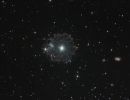
NGC-6543.jpgNGC 6543 - The "Cat's Eye Nebula"58 visite"...Omnium est communis inimicus, qui est (fuit) hostis suorum. Nemo unquam sapiens proditori credendum putat (putavit)..."
(Cicerone)
"...E' nemico comune colui che è (o fu) nemico dei suoi. Nè alcun uomo avveduto pensa che si possa prestar fede a chi è (o fu) - comunque - un traditore..."MareKromium
|
|
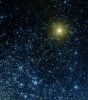
NGC-0362-PIA09653.jpgNGC 362 - Globular Star Cluster58 visiteThe Galaxy Evolution Explorer's ultraviolet eyes have captured a globular star cluster, called NGC 362, in our own Milky Way galaxy. In this new image, the cluster appears next to stars from a more distant neighboring galaxy, known as the Small Magellanic Cloud.
Globular clusters are densely packed bunches of old stars scattered in galaxies throughout the universe. NGC 362, located 30,000 light-years away, can be spotted as the dense collection of mostly yellow-tinted stars surrounding a large white-yellow spot toward the top-right of this image. The white spot is actually the core of the cluster, which is made up of stars so closely packed together that the Galaxy Evolution Explorer cannot see them individually.
The light blue dots surrounding the cluster core are called extreme horizontal branch stars. These stars used to be very similar to our sun and are nearing the end of their lives. They are very hot, with temperatures reaching up to about four times that of the surface of our sun (25,000 Kelvin or 45,500 degrees Fahrenheit).
A star like our sun spends most of its life fusing hydrogen atoms in its core into helium. When the star runs out of hydrogen in its core, its outer envelope will expand. The star then becomes a red giant, which burns hydrogen in a shell surrounding its inner core. Throughout its life as a red giant, the star loses a lot of mass, then begins to burn helium at its core. Some stars will have lost so much mass at the end of this process, up to 85 percent of their envelopes, that most of the envelope is gone. What is left is a very hot ultraviolet-bright core, or extreme horizontal branch star.
Blue dots scattered throughout the image are hot, young stars in the Small Magellanic Cloud, a satellite galaxy of the Milky Way located approximately 200,000 light-years away. The stars in this galaxy are much brighter intrinsically than extreme horizontal branch stars, but they appear just as bright because they are farther away. The blue stars in the Small Magellanic Cloud are only about a few tens of millions of years old, much younger than the approximately 10-million-year-old stars in NGC 362.
Because NGC 362 sits on the northern edge of the Small Magellanic Cloud galaxy, the blue stars are denser toward the south, or bottom, of the image.
Some of the yellow spots in this image are stars in the Milky Way galaxy that are along this line of sight. Astronomers believe that some of the other spots, particularly those closer to NGC 362, might actually be a relatively ultraviolet-dim family of stars called "blue stragglers." These stars are formed from collisions or close encounters between two closely orbiting stars in a globular cluster.
This image is a false-color composite, where light detected by the Galaxy Evolution Explorer's far-ultraviolet detector is colored blue, and light from the telescope's near-ultraviolet detector is red.
MareKromium
|
|

as17-147-22504.JPGAS 17-147-22504 - Signs of Gravity Wasting?58 visiteEVA-1 at the LM. 4 o'clock pan. Wessex Cleft in shadow.MareKromium
|
|
SOL1238-2P236266234EFFAUATP2629L6M1.jpgMartian Morning Mist... - Sol 123858 visitenessun commentoMareKromium
|
|
OPP-SOL1220-1P236485422EFF85R9P2629L4M1.jpgMorning Mist over Victoria (1) - Sol 122058 visitenessun commentoMareKromium
|
|

as17-147-22555.JPGAS 17-147-22555 - Sculptured Hills and East Massif58 visiteGeophone 3 pan. Gap between the Sculptured Hills and the East Massif. The LM is partly visible in the up-Sun glare.
MareKromium
|
|

as17-147-22554.JPGAS 17-147-22554 - LM and Sun glare58 visiteGeophone 3 pan. LM.MareKromium
|
|

as17-147-22553.JPGAS 17-147-22553 - Lost in the Sun glare...58 visiteGeophone 3 pan. LM hidden in the up-Sun glare.MareKromium
|
|
| 25353 immagini su 2113 pagina(e) |
 |
|
|
|
|
1317 | |
|
|
|
|





