| Piú viste |

ORIGINAL NASA - APOLLO 15 - AS 15-88-11901.JPGAS 15-88-11901 - The final "parking place"...58 visite
|
|
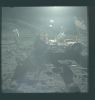
as17-134-20400.JPGAS 17-134-20400 - The Rover in the Sun-light58 visiteCaption originale NASA:"122:21:34 MT - Station 1. Second boulder "locator" to the LRV.
The photo is degraded by up-Sun glare".
|
|
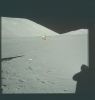
as17-134-20442.JPGAS 17-134-20442 - South Massif, LM and Shadow58 visiteCaption originale:"123:06:24 MT - SEP site. This frame from Gene's SEP partial pan is centered on the LM with Geophone Rock, the US flag, and the ALSEP site in the background. Jack's shadow is on the left".
|
|
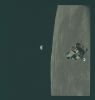
as11-44-6643.JPGAS 11-44-6643 - Rendez-Vous!58 visiteCaption NASA originale:"The LM Eagle is approaching the CSM Columbia during rendezvous. The LM hatch is pointed toward us and the Ascent Engine is pointed up and to the left".
|
|

as15-87-11718.JPGAS 15-87-11718 - Hadley Delta58 visiteCaption NASA originale:"Jim Irwin took this picture of the Landing Site from the LM on Rev. 13. They were then at an altitude of about 12 Km. On the near side of the Rille, the South Cluster is at the base of Hadley Delta one fiducial below the center of the image. The North complex and Schaber Hill are at the right side of the image. Note that the dark area at the top of the picture is the top of Jim's window and not the terminator".
|
|

M 82-PIA08093.jpgM 82: A "Space Rainbow"58 visiteCaption NASA originale:"NASA's Spitzer, Hubble and Chandra Space Observatories teamed up to create this multi-wavelength, false-colored view of the M82 galaxy.
The lively portrait celebrates Hubble's "sweet sixteen" birthday.
X-ray data recorded by Chandra appears in blue; infrared light recorded by Spitzer appears in red; Hubble's observations of hydrogen emission appear in orange, and the bluest visible light appears in yellow-green".
|
|

PIA07854.jpgA beautiful "Asteroid Belt"58 visiteThis artist's animation illustrates a massive asteroid belt in orbit around a star the same age and size as our Sun. Evidence for this possible belt was discovered by NASA's Spitzer Space Telescope when it spotted warm dust around the star, presumably from asteroids smashing together.
The view starts from outside the belt, where planets like the one shown here might possibly reside, then moves into to the dusty belt itself. A collision between two asteroids is depicted near the end of the movie. Collisions like this replenish the dust in the asteroid belt, making it detectable to Spitzer.
The alien belt circles a faint, nearby star called HD 69830 located 41 light-years away in the constellation Puppis. Compared to our own solar system's asteroid belt, this one is larger and closer to its star - it is 25 times as massive, and lies just inside an orbit equivalent to that of Venus. Our asteroid belt circles between the orbits of Mars and Jupiter.
Because Jupiter acts as an outer wall to our asteroid belt, shepherding its debris into a series of bands, it is possible that an unseen planet is likewise marshalling this belt's rubble. Previous observations using the radial velocity technique did not locate any large gas giant planets, indicating that any planets present in this system would have to be the size of Saturn or smaller.
Asteroids are chunks of rock from "failed" planets, which never managed to coalesce into full-sized planets. Asteroid belts can be thought of as construction sites that accompany the building of rocky planets.
|
|

as15-87-11725.JPGAS 15-87-11725 - Thomson Crater and a strange "light"58 visiteLM - Rev 13. Beautiful oblique photo of Thomson Crater, Sea of Ingenuity.
|
|

as11-44-6661.JPGAS 11-44-6661 - The Moon, on the way home...58 visite
|
|

M 74-PIA08533_fig1.jpgM 74 and Supernova SN2003gd58 visiteThis image is the galaxy M 74, as seen by SST's infrared array camera. The white box to the left of the Galaxy's center identifies the location of the Supernova Remnant. In all the images, the blue dots represent hot gas and stars. The galaxy's cool dust is shown in red.
Astronomers using NASA's SST have spotted a "dust factory" 30 MLY away in the spiral galaxy M 74. The factory is located at the scene of a massive star's explosive death, or supernova.
While astronomers have suspected for years that supernovae could be producers of cosmic dust particles, the technology to confirm this suspicion has only recently become available.
|
|

M 74-PIA08533_fig3.jpgSupernova SN2003gd in January 2005 (2)58 visiteBy January 2005, the dust had cooled and completely faded from the camera's view (here). However, it was still detected in January 2005 by another instrument aboard Spitzer called the Multiband Imaging Photometer.
All the images are false-color, infrared composites, in which 3,6-micron light is blue, 4,5-micron light is green, and 8-micron light is red.
|
|

M 74-PIA08533.jpgM 74 - Spiral Galaxy58 visite
|
|
| 25353 immagini su 2113 pagina(e) |
 |
|
|
|
|
1313 | |
|
|
|
|





