| Piú viste |

OPP-SOL220-1N147720902EFF35CCP1871L0M1.jpgInside Endurance Crater58 visitenessun commento
|
|
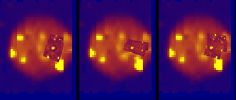
Io-active volcanoes-PIA02558_modest.jpgActive volcanoes on Io in 3 different months58 visiteCaption NASA originale:Changes in the volcanoes on Io can be seen in these 3 views, taken by NASA's Galileo spacecraft during its 3 flybys of Io in October and November 1999 and February 2000. All the images show the active volcanoes as bright yellow, corresponding to hot lava flows that appear glowing in infrared wavelengths. The 3 views were taken by the spacecraft's near-infrared mapping spectrometer and show the comparison of a typical low-resolution observation to the high-resolution views. The Prometheus volcano is seen near the middle of all three images. Before the recent flybys, only Prometheus and three other volcanoes were known to be active in this region. After these and other high-resolution observations, scientists were able to detect 14 volcanoes in the same area. The fainter volcanoes (hot spots) show some significant changes over intervals of 1 to 3 months. The area shown by all three observations put together is about 2 million square kilometers (about 770,000 square miles)".
|
|
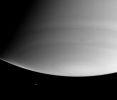
Saturn and Enceladus - PIA06483_modest.jpgSaturn and Enceladus (in ultra-violet)58 visiteCaption NASA originale:"Looking beyond Saturn's south pole, this was the Cassini spacecraft's view of the distant, icy moon, Enceladus on July 28, 2004. The planet itself shows few obvious features at these ultraviolet wavelengths, due to scattering of light by molecules of the gases high in the atmosphere. Enceladus is 499 Km wide.
The image was taken with the Cassini spacecraft narrow angle camera at a distance of 7.4 MKM from Saturn through a filter sensitive to ultraviolet wavelengths of light. The image scale is 44 Km per pixel of Saturn".
|
|
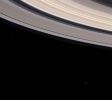
Saturn-PIA06485_modest.jpgSaturn, Janus and Mimas (in natural colors)58 visiteCaption NASA originale:"Looking something like the fibrous bow of a violin, Saturn's colorful rings sweep through this spectacular natural color view while two small moons look on.
From left, the moons visible here are Janus (181 Km across) and Mimas (398 Km across). Cassini's view in this image is from beneath the ring plane; the moons are on the far side of Saturn. Janus leads Mimas as the two moons orbit the planet. Nearly the entire ring system can be seen in this view. The diaphanous C-Ring appears at the upper right, followed by the multi-hued B-Ring. Next, the famous Cassini division (4.800 Km wide) separates the A and B rings. The outer edge of the B-Ring which forms the inner boundary of the Cassini division is maintained by a gravitational resonance with Mimas. Near the outer edge of the A-Ring are the Encke Gap (325 Km wide) and the barely visible Keeler Gap (35 Km wide). The faint, thread-like F-Ring is slightly discernible just beyond the main rings".
|
|

Saturn-N00021000.jpgSaturn and his Rings58 visitenessun commento
|
|

OPP-SOL251-Endurance Panorama.jpgEndurance Crater (mosaic panorama from "NASA - Picture of the Day")58 visiteUn Panorama "ridondante", pubblicato sul Sito "NASA - Picture of the Day" del giorno 11 Ottobre 2004. Vale la pena riportare una parte del commento originale all'immagine: "...Possible choices for the Opportunity rover team on Earth (...) were to send the Martian robot inside Endurance Crater toward the arc-shaped sand dunes on the left, the unusually shaped rock on the right slope dubbed Wopmay and lower parts of Burns Cliff at the top of the craters inner slopes. The Opportunity rover team chose 1-meter diameter rock Wopmay as their next target and closer photographs are already being returned. (...) Opportunity has recently found rocks in Endurance crater with a network of cracks potentially indicative of dried mud, bolstering the case that Mars had a wet ancient past". Secondo noi il fatto di parlare di prove solo "potentially indicative...that Mars had a wet ancient past", a questo punto, è ridicolo. Che cosa deve vedere il Rover per smuovere la NASA? Delle cascate come quelle del Niagara?
|
|

VB-Uranus-EpsilonRing-V2-PIA01983_modest.jpgUranus' Rings (4) - the "Epsilon Ring"58 visitenessun commento
|
|

Janus-N00021433.jpgRings and Janus58 visitenessun commento
|
|

SOL277-2N150960309EFF8982P0674R0M1.jpgTime is passing by... (2)58 visitevedi commento al frame precedente
|
|

DACTYL-PIA00298.jpgAsteroid Dactyl58 visiteWithin seconds of its closest approach to the asteroid 243 Ida on August 28, 1993, the Galileo spacecraft's Solid State Imaging camera caught this glimpse of Ida's previously unknown moon orbiting the asteroid. One frame of a 15-image set designed to capture a view of Ida at the highest possible resolution landed by chance with its edge right on the little moon. The range from the spacecraft was about 2.400 Km and each picture element spans about 24 meters (80 feet) on the surface of the moon. Only a small sliver of the sunlit crescent is visible at the edge of the frame (which was shifted inward toward the center in this frame). Dactyl is approximately egg-shaped, measuring about 1.2 x 1.4 x 1.6 Km (0.75 x 0.87 x 1 mile). At the time this image was shuttered, Ida was about 90 Km (56 miles) away from the moon, outside this frame to the left and slightly below center. The smoothly curving shape of the dark edge of Ida's moon can be seen on the left. The moon's observed darkside was just barely detectable.
|
|

IDA-PIA00135.jpgAsteroid Ida (HR)58 visiteThis view of the asteroid 243 Ida is a mosaic of 5 image frames acquired by the Galileo spacecraft's solid-state imaging system at ranges of 3.057 to 3.821 Km on August 28, 1993, about 3-1/2 minutes before the spacecraft made its closest approach to the asteroid. Galileo flew about 2.400 Km from Ida at a relative velocity of 12.4 km/sec (28,000 mph). Asteroid and spacecraft were 441 million Km from the Sun. Ida is the second asteroid ever encountered by a spacecraft. It appears to be about 52 Km in length, more than twice as large as Gaspra, the first asteroid observed by Galileo in October 1991. Ida is an irregularly shaped asteroid placed by scientists in the S class (believed to be like stony or stony iron meteorites). It is a member of the Koronis family, presumed fragments left from the breakup of a precursor asteroid in a catastrophic collision. This view shows numerous craters, including many degraded craters larger than any seen on Gaspra.
|
|

Saturn-N00022514.jpgA big "white and round spot" on Saturn58 visiteUna configurazione transitoria delle nuvole di Saturno: si è formato, in prossimità del Polo Sud del Pianeta Anellato, un disco di nuvole bianche, molto ben definito nelle sue linee essenziali. Un uragano, probabilmente, che scarica la sua immensa energia negli strati superiori dell'atmosfera di Saturno e che si esaurirà in qualche giorno.
|
|
| 25353 immagini su 2113 pagina(e) |
 |
|
|
|
|
1312 | |
|
|
|
|





