| Piú viste |

Io-Volcanic Plumes and Flares-PIA00703.jpgVolcanic activity on Io ("Plumes" and "Flares")58 visitenessun commento
|
|

Io-PIA00740.jpgThe "face" of Io58 visitenessun commento
|
|

Io-Plumes-PIA01081.jpgMore "Plumes" on Io58 visitenessun commento
|
|
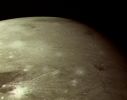
Ganymede-PIA01515.jpgThe North Pole of Ganymede (in real colors)58 visiteThis color picture as acquired by Voyager 1 during its approach to Ganymede on Monday afternoon (the 5th of March). At ranges between about 230 to 250 thousand km. The images show detail on the surface with a resolution of four and a half km. This picture is of a region in the northern hemisphere near the terminator. It shows a variety of impact structures, including both razed and unrazed craters, and the odd, groove-like structures discovered by Voyager in the lighter regions. The most striking features are the bright ray craters which have a distinctly 'bluer' color appearing white against the redder background. Ganymede's surface is known to contain large amounts of surface ice and it appears that these relatively young craters have spread bright fresh ice materials over the surface. Likewise, the lighter color and reflectivity of the grooved areas suggests that here, too, there is cleaner ice. We see ray craters with all sizes of ray patterns, ranging from extensive systems of the crater in the southern part of this picture, which has rays at least 300-500 kilometers long, down to craters which have only faint remnants of bright ejects patterns (such as several of the craters in the southern half of PIA01516; P21262). This variation suggests that, as on the Moon, there are processes which act to darken ray material, probably 'gardening' by micrometeoroid impact.
|
|

ZA-Neptune_s Rings-PIA02202_modest.jpgThe Rings of Neptune (full system) 258 visiteCaption NASA originale:"This pair of Voyager 2 images (FDS 11446.21 and 11448.10), two 591-s exposures obtained through the clear filter of the wide angle camera, show the full ring system with the highest sensitivity. Visible in this figure are the bright, narrow N53 and N63 rings, the diffuse N42 ring, and (faintly) the plateau outside of the N53 ring (with its slight brightening near 57.500 Km)".
|
|

ZB-Neptune_s Partial Rings-PIA02200_modest.jpgNeptune's "Partial Rings" (or "Ring Arcs")58 visiteCaption NASA originale:"One of two new ring arcs, or partial rings, discovered by NASA's Voyager 2 spacecraft, is faintly visible here just outside the orbit of the Neptunian moon 1989N4, also discovered by Voyager 2.
The 155 second exposure taken by Voyager's narrow-angle camera shows the glare of an overexposed Neptune to the right of the moon and ring arc.
The two bright streaks below the moon and ring arc are stars.
The ring arc is approximately 50.000 Km (or 30.000 miles) long".
|
|

ZC-Neptune_s Rings-PIA01493_modest.jpgThe Rings of Neptune58 visiteCaption NASA originale:"In Neptune's outermost ring, 39.000 miles out, material mysteriously clumps into 3 arcs.
Voyager 2 acquired this image as it encountered Neptune in August 1989".
|
|
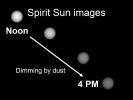
SOL010-THE_SUN_FROM_MARS-01.jpgThe Sun from Mars - Sol 1058 visiteCaption originale NASA: "This image shows the Sun as it appears on Mars throughout the day. Scientists monitor the dimming of the setting Sun to assess how much dust is in the martian atmosphere. The pictures were taken by the Mars Exploration Rover Spirit's panoramic camera".
|
|

Saturn-HST-Oct1997-PIA03159_modest.jpgSaturn from Hubble Space Telescope (Oct. 1997)58 visitenessun commento
|
|

Saturn-HST-Oct1996-PIA03158_modest.jpgSaturn from Hubble Space Telescope (Oct. 1996)58 visitenessun commento
|
|

Jupiter-V2-PIA01527_modest.jpgThe "Red Spot" of Jupiter58 visiteCaption NASA originale:"The region of white clouds now extends from east of the Red Spot and around its northern boundary, preventing small cloud vortices from circling the feature. The disturbed region west of the Red Spot has also changed since the equivalent Voyager 1 image. It shows more small scale structure and cloud vortices being formed out of the wave structures. The picture was taken on July 3, 1979, from about 6 MKM".
|
|

Jupiter-WO-PIA01513_modest.jpgWhite Ovals on Jupiter58 visiteCaption NASA originale:"This photo of Jupiter was taken by Voyager 1 on March 1st, 1979, from a distance of 4.300.000 Km. The region shown is just to the southeast of the Great Red Spot. A small section of the spot can be seen at upper left. One of the 40-year-old white ovals in Jupiter's atmosphere can also be seen at middle left, as well as a wealth of other atmospheric features, including the flow lines in and around the ovals.
The smallest details that can be seen in this photo are about 80 Km across".
|
|
| 25353 immagini su 2113 pagina(e) |
 |
|
|
|
|
1311 | |
|
|
|
|





