| Piú viste |
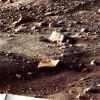
PHOE-SOL119-MF-LXT.jpgMorning Frost over Vastitas - Sol 119 (natural colors; credits: Dr M. Faccin)59 visitenessun commentoMareKromium
|
|
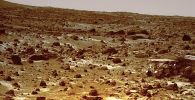
SOU-SOL080-LXT.jpgAres' Horizon and a "tired" Soujourner ... - Sol 80 (natural colors; credits: Lunexit)59 visitenessun commentoMareKromium
|
|

PHOE-SOL122-lg35921-35922-35923-2.jpgMicroscopic Vastitas - Sol 122 (Superdefinition and possible True Colors; credits: Dr G. Barca & Lunexit)59 visitenessun commentoMareKromium
|
|
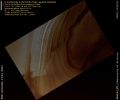
Psp_009390_2595_red.jpgUnconformity in North Polar Layered Deposits (natural colors; credits: Lunexit)59 visiteThis image features the North Polar Layered Deposits. The flat tongue-shaped feature at the bottom of the image is the surface of the cap.
The bright textured region near the top of the image is polygonal ground, which is commonly found in the Martian High-Latitudes. Polygonal ground formation is thought to relate to temperature cycles in ice-rich soil.
Just south of the polygonal ground, a bright layer within the cap can be seen eroding in the form of landslides, particularly near the center of the image.
The most noticeable part of the polar cap is visible in an unconformity, the horizontal break in the cap layers. An unconformity is caused by non-uniform erosion or deposition. In this case, non-uniform erosion or deposition might have occurred due to variable climate over geologic time.
MareKromium
|
|
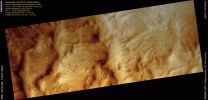
Psp_009548_1420_red.jpgEnigmatic Terrain in Hellas Planitia (Saturated Natural Colors; credits for the additional process. and color.: Dr Paolo C. Fienga - Lunexit Team)59 visiteHellas Planitia is the low-lying plain on the floor of the Hellas Basin, an ancient impact crater over 2000 Km wide. This Basin includes the lowest point on the surface of Mars.
A variety of unusual landforms occur on the floor of the basin due to the low elevation. One hypothesis is that Hellas may once have held lakes or seas, possibly with thick ice that might account for some of these features.
This image shows a small portion of Western Hellas, in a Region of "Enigmatic Ridges".
These ridges form an intricate pattern, enclosing kilometer-wide depressions. These strange features are still not well-understood; one possibility is that they formed in lake-bottom sediments when ice covering the lake touched bottom and shoved wet, loose material to the side.
This HiRISE image reveals that the ridges contain many boulders; sediments deposited on the bottom of a lake might be fine-grained, although they may have hardened to rock later. The image also shows lineations, probably outcropping layers, running between the large ridges.
Because the resolution of HiRISE images is sufficient to see details such as the abundance of boulders and the presence of thin sedimentary layers, images of this and other poorly-understood terrains will be important in interpreting the geological and climatological history of Mars.
This observation is part of a stereo pair along with PSP_007834_1420.MareKromium
|
|
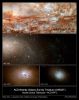
Galaxies-HST.jpgGalaxies!59 visiteThese images taken with NASA's Hubble Space Telescope are close-up views of four galaxies from a large survey of nearby galaxies.
The galaxies have very different masses and sizes and showcase the diversity of galaxies found in the ANGST study. Although the galaxies are separated by many light-years, they are presented as if they are all at the same distance to show their relative sizes.
The images, taken with Hubble's Advanced Camera for Surveys, reveal rich detail in the stellar populations and in the interstellar dust scattered between the stars. Hubble's sharp views reveal the colors and brightnesses of individual stars, which astronomers used to derive the history of star formation in each galaxy.
In the composite image at the top, NGC 253 is ablaze with the light from thousands of young, blue stars. The spiral galaxy is undergoing intense star formation. The image demonstrates the sharp "eye" of the Advanced Camera, which resolved individual stars. The dark filaments are clouds of dust and gas. NGC 253 is the dominant galaxy in the Sculptor Group of galaxies and it resides about 13 million light-years from Earth.
In the view of the spiral galaxy NGC 300, second from top, young, blue stars are concentrated in spiral arms that sweep diagonally through the image. The yellow blobs are glowing hot gas that has been heated by radiation from the nearest young, blue stars. NGC 300 is a member of the Sculptor Group of galaxies and it is located 7 million light-years away.
The dark clumps of material scattered around the bright nucleus of NGC 3077, the small, dense galaxy at bottom, left, are pieces of wreckage from the galaxy's interactions with its larger neighbors. NGC 3077 is a member of the M81 group of galaxies and it resides 12.5 million light-years from Earth.
The image at bottom, right, shows a swarm of young, blue stars in the diffuse dwarf irregular galaxy NGC 4163. NGC 4163 is a member of a group of dwarf galaxies near our Milky Way and is located roughly 10 million light-years away.
These galaxies are part of a detailed survey called the ACS Nearby Galaxy Survey Treasury program (ANGST). In the census, Hubble observed roughly 14 million stars in 69 galaxies. The survey explored a region called the "Local Volume," and the galaxy distances ranged from 6.5 million light-years to 13 million light-years from Earth. The Local Volume resides beyond the Local Group of galaxies, an even nearer collection of a few dozen galaxies within about 3 million light-years of our Milky Way Galaxy.
The natural-color images were constructed using observations taken in infrared, visible, and blue light. The observations of NGC 253 and NGC 300 were taken in September 2006; of NGC 3077 in November 2006; and of NGC 4163 in December 2006.
Object Names: NGC 253, NGC 300, NGC 3077, NGC 4163
MareKromium
|
|
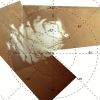
SouthPole-MG_SP_Fig02a_H.jpgThe South Pole of Mars (natural colors; credits: Lunexit)59 visiteCaption ESA:"This is a mosaic of images taken by the Mars Express’s Visible and Infrared Mineralogical Mapping Spectrometer, OMEGA.
It shows the Residual South Polar Cap at the end of Northern Winter on the Red Planet. The cap appears clearly asymmetric, its centre being displaced by 3° from the Geographic Pole".MareKromium
|
|

OPP-SOL0989-3D-2copia.jpgVictoria's Capes - Sol 989 (Hi-Def3-D - credits and Copyright: Dr G. Barca and Lunar Explorer Italia)59 visitenessun commentoMareKromium
|
|

ZO-Mercury-Flyby2_Messenger_big.jpgMercury as Revealed by MESSENGER (Enhanced Natural Colors; credits for the additional process. and color.: Dr Paolo C. Fienga/Lunar Explorer Italia/Italian Planetary Foundation)59 visiteCaption NASA:"The Planet Mercury has been known since history has been recorded, but parts of the Solar System's Innermost Planet have never been seen like this before. Two days ago the robotic MESSENGER Spacecraft buzzed past Mercury for the second time and imaged terrain mapped previously only by comparatively crude radar.
The above image was recorded as MESSENGER looked back 90 minutes after passing, from an altitude of about 27.000 Km. Visible in the above image, among many other newly imaged features, are unusually long rays that appear to run like meridians of longitude out from a young crater near the northern limb.
MESSENGER is scheduled to fly past Mercury once more before firing its thrusters to enter orbit in 2011".MareKromium
|
|
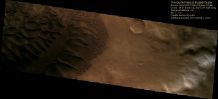
Craters-Russel_Crater-Dunefield-20080317a-PCF-LXTT.jpgDunefield inside Russel Crater (Absolute Natural Colors; credits for the additional process. and color.: Dr Paolo C. Fienga - Lunexit Team)59 visiteCaption NASA:"This beautiful Dunefield is located on the Floor of Russell Crater, in the Noachis Region of Mars".
MareKromium
|
|
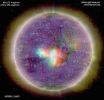
The_Sun-00.jpgThe Sun in 3D59 visitenessun commentoMareKromium
|
|

M-051.JPGM-51: The Whirlpool Galaxy (in Canes Venatici)59 visiteMareKromium
|
|
| 25353 immagini su 2113 pagina(e) |
 |
|
|
|
|
1307 | |
|
|
|
|





