| Piú viste |

as14-66-09335.JPGAS 14-66-9335 - Reflections and some Blue Flares59 visiteCaption NASA:"This frame was probably taken out Ed's window, a conclusion based on the relative azimuths of some small foreground rocks and the ALSEP instruments".MareKromium
|
|

OPP-SOL207-1N146560905EFF35B8P0643L0M1-2.jpgSunshine over Endurance59 visitenessun commentoMareKromium
|
|
![ZZ-ZZ-Horizon-2P161783721EFFA500P2664L4M1[1].jpg](albums/userpics/10060/small_ZZ-ZZ-Horizon-2P161783721EFFA500P2664L4M1%5B1%5D.jpg "Nome del file=ZZ-ZZ-Horizon-2P161783721EFFA500P2664L4M1[1].jpg
Dimensione del file=155KiB
Dimensioni=1600x1600
Aggiunta il=Ago 26, 2007")
ZZ-ZZ-Horizon-2P161783721EFFA500P2664L4M1[1].jpgMartian Day with high A.O. over Gusev (3) - (natural colors; Keith Laney and additional processing by Lunexit)59 visitenessun commentoMareKromium
|
|

ZZ-ZZ-Horizon-2P1271708-072648color.jpgMartian Day with high A.O. over Gusev (1) - (natural colors; Keith Laney and additional processing by Lunexit)59 visitenessun commentoMareKromium
|
|
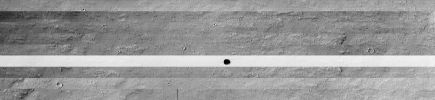
PSP_004847_1745-WFull.JPGThe "Martian Black Hole" (general context frame)59 visiteRingraziamo il Dr Gianluigi Barca per il lavoro svolto e per la pazienza avuta. Di che si tratta? Si tratta della ricostruzione, strip-by-strip, della Regione situata nei pressi del Grande Vulcano Arsia Mons laddove, come vedete bene, si trova il nostro "Martian Black Hole".
Come è facile notare, la striscia che comprende la voragine è stata processata (o ripresa?) in maniera tale da risultare, rispetto alle altre stripes che vanno a comporre l'interezza della Regione, completamente piallata e palesemente sovraesposta.
Il motivo (l'unico che ci viene in mente) potrebbe essere trovato nel tentativo di contrastare meglio quello che si vedeva "dentro" la voragine. Tuttavia, considerati i mezzi dei quali la NASA dispone, ci sentiamo pure di dire che quanto fatto NON è esattamente un "gran bel lavoro".
E allora?
E allora ribadiamo ed esplichiamo meglio quanto scritto in "Velvet Underground": o la NASA è in perfetta Buona Fede (però lavora - spesso - "in qualche modo"...), oppure la porzione di terreno che circonda la "voragine" è stata VOLUTAMENTE piallata, per motivi ignoti.
La Verità? Noi non la sappiamo, ma la nostra Coscienza e Professione ci spingono a proporre TUTTE le ipotesi che ci vengono in mente e che trovano una certa sostanza. Per il resto...dovete decidere Voi.MareKromium
|
|

Titan-Atmosphere-N00091073.jpgIn the Night of Titan - (possible natural colors; elab. Lunexit)59 visiteCaption NASA:"N00091073.jpg was taken on August 30, 2007 and received on Earth September 01, 2007. The camera was pointing toward TITAN that, at the time, was approx. 138.726 Km away, and the image was taken using the CL1 and UV3 filters. This image has not been validated or calibrated".MareKromium
|
|

Tethys-N00090940.jpgTethys (natural colors; elab. Lunexit)59 visiteCaption NASA:"N00090940.jpg was taken on August 29, 2007 and received on Earth August 30, 2007. The camera was pointing toward TETHYS that, at the time, was approx. 48.664 Km away, and the image was taken using the CL1 and CL2 filters. This image has not been validated or calibrated".MareKromium
|
|
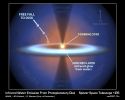
NGC-1333-PIA09966.jpgWater Vapor inside NGC 133359 visiteThis diagram illustrates the earliest journeys of water in a young, forming Star System. Stars are born out of icy cocoons of gas and dust. As the cocoon collapses under its own weight in an inside-out fashion, a stellar embryo forms at the center surrounded by a dense, dusty disk.
The stellar embryo "feeds" from the disk for a few million years, while material in the disk begins to clump together to form planets.
NASA's Spitzer Space Telescope was able to probe a crucial phase of this stellar evolution - a time when the cocoon is vigorously falling onto the pre-planetary disk. The infrared telescope detected water vapor as it smacks down on a disk circling a forming star called NGC 1333-IRAS 4B.
This vapor started out as ice in the outer envelope, but vaporized upon its arrival at the disk.
By analyzing the water in the system, astronomers were also able learn about other characteristics of the disk, such as its size, density and temperature.
How did Spitzer see the water vapor deep in the NGC 1333-IRAS 4B system?
This is most likely because the system is oriented in just the right way, such that its thicker disk is seen face-on from our Earthly perspective. In this "face-on" orientation, Spitzer can peer through a window carved by an outflow of material from the embryonic star. This system in this drawing is shown in the opposite "edge-on" configuration.MareKromium
|
|

Titan-N00091161.jpgTitan59 visiteCaption NASA:"N00091161.jpg was taken on September 02, 2007 and received on Earth September 03, 2007. The camera was pointing toward TITAN that, at the time, was approximately 1.313.086 Km away, and the image was taken using the CL1 and UV3 filters. This image has not been validated or calibrated".MareKromium
|
|
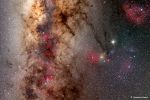
The_Scorpius.jpgThe Scorpius Region59 visite"...Nemo sibi tantummodo errat, sed alieni erroris et causa et auctor est..."
(Seneca)
"...Chi sbaglia, non sbaglia solo in suo danno poichè - sovente - egli è anche causa ed origine di errori altrui..." (trad. libera)MareKromium
|
|

Japetus-N00092235.jpgRough Terrain and Canyons of Japetus (possible natural colors - elab. Lunexit)59 visiteCaption NASA:"N00092235.jpg was taken on September 10, 2007 and received on Earth September 12, 2007. The camera was pointing toward Japetus that, at the time, was approximately 22.704 Km away, and the image was taken using the CL1 and CL2 filters. This image has not been validated or calibrated".MareKromium
|
|

Uranus-2007-01.jpgGoing, Going, Gone: Hubble captures Uranus's Rings on Edge (4)59 visitenessun commentoMareKromium
|
|
| 25353 immagini su 2113 pagina(e) |
 |
|
|
|
|
1305 | |
|
|
|
|





