| Piú viste |
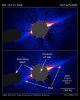
HD-15115.jpgLopsided debris disk around the young star HD 1511559 visiteThe disk, seen edge-on, is the dense blue line extending from the star to the upper right and lower left of the image. As seen from Earth, the edge-on disk resembles a needle sticking out from the star. The disk appears thicker and longer at upper right than at lower left, evidence of the disk's lopsided structure.
Astronomers think the disk's odd imbalanced look is caused by dust particles following a highly elliptical orbit around the star, which is slightly brighter than the Sun. The lopsidedness may have been caused by planets sweeping up debris in the disk or by the gravity of a nearby star.
Astronomers used an occulting mask on Hubble's Advanced Camera for Surveys to block out the bright starlight so they could see the dim disk. The occulting masks can be seen in the image as the dark circle in the center and the dark bar on the left. The star is behind the central mask.
HD 15115 is among nearly 30 stars that belong to the Beta Pictoris Moving Group. Moving groups are expanded clusters of stars believed to have a common birthplace and age, in this case about 12 million years, that are traveling together loosely through space. HD 15115 is 150 light-years from Earth.
Dusty disks are known to exist around at least 100 stars, but because of the difficulty in observing material close to the brightness of a star, less than a dozen have been studied closely.
Astronomers described the disk as one of the most peculiar debris disks that Hubble has ever imaged. They in fact made follow-up observations with the W.M. Keck Observatory in Hawaii to confirm the disk's presence.
Hubble's Advanced Camera for Surveys snapped the image on July 17, 2006.
MareKromium
|
|

Uranus-HST-PIA01283.jpgUranus' Rotation from HST59 visiteThese 3 NASA HST images of the planet Uranus reveal the motion of a pair of bright clouds in the Planet's Southern Hemisphere, and a high altitude haze that forms a "cap" above the Planet's South Pole.
Hubble's view was obtained on August 14, 1994, when Uranus was 1,7 BM (about 2,8 BKM) from Earth. These atmospheric details were only previously seen by the Voyager 2 spacecraft, which flew by Uranus in 1986. Since then, detailed observations of Uranus's atmospheric features have not been possible because the Planet is at the resolution limit of ground-based telescopes.
Hubble's Wide Field Planetary Camera 2 observed Uranus through a filter that is sensitive to light reflected by a pair of high altitude clouds. This makes a high altitude haze over Uranus' south polar region clearly visible, along with a pair of high altitude clouds or plume-type features that are 2500 and 1800 miles (4300 and 3100 kilometers) across, respectively. This sequence of images shows how the clouds (labeled A and B) rotate with the planet during the three hours that elapsed between the first two observations (left and center picture) and the five hours that elapsed between the second pair of observations (center and right picture). Some cloud motion might be due to high altitude winds on the planet. (Observations are indicated in Universal Time.)
By tracking the motion of high-altitude clouds, the new Hubble observations will allow astronomers to make new measurements of Uranus' rotation period. Based on the previous Voyager observations, Uranus spins on its axis at a faster rate than Earth does, completing one rotation every 7 hours, 14 minutes.
One of the four gas giant planets of our solar system, Uranus is largely featureless. Unlike Earth, Uranus' south pole points toward the Sun during part of the planet's 84-year orbit. Thanks to its high resolution and ability to make observations over many years, Hubble can follow seasonal changes in Uranus's atmosphere, which should be unusual given the planet's large tilt.
The Wide Field/Planetary Camera 2 was developed by the Jet Propulsion Laboratory and managed by the Goddard Spaced Flight Center for NASA's Office of Space Science.
MareKromium
|
|

Uranus-HST-PIA01282.jpgUranus from HST59 visiteThis NASA HST image of Uranus reveals the Planet's Rings and bright clouds and a high altitude haze above the Planet's South Pole.
Hubble's view was obtained on August 14, 1994, when Uranus was 1,7 BM (about 2,8 BKM) from Earth. These details, as imaged by the Wide Field Planetary Camera 2, were only previously seen by the Voyager 2 spacecraft, which flew by Uranus in 1986. Since then, none of these inner satellites has been further observed, and detailed observations of the Rings have not been possible.
Though Uranus' Rings were discovered indirectly in 1977 (through stellar occultation observations), they have never before been seen in visible light through a ground-based telescope.
Hubble resolves several of Uranus' Rings, including the outermost Epsilon-Ring. The Planet has a total of 11 concentric Rings of dark dust. Uranus is tipped such that its rotation axis lies in the plane of its orbit, so the Rings appear nearly face-on.
Three of Uranus' inner moons each appear as a string of three dots at the bottom of the picture. This is because the picture is a composite of three images, taken about six minutes apart, and then combined to show the moons' orbital motions. The satellites are, from left to right, Cressida, Juliet, and Portia. The moons move much more rapidly than our own Moon does as it moves around the Earth, so they noticeably change position over only a few minutes.
One of the four gas giant planets of our solar system, Uranus is largely featureless. HST does resolve a high altitude haze which appears as a bright "cap" above the planet's south pole, along with clouds at southern latitudes (similar structures were observed by Voyager). Unlike Earth, Uranus' south pole points toward the Sun during part of the planet's 84-year orbit. Thanks to its high resolution and ability to make observations over many years, Hubble can follow seasonal changes in Uranus's atmosphere, which should be unusual given the planet's large tilt.
The Wide Field/Planetary Camera 2 was developed by the Jet Propulsion Laboratory and managed by the Goddard Spaced Flight Center for NASA's Office of Space Science.
MareKromium
|
|

Dione-N00086879.jpgSpace Encounter: Dione and Prometheus (1)59 visitenessun commentoMareKromium
|
|
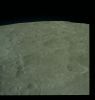
as17-153-23593.jpgAS 17-153-23593 - Lunar Horizon59 visiteImage Collection: 70mm Hasselblad
Mission: 17
Magazine: 153
Magazine Letter: MM
Revolution: 40
Latitude: 4,3° South
Longitude: 129,7° East
Lens Focal Length: 80 mm
Camera Altitude: 124 Km
Sun Elevation (on Local Horizon): 40°
Mission Activity: REV 40
Film Type: SO-368
Film Width: 70 mm
Film Color: colorMareKromium
|
|

as17-153-23589.jpgAS 17-153-23589 - Wallace Crater59 visiteImage Collection: 70mm Hasselblad
Mission: 17
Magazine: 153
Magazine Letter: MM
Revolution: 39
Latitude: 20,4° North
Longitude: 8,3° West
Lens Focal Length: 80 mm
Camera Altitude: 103 Km
Sun Elevation (on Local Horizon): 1°
Mission Activity: REV 39
Film Type: SO-368
Film Width: 70 mm
Film Color: colorMareKromium
|
|
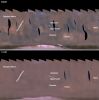
OPP-SOL1235-PIA-00936.jpgSeries of Storms Shrouds Mars in Dust (1) - NASA/JPL/Malin Space Science Systems59 visiteSince late June 2007, Mars has been having a series of regional dust storms. The dust raised by these individual storms has obscured most of the planet over the past few weeks. The two maps shown here are mosaics of images acquired by the Mars Reconnaissance Orbiter (MRO) Mars Color Imager (MARCI) on two days separated by about 3 and a half weeks. The first, on 22 June, shows that there was a dust storm occurring near the east end of the Valles Marineris trough system (left of the label for "Opportunity" in the map). This was the first in the series of storms. The second mosaic shows how Mars appeared on 17 July, after dust was lofted high into the atmosphere by several regional storms and countless smaller, local dust storms.
Each map was constructed from 13 pole-to-pole image swaths at red, green, and blue wavelengths acquired by the MRO MARCI. The maps are simple cylindrical projections, with north at the top and south at the bottom. Each image swath was acquired at about 3 p.m. local time on Mars over the course of 13 orbits. The black gaps occur in the MARCI data at places where the MRO spacecraft was slewed east or west to point its instruments at a specific target of scientific interest. The north polar region is not shown because winter began on 4 July and the north polar region is in wintertime darkness. Key features labeled on the maps include the Tharsis Montes and Olympus Mons volcanoes, the Hellas impact basin, Noachis Terra, Sinus Meridiani, and the two Mars Exploration Rover (MER) landing sites, Opportunity and Spirit. The dust storms, and the planet-encircling dust veil they generated, has greatly reduced the amount of sunlight available to run the two solar-powered rovers.
MareKromium
|
|
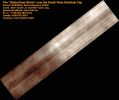
PSP_004353_0935_RED_browse.jpgThe "Global Dust Storm" over the South Polar Residual Cap59 visiteA dust storm has been raging on Mars, hampering the ability of the HiRISE team to carry out a seasonal monitoring campaign.
An area of the Southern Seasonal Polar Cap was selected in December 2006 for repeated imaging, to observe the sublimation (evaporation) of the seasonal Carbon Dioxide Polar Cap through Southern Spring.
Images collected as the season progressed show channels carved by escaping gas and fans of dust blown by the wind. This campaign has been stymied however by the arrival of a Martian dust storm. In this image the surface is completely obscured by the dust in the air.MareKromium
|
|

A-Phoenix-003A.jpgThe Road to Mars59 visitenessun commentoMareKromium
|
|

North_Polar_Features-Dunes-MGS-09.jpgNorth Polar Dunes (Natural Colors; credits for the additional process. and color.: Dr Paolo C. Fienga - Lunexit Team)59 visiteCaption NASA:"What causes the black dots on dunes on Mars? As spring dawned on the Northern Hemisphere of Mars in 2004, dunes of sand near the Poles begin to defrost. Thinner regions of ice typically thaw first revealing sand whose darkness soaks in sunlight and accelerates the thaw.
The process might involve sandy jets exploding through the thinning ice. By Summer, the spots expanded to encompass the entire dunes that were then completely thawed and dark. The carbon dioxide and water ice actually sublime in the thin atmosphere directly to gas. Taken in mid-July, the above image shows a field of spotted polar dunes spanning about 3 Km near the Martian North Pole.
Today, the future of Mars Rovers Spirit and Opportunity remains unknown windy dust storms continue to starve them of needed sunlight".MareKromium
|
|

NGC-6960-1.jpgNGC 6960 - The "Veil Nebula"59 visite"...We look not at what can be seen, but at what cannot be seen: for what can be seen is temporary, but what cannot be seen is eternal..."
- 2, Corinthians, 4:18MareKromium
|
|

North_Polar_Features-Dunes-MGS-08.jpgNorth Polar Dunes (Natural Colors; credits for the additional process. and color.: Dr Paolo C. Fienga - Lunexit Team)59 visiteCaption NASA originale:"This MGS-MOC image shows dunes in the Martian North Polar Region. The dunes are composed of dark, coarse (--> ruvido, di tessitura grossolana) sand. The white areas around the dunes are the last remaining areas of seasonal CO2 frost cover.
The solid CO2 accumulates during the Autumn and Winter and sublimes (goes from solid to gas) away in the Spring.
This image was taken near the end of the Northern Spring".
Location near: 78,0° North; 244,5° West
Image width: ~3 Km (~1,9 mi)
Illumination from: lower left
Season: Northern SpringMareKromium
|
|
| 25353 immagini su 2113 pagina(e) |
 |
|
|
|
|
1303 | |
|
|
|
|





