| Piú viste |

014-vg2_p24368.jpgSaturn59 visitenessun commento
|
|

024-vg2_4391335-4.jpgAnomalies near Japetus (Objects "B" and "C" - detail mgnf)59 visitenessun commento
|
|

039-vg1_3493040.jpgMimas (Herschel Crater) and other controversial features59 visiteIncommentabile...
|
|

Helene-PIA08269.jpgMoments of "Helene"59 visiteCaption NASA originale:"This set of images exposes details on small and crumpled-looking Helene. Large portions of this Trojan moon of Dione appear to have been blasted away by impacts.
Cassini passed within 50.000 Km (about 31,000 miles) of Helene (which is about 32 Km - or 20 miles across) on Aug. 17, 2006, when these images were acquired.
The views were obtained over the course of an hour and are presented here in reverse order (i.e.: the leftmost image was taken latest).
The images were taken in visible light with the Cassini spacecraft narrow-angle camera. As presented here, the views were acquired at distances ranging from about 62.000 to 51.000 Km (such as about 39.000 to 32.000 miles) from Helene and at a Sun-Helene-spacecraft, or phase, angle of 111 to 120°. Image scale is roughly 375 to 300 meters (approx. 1.230 to 984 feet) per pixel, from left to right".
|
|
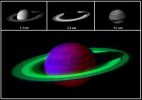
Saturn-PIA08735.jpgThree, for one and the same: Saturn, in infrared light59 visiteCaption NASA:"This false-color image of Saturn was constructed by combining 3 images at 3 different infrared wavelengths.
The image at the upper left was taken at 1,3 microns, where both Saturn and its Rings strongly reflect light. The center image in the top panel was taken at 2,4 microns, where the Rings strongly reflect light, but Saturn, because of the methane in its atmosphere, absorbs most of the light. The third image on the right in the panel was taken at a wavelength of 5 microns where, because they are composed of almost pure water ice, the Rings absorb almost all the light, and Saturn, because its interior is warm, glows. Assigning each of the three images to blue, green and red, respectively, results in the beautiful, false-color, composite image shown here.
These images were taken on June 21, 2004, with Cassini's VIMS (Visual and Infrared Mapping Spectrometer) from a distance of approx. 6,35 MKM (about 3,94 MMs) from Saturn".
|
|

LLM-Itokawa.jpg25143-Itokawa59 visiteA Japanese spacecraft has provided one of the best arguments yet in favor of a conception of asteroids which was pioneered by PSI (Planet Science Institute) scientists Don Davis and Clark Chapman in the late 70's. The evidence comes in startling closeup pictures of the tiny asteroid 25143-Itokawa, photographed by the Japanese Hayabusa spacecraft during a two-month encounter in late 2005. The asteroid illustrates the concept of a "Rubble-Pile" asteroid, which is composed of a mixture of boulders and dust gravitationally bound together.
The scientific results, recently highlighted in the journal Science, show that, unlike other asteroids recently imaged by spacecraft, which are mostly rounded and potato-like, dotted by craters, and with a few scattered boulders on the surface, Itokawa appears to be composed of massive splinter-like boulders protruding from a matrix of smaller fragments.
The largest boulders sticking out of the body appear to be some tens of meters across.
The Hayabusa science team includes PSI scientists Paul Abell and Bob Gaskell, and PSI affiliate scientists Hirdy Miyamoto and Faith Vilas.
|
|
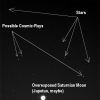
Saturn-W00017983.jpgWhat do these images show? (1)59 visitenessun commento
|
|

Saturn-W00017998.jpgWhat do some images show? (3)59 visitenessun commento
|
|
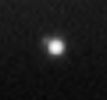
Earth-PIA08324-2.jpgEarth, from Saturn's Space (2)59 visiteThis magnified view of the image taken through the clear filter (monochrome) shows the Moon as a dim protrusion to the upper left of Earth. Seen from the Outer Solar System through Cassini's cameras, the entire expanse of direct human experience, so far, is nothing more than a few pixels across. Earth no longer holds the distinction of being our Solar System's only "water world", as several other bodies suggest the possibility that they too harbor liquid water beneath their surfaces. The Saturnian moon, Enceladus, is among them, and is also captured on the left in this image, with its plume of water ice particles and swathed in the blue E-Ring which it creates. Delicate fingers of material extend from the active moon into the E-Ring. The narrow and tenuous G-Ring and the Main Rings are seen at the right. The view looks down from about 15° above the un-illuminated side of the Rings.
Images taken using red, green and blue spectral filters were combined to create this view. The image was taken by the Cassini spacecraft wide-angle camera on Sept. 15, 2006, at a distance of approx. 2,1 MKM (about 1,3 MMs) from Saturn and at a sun-Saturn-spacecraft angle of almost 179°.
Image scale is roughly 129 Km (about 80 miles) per pixel.
At this time, Cassini was nearly 1,5 BKM (about 930 MMs) from Earth.
|
|
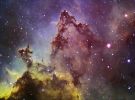
IC-1805-3.jpgIC 1805 (alias "The Heart Nebula")59 visite"...Sat est disertus e quo loquitur Veritas..."
(P. Siro)
"...Colui che dice la Verità (lett. "per il quale parla la Verità") è sufficientemente eloquente..."
|
|

Aeolian_Features-Yardangs-Terra_Sabaea-MGS-00.jpgYardangs in Terra Sabaea (1 - Original NASA/MGS/MSSS b/w Frame)59 visiteCaption NASA originale:"This MGS-MOC image shows the contact between a group of Yardangs, tapered Ridges formed by the removal of relatively easily-eroded material (e.g.: Sedimentary Rock) and a concentration of dark-toned windblown Sand on the Floor of an Unnamed Crater in the Terra Sabaea Region of Mars".
Location near: 1,4° North Lat. and 333,9° West Long.
Image width: ~3 Km (~1,9 mi)
Illumination from: upper left
Season: Northern Spring
|
|

Aeolian_Features-Yardangs-Terra_Sabaea-MGS-02.jpgYardangs in Terra Sabaea (3 - Original NASA/MGS/MSSS b/w Frame)59 visiteLocation near: 1,4° North Lat. and 333,9° West Long.
Image width: ~3 Km (~1,9 mi)
Illumination from: upper left
Season: Northern Spring
|
|
| 25353 immagini su 2113 pagina(e) |
 |
|
|
|
|
1299 | |
|
|
|
|





