| Piú viste |

OPP-SOL662-1F186870243ESF64KCP1157L0M1~0.jpgWonderful Paving... (8) - Sol 66259 visiteOpportunity's commands for Sol 654 (Nov. 25, 2005) included unstowing the RA (Robotic Arm) to begin using the tools on it for examining the layered outcrop that the Rover had driven to 3 Soles earlier. The RA is always stowed during drives. This time, a shoulder-joint motor that is needed for unstowing the RA stalled, and the RA stayed stowed. In subsequent Soles, engineers worked to narrow the range of possibilities for the cause of the stall. Among the remaining possibilities is that, after working more than seven times longer than originally planned, the lubrication is degrading. One possible fix would be to increase the duration of the allowed motor start-up, to overcome the increased initial friction. The first diagnostic activity for the RA was performed Sol 659, where a very small motion was recorded. Future diagnostic activities and continuing analysis will be performed to further characterize the shoulder-joint motor in upcoming Soles.
|
|

Saturn-PIA07646.jpgThe limb of Saturn59 visiteOriginal caption:"This brooding portrait shows the South-Western limb of the cold gas giant and the thread-like cloud features lurking there. The limb appears smooth, but at the terminator (such as the boundary between light and dark) and at higher resolution, variations in cloud height can cause shadows that are visible to Cassini.
The image was taken in visible, red light with the Cassini spacecraft wide-angle camera on Oct. 30, 2005, at a distance of approx. 401.000 Km(such as about 249.000 miles) from Saturn and at a phase angle of 155°. Image scale is 20 Km (13 miles) per pixel. The image was contrast enhanced to improve visibility of features in the atmosphere".
|
|

Rings-PIA07654.jpgCrescent Enceladus and Crescent Rings59 visiteSunlight reflects off the bright, frozen surfaces of the billions and billions of particles comprising Saturn's Rings to brighten the Planet's Southern Skies.
The particles in Saturn's Rings are each too small to be seen by Cassini in this image but, if they could, each would look like the bright reflective crescent of Enceladus seen here, with each reflecting sunlight onto the Southern Hemisphere of the Planet.
The image was taken in polarized infrared light with Cassini's wide-angle camera on Nov. 2, 2005, at a distance of approx. 1,7 MKM (1,1 MMs) from Saturn and at a phase angle of 119°. The image scale is roughly 104 Km (about 65 miles) per pixel.
|
|

Meridiani_Planum_Region-PIA03650~0.jpgUnusual Landform in Meridiani Planum (Original NASA/MGS/MSSS b/w Frame)59 visiteOriginal caption:"This MGS-MOC image shows exposures of light-toned, layered, Sedimentary Rock among dark-surfaced plains in Northern Sinus Meridiani. The circular feature in the South-East (lower right) corner of the image is a wedding-cake-like tower of Sedimentary Rocks".
Location near: 2,9° North Lat. and 359,9° West Long.
Image width: width: ~3 Km (~1,9 mi)
Illumination from: lower left
Season: Northern Winter
Nota: una "torre", piuttosto regolare nelle forme e presumibilmente costituita da rocce sedimentarie stratificate ed erose dal vento (e se ci pensate solo un attimo non Vi sarà difficile realizzare quanto rara possa essere una simile configurazione) viene liquidata come "torre-tipo-torta-matrimoniale". Non fraintendeteci: lo sappiamo che la banalizzazione fa parte del più recente stile NASA ma, alle volte, dopo gli assurdi nomi dati alle rocce Marziane, dopo la Hamburger-Nebula e dopo la torre a torta, ci domandiamo quali sìano mai le reali idee ed impressioni dei Signori che si occupano di questa Materia.
|
|
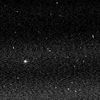
SOL692-2P187755470ESFAJ2EP2736L6M1.jpgMartian Night, Earth and Moon?!? (2)59 visiteOriginal caption:"Left Pan-Cam Non-linearized Sub-frame EDR acquired on Sol 692 of Spirit's mission to Gusev Crater at approximately 00:33:36 MLT.
Camera commanded to use Filter 6 (482 nm)".
|
|

Titan-PIA07774.jpgCrescent Titan59 visiteWith its thick, distended atmosphere, Titan's orange globe shines softly, encircled by a thin halo of purple light-scattering haze. Images taken using blue, green and red spectral filters were used to create this enhanced-color view; the color images were combined with an ultraviolet view that makes the high-altitude, detached layer of haze visible.
The ultraviolet part of the composite image was given a purplish hue to match the bluish-purple color of the upper atmospheric haze seen in visible light.
Small particles that populate high hazes in Titan's atmosphere scatter short wavelengths more efficiently than longer visible or infrared wavelengths, so the best possible observations of the detached layer are made in ultraviolet light.
The images in this view were taken by the Cassini narrow-angle camera on May 5, 2005, at a distance of approx. 1,4 MKM (about 900.000 miles) from Titan and at a phase angle of 137°.
Image scale is 8 Km (5 miles) per pixel.
|
|
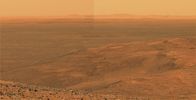
SOL595-MarsPanorama-PIA03252-2.jpgHorizon... - Sol 59559 visiteOriginal caption:(...) This is an approximately true-color rendering generated using the camera's 750-, 530- and 430-nanometer filters".
Note: un'ennesima visione di Marte, area Gusev Crater, ottenuta in colori approssimativamente veri che NON va d'accordo con altre "n" visioni di Marte ottenute (a detta della NASA) in colori approssimativamente veri.
Ok: diremmo che a questo punto dovrebbe essere chiaro proprio a tutti che qualcosa non va...negli occhi o nei sofisticati meccanismi dei Tecnici dell'Immagine.
|
|

Janus-N00047102.jpgJanus and...?59 visiteOriginal caption:"N00047102.jpg was taken on December 23, 2005 and received on Earth December 23, 2005. The camera was pointing toward JANUS that, at the time, was approximately 1.111.348 Km away.
The image was taken using the CL1 and CL2 filters".
|
|

Hyperion-N00047027.jpgHyperion? (1)59 visiteOriginal caption:"N00047027.jpg was taken on December 23, 2005 and received on Earth December 23, 2005. The camera was pointing toward HYPERION that, at the time, was approx. 227.969 Km away.
The image was taken using the CL1 and CL2 filters".
Saranno scherzi della luce, dell'angolo di fase (o di quello di ripresa), della distanza...Chissà. L'unica cosa che a noi sembra evidente è che Hyperion, in questo frame (e nel successivo) non assomiglia per nulla al corpo celeste che avevamo già visto in passato ed ammirato durante l'ultimo fly-by di Cassini.
Diremmo che assomiglia ad Epimetheus e, comunque, ricorderete anche Voi un altro "face-change" che rilevammo qualche mese fa analizzando alcune immagini MGS di Phobos (un "cambio-faccia" del quale Vi abbiamo già parlato in passato, nella Sezione "Mars and His Moons").
Le possibili cause di questi (apparenti?) "cambi-faccia"? Ripetiamo: la luce, l'angolo di ripresa, l'angolo di fase...senza dimenticare le "sviste": nostre e non solo!
|
|

Hyperion-N00047056.jpgHyperion? (2)59 visiteOriginal caption:"N00047056.jpg was taken on December 23, 2005 and received on Earth December 23, 2005. The camera was pointing toward HYPERION that, at the time, was approximately 235.195 Km away.
The image was taken using the CL1 and CL2 filters".
|
|
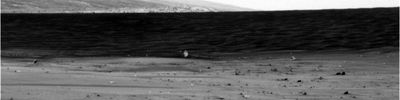
SOL699-2P188412824ESFAKFFP2589R2M1.jpgDark horizon (1) - Sol 69959 visiteUna serie di frames (ne proponiamo 2) davvero strani: non crediamo che l'ombra nera che copre un'abbondante porzione del paesaggio sia un photo-artifact, nè la risultante di un qualche errore nella trasmissione dei dati relativi all'immagine. Sembrerebbe più un improvviso oscurarsi di una porzione del suolo a seguito - magari - di qualche grande nuvola che copre il Sole o, più probabilmente, l'ombra di una eclissi che transita accanto all'area su cui si trova Spirit, ma senza arrivare a coprire Spirit (per maggiori informazioni sulle eclissi marziane - davvero molto diverse dalle eclissi terrestri - Vi suggeriamo di andare a rivedere un frame Viking 1 molto famoso - nella Sez. "Mariner, Viking & MGS's Maps & Mars in the '70s", frame 23 - e quindi rileggere la caption originale).
Caption originale:"Right Pan-Cam Non-linearized Sub-frame EDR acquired on Sol 699 of Spirit's mission to Gusev Crater at approx. 10:17:27 MLT.
Camera commanded to use Filter 2 (754 nm)".
|
|

Rhea-N00047136.jpgRhea59 visiteOriginal caption:"N00047136.jpg was taken on December 23, 2005 and received on Earth December 24, 2005. The camera was pointing toward RHEA that, at the time, was approximately 283.082 Km away.
The image was taken using the CL1 and IR3 filters".
|
|
| 25353 immagini su 2113 pagina(e) |
 |
|
|
|
|
1298 | |
|
|
|
|





