| Piú viste |
OPP-SOL620-1P183223114EFF63DGP2405L2M1.jpgErebus' edge (2) - Sol 62059 visitenessun commento
|
|
OPP-SOL622-1P183405125EDN63IRP2277L1M1.jpgPostcards from Erebus Crater (6) - Sol 62259 visitenessun commento
|
|

Triton-PEI.jpgMoments of Triton...59 visiteThis set of images shows the best views of Neptune's moon Triton taken by Voyager 2 as the spacecraft withdrew from the Neptune system on August 25, 1989. The top four images were constructed from various color image bands as Voyager receded from Triton.
The third image from the left is sharper than the other four, because it was taken with the Narrow Angle Camera, with Triton filling two thirds of the frame. The thin crescent first image, while much closer, spanned about a quarter of the frame. The second image was somewhat smaller, and the last was very small. The first of the four images was composed of Blue, Green, and Orange filter images. The second utilized Violet, Green, and Orange Filtered images. In both composites, the Orange image was of poorer quality. In the fourth image, no orange was available, and the green and blue images were badly smeared, though somewhat salvageable. A clear filtered image (also smeared) was substituted for orange. They were combined and used as a color overlay for a slightly overexposed, but sharp clear filtered view. The third image is composed of a Violet and a Green wide-angle image. Like all the images in the first and second composites, and like the images used to color the fourth composite, these images were underexposed. However, they were very sharp. The orange image came from a poor quality wide angle orange image. The resulting color image was combined with a well exposed clear filter image to provide the detail
The Narrow Angle images used in these mosaics were the first obtained after closest approach, with the exception of a single clear filter image obtained while the disk was about twice as big as what could be framed in the camera's field of view. It is very noisy, and by far the worst underexposure of them all, and could not be processed to the point in which the whole image could be made presentable. However, a few sections were salvaged. The first (lower left) was binned to make up for noisiness and sharpened. It was then merged with the color data from the third image above. A cloud can be seen near the limb. To its right is an image of the cloud that has not been as heavily processed. The cloud itself is better presented, as it was far brighter than the surrounding area and hence more securely detected. Its shadow can be faintly made out to its right.
The next two images are the same, but one to the right was merged with color data. The image is towards the center of the crescent, the brightest area, in which white spots can be seen. Although a few of them may be impact craters, this area, as most of the crescent, is over the south polar cap, and thus frost covered, and the appearance of this area most closely resembles the cantaloupe terrain seen on the other hemisphere before closest approach. The final image (lower right) hints of surface topography near the terminator. It seems it is one of the more rugged parts of Triton. The large, foreshortened circular feature slightly below the center of the image is a dimple similar those found in the cantaloupe terrain. The other features are too ambiguous to determine whether or not they are of the same nature.
|
|

Saturn-W00011753.jpgSaturn's limb59 visiteOriginal caption:"W00011753.jpg was taken on October 30, 2005 and received on Earth October 30, 2005. The camera was pointing toward SATURN at approximately 345.545 Km away, and the image was taken using the CL1 and BL1 filters. This image has not been validated or calibrated".
|
|

Titan-Dunes_and_Ridges-PIA03566.jpgPossible Tectonic fractures on Titan59 visiteOriginal caption:"This synthetic aperture radar image of Titan was taken on Oct. 28, 2005, as the Cassini spacecraft flew by at a distance of 1.350 Km (about 840 miles). This was the first pass dedicated to radar and it was the fourth time Cassini's radar honed in on the smoggy moon.
The bright, curving features are high-standing ridges, poking up above the plains of Titan. Some of the ridges extend for over 100 Km (roughly 60 miles). They are likely to be tectonic in origin, formed by deformation of Titan's icy crust. The low-lying terrain between the ridges is covered in dark streaks, which could be dunes formed by wind. The streaks, spaced 1 to 2 Km apart (0,6 to 1 mile), curve between patches of the bright terrain, which probably act as topographic barriers.
This image is 400 Km (about 250 miles) across and 275 Km-wide (about 170 miles). It is located 8° South Latitude and 215° West Longitude".
|
|

Japetus-W00012022.jpgIs this Japetus?!?59 visiteOriginal caption:"W00012022.jpg was taken on November 03, 2005 and received on Earth November 05, 2005. The camera was pointing toward IAPETUS at approximately 1.624.627 Km away, and the image was taken using the CL1 and CL2 filters. This image has not been validated or calibrated".
|
|

SOL653-2P184338232EFFAIBMP2298R2M1.jpgOn the way down: Mars-scape (4) - Sol 65359 visitenessun commento
|
|

Dione&Co.-PIA07628.jpgDione, Tethys and Pandora59 visiteOriginal caption:"This excellent grouping of 3 moons - Dione, Tethys and Pandora - near the Rings, provides a sampling of the diversity of worlds that exists in Saturn's Realm. A 330-Km-wide (about 205 miles) impact basin can be seen near the bottom right on Dione (at left). Ithaca Chasma and the Region imaged during the Cassini spacecraft¿s Sept. 24, 2005, flyby can be seen on Tethys (middle). Little Pandora makes a good showing here as well, displaying a hint of surface detail. Tethys is on the far side of the Rings in this view; Dione and Pandora are much nearer to the Cassini spacecraft.
Rememeber that Dione is approx. 1.126 Km (about 700 miles) across. Tethys is approx. 1.071 Km (about 665 miles) across and Pandora is 84 Km (roughly 52 miles) across.
This image was taken in visible blue light with the Cassini spacecraft narrow-angle camera on Sept. 22, 2005, at a distance of approx. 1,2 MKM (about 800.000 miles) from Saturn. The image scale is about 5 Km (approx. 3 miles) per pixel on Dione and Pandora and 9 kilometers (6 miles) per pixel on Tethys".
|
|

Chaotic_Terrain-Jani_Chaos-PIA03200.jpgFeatures of Iani Chaos (Original NASA/2001 Mars Odyssey Orbiter b/w Frame)59 visitePiccolo promemoria: quando si parla di "chaos terrain", si tratta di un'area che è stata - letteralmente - privata di sostegno sotterraneo e che quindi è "crollata su se stessa" (---> "Chaos" is typically interpreted to be a collapse terrain; it is the blocky landscape after the transport and removal of subsurface support).
|
|
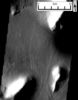
Islands.jpgThe Islands of Mars (Original NASA-2001 Mars Odyssey Orbiter b/w Frame)59 visiteNew HR images of mid-latitude Mars are revealing glacier-formed landscapes far from the Martian Poles, says a leading Mars Researcher.
Conspicuous trains of debris in valleys, arcs of debris on steep slopes and other features far from the polar ice caps bear striking similarities to glacial landscapes of Earth, says Brown University's James Head III. When combined with the latest climate models and orbital calculation for Mars, the geological features make a compelling case for Mars having ongoing climate shifts that allow ice to leave the poles and accumulate at lower latitudes.
"The exciting thing is a real convergence of these things, said Head, who will present the latest Mars climate discoveries on Sunday, 16 October, at the Annual Meeting of the Geological Society of America in Salt Lake City (Utah). "For decades people have been saying that deposits at mid and equatorial latitudes look like they are ice-created, said Head. But without better images, elevation data and some way of explaining it, ice outside of Mars' polar regions was a hard sell.
Now high-resolution images from the Mars Odyssey spacecraft's Thermal Emission Imaging System combined with images from the Mars Global Surveyor spacecraft's Mars Orbiter Camera and Mars Orbiter Laser Altimeter can be compared directly with glacier features in mountain and polar regions of Earth. The likenesses are hard to ignore.
For instance, consider what Head calls "lineated valley fill." These are lines of debris on valley floors that run downhill and parallel to the valley walls, as if they mark some sort of past flow. The same sorts of lines of debris are seen in aerial images of Earth glaciers. The difference is that on Mars the water ice sublimes away (goes directly from solid ice to gas, without any liquid phase between) and leaves the debris lines intact. On Earth the lines of debris are usually washed away as a glacier melts.
|
|

Itokawa-07.jpgOrbiting around Itokawa (4)59 visiteThe deep-space exploration technologies that the Top World's Space Agencies are pursuing consist of 3 major elements:
1) high efficiency electric propulsion for cruise;
2) rendez-vous with target destinations and
3) round-trip flights back to the Earth.
As of this time Hayabusa has accomplished the first and second of these elements, leading the way for the Space Exploration Agencies of the World.
Furthermore, robotic sample collection and return from an extra terrestrial object has not been executed before, and is not currently planned, except for Hayabusa, which will attempt to gather a bulk sample from Itokawa.
Hayabusa’s success clearly shows that Japan’s deep space exploration technology has reached the level of the World’s most developed Space Agencies, and that Japan is now in a Leadership Position in some select engineering fields.
Thus Hayabusa opens a New Era in the exploration of the Solar System.
|
|

Itokawa-09.jpgSurface details (2)59 visiteA) Morphological and geological discoveries about Itokawa: the a-priori theoretical assumption that small near-Earth asteroids should have geologically homogeneous features was completely overturned by the observation of a wide variety of surface features and types at Itokawa. The surface is covered with huge boulders and, for the first time, naked surfaces not covered with regolith have been exposed. Previously visited asteroidswere covered with thick regolith, thus Itokawa’s surface is like nothing that has seen before, which is quite fortunate for the Hayabusa Mission. The opportunity to observe the true asteroid surface, which isusually concealed from view, advancesour understanding of spectroscopic observations of asteroids taken from Earth, and allows us to expand our knowledge of near Earth asteroids.
|
|
| 25353 immagini su 2113 pagina(e) |
 |
|
|
|
|
1296 | |
|
|
|
|





