| Piú viste |
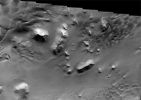
Juventae_Chasma-PIA08444-2.jpgUnusually-looking Landforms in Juventae Chasma (Original NASA-2001 Mars Odyssey Orbiter b/w Frame)59 visiteImage information: VIS instrument;
Latitude: 3,9° South;
Longitude: 299,2° East;
Resolution: 18 meter/pixel.
|
|

Japetus-PIA08164.jpgThe unusual colors of Japetus59 visiteThese two views of Iapetus primarily show terrain in the Southern part of the moon's dark Leading Hemisphere - the side of Iapetus that is coated with dark material. The bright South Pole of Iapetus is visible, along with some terrain (at the bottom) that lies on the bright Trailing Hemisphere.
The dark terrain known as Cassini Regio is uniformly dark between the equator and about 30° South Lat. From there down to about 50 to 60° South Lat., the dark material looks "patchy" because south-facing crater walls are bright (being largely devoid of the dark material). South of this Region, only some northward-facing crater walls are still dark, while the bright terrain has a somewhat reddish color.
Beyond 90° South, the reddish color becomes white. The Region at the bottom of the color view presented here shows this "color boundary" in the bright terrain, which also marks the boundary between the Leading and Trailing Hemispheres.
The monochrome image on the left was taken using a filter sensitive to wavelengths of infrared light centered at 930 nanometers. The image was obtained with the Cassini spacecraft narrow-angle camera on April 8, 2006, at a distance of approximately 866,000 kilometers (538,000 miles) from Iapetus and at a Sun-Iapetus-spacecraft, or phase, angle of 88 degrees. The image scale is 5 kilometers (3 miles) per pixel.
The color view on the right was created by combining images taken in ultraviolet, green and infrared spectral filters. The images were acquired with the Cassini spacecraft narrow-angle camera on April 9, 2006, at a distance of approximately 692,000 kilometers (430,000 miles) from Iapetus and at a Sun-Iapetus-spacecraft, or phase, angle of 101 degrees. The image scale is 4 kilometers (2.5 miles) per pixel.
|
|

Earth-N00061732-detmgnf.jpgEarth and Moon...maybe? (2)59 visitedettaglio del frame precedente
|
|
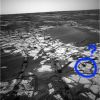
OPP-SOL829-1N201780773EFF71A3P1605L0M1.jpgSands and Outcrops (3) - Sol 82959 visiteCerchiatura Blu: allorchè un tassello dei Pavimenti Marziani di Meridiani Planum palesa una forma circolare e (quasi) regolare ci si trova, a nostro parere, davanti ad un dettaglio di un certo interesse. Come sapete, noi non riteniamo - a differenza di altri Ricercatori - che i Martian Pavings costituiscano un opera "artificiale"; tuttavia dei particolari di questo tipo non possono non affascinare e lasciare - quantomeno - perplessi.
|
|
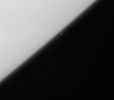
Rigel-PIA08187.jpgRising Rigel, from Cassini59 visiteCaption NASA originale:"The brilliant supergiant star, Rigel, emerges from behind the haze of Saturn's upper atmosphere in this Cassini view.
Rigel in is one of the 10 brightest stars in Earth's sky and forms the left foot (sometimes referred to as the left knee) of the familiar constellation Orion.
Imaging scientists use views like these to probe the vertical structure of haze in Saturn's upper atmosphere. The dimming of the star at each altitude in the atmosphere yields information on the density of the haze at that location.
The image was taken in visible green light with the Cassini spacecraft narrow-angle camera on April 28, 2006 at a distance of approx. 663.000 Km (about 412.000 miles) from Saturn. Image scale is roughly 4 Km (such as about 2 miles) per pixel".
|
|
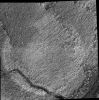
OPP-SOL819-PIA08499.jpgCheyenne - Sol 81959 visiteCaption originale:"As NASA's MER Opportunity is traversing southward toward Victoria Crater, it is periodically stopping to characterize exposed bedrock, using the contact instrument suite on the RA.
Between Soles 818 and 821 of the mission (such as from May 13 up to May 16), one such characterization was carried out on a rock target called Cheyenne. The target was brushed by the RAT, analyzed by the Alpha Particle X-ray Spectrometer and Moessbauer Spectrometer and photographed by the MI.
This image is a mosaic of 4 frames taken by the MI after the brush had removed dust and sand grains from most of the area shown, exposing the underlying bedrock. The resolution is 30 microns per pixel and the entire mosaic is 6 cm (about 2,4") square. Opportunity acquired the images on Sol 819 (May 14, 2006) while the target was fully shadowed.
This rock surface exhibits relatively small spherical concretions compared to those observed in the vicinity of "Eagle Crater" and "Endurance Crater." Such small concretions, and in places apparent absence of concretions, have characterized the outcrops south of "Vostok Crater." Also visible in this image are small pits and grooves in the rock surface, including narrow, elongated void spaces different from any previously observed by Opportunity. Crystal-shaped and elongated void spaces that were seen in the vicinity of Eagle and Endurance Craters are interpreted as spaces left by dissolving of soluble salts. However, these features at Cheyenne have a significantly different appearance and the science team is considering a number of alternative hypotheses for their origin.
|
|
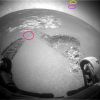
OPP-SOL840-1F202759290EFF71HQP1204R0M1.jpgPhotoartifact and UFO (1) - Sol 84059 visiteCaption NASA originale:"Right Front HazCam Non-linearized Full frame EDR acquired on Sol 840 of Opportunity's mission to Meridiani Planum at approximately 13:35:24 MLT".
Dal sempre ottimo "occhio" del Dr Gianluigi Barca:
Cerchiatura Gialla: photoartifact ricorrente
Cerchiatura Fucsia (in cielo): oggetto reale
Cerchiatura Fucsia (nei pressi del Rover): pebble (ciottolo luccicante, forse perchè piatto e liscio - e quindi capace di riflettere bene la luce del Sole - o forse perchè ricco di micro-cristalli).
|
|

Aeolian_Features-Windstreak-MGS.JPGWindstreak in Cyane Fossae59 visiteCaption NASA originale:"This MGS-MOC image shows a light-toned wind streak created in the lee — such as the downwind side — of an impact crater in the Cyane Fossae Region of Mars. Winds blowing from the bottom (South) toward the top (North) swept this scene clean of fine, bright dust except for the dust that had accumulated in a few protected areas such as that in the lee of this crater".
Location near: 42,0° North; 125,8° West
Image width: ~3 Km (~1,9 mi)
Illumination from: lower left
Season: Northern Spring
|
|

SOL863-2P202978875EFFAS00P2260L2M1.jpgDisturbed soil near the "Winter Haven" (3) - Sol 86359 visitenessun commento
|
|

Titan_and_Rhea-N00062452.jpgObscuring the Sun...59 visiteCaption originale:"N00062452.jpg was taken on June 11, 2006 and received on Earth June 12, 2006. The camera was pointing toward Rhea that, at the time, was approximately 3.619.486 Km away.
The image was taken using the CL1 and CL2 filters".
|
|
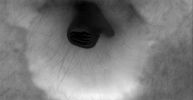
Craters-Unnamed_Southern_Crater-PIA08541-00.jpgUnnamed Southern Crater with possible surfacing Hydrocarbons (Original NASA/2001 Mars Odyssey Orbiter b/w Frame)59 visiteImage information: VIS instrument;
Latitude: - 68,1° North;
Longitude: 175,6° East;
Resolution: 17 meter/pixel.
Nota: quello che la NASA chiama "Mitten-like Dune Field" (e cioè un'area ricoperta di dune avente l'apparenza - forma - di un guanto) ci sembra, in realtà ed una volta effettuata un'analisi un pò più particolareggiata di questa immagine, una sorta di "palude".
Non ci è ovviamemte possibile essere definitivi, ma la "sensazione" che sul fondo di questo cratere - posto ad una medio-alta latitudine Sud - vi sia una sorta di "denso liquame scuro" (un giacimento di idrocarburi affioranti, magari? O un "laghetto" di Metano?...) è molto forte e precisa.
|
|
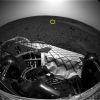
SOL011-2F127354635EFF0234P1003L0M1.jpgLittle Spark... (1) - Sol 1159 visiteDai frames meno "taroccati" della Saga del MER Spirit, il nostro Dr Barca ci segnala l'occorrere di un evento che, nella sua (apparente inusualità), si sarebbe poi ripetuto tante altre volte, sia in Area Gusev Crater, sia in Area Meridiani Planum.
Di che cosa si tratta?
Di una piccola "scintilla" (spark) che si accende sulla superficie Marziana e che poi, improvvisamente come era apparsa, scompare.
Ma se in svariati frangenti (specie in Area Meridiani) la possibile Anomalìa di Superficie poteva anche risolversi in un photoartifact, in questo caso specifico la sua nitidezza e ripetitività (per ben tre frames consecutivi) ci convince del fatto che si sia trattato di qualcosa che non è solo "strano", ma anche (ed estremamente) reale.
|
|
| 25353 immagini su 2113 pagina(e) |
 |
|
|
|
|
1290 | |
|
|
|
|





