| Piú viste |

M 74-PIA08533.jpgM 74 - Spiral Galaxy59 visite
|
|
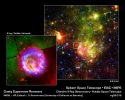
N76-PIA08516-2.jpgThe "N 76 Nebula"59 visiteThe supernova remnant1E0102.2-7219 sits next to the Nebula N76 in a bright, Star-Forming Region of the Small Magellanic Cloud, a satellite galaxy to our Milky Way galaxy located about 200.000 LY from Earth. A Supernova Remnant is made up of the messy bits and pieces of a massive star that exploded, or went Supernova. This image shows glowing dust grains in three wavelengths of infrared radiation: 24 microns (red) measured by the Multiband Imaging Photometer aboard NASA's Spitzer Space Telescope; and 8.0 microns (green) and 3.6 microns (blue) measured by Spitzer's infrared array camera. The red bubble is a dust envelope around the supernova remnant E0102, which is being heated by the shock wave created in the explosion of the remnant's massive progenitor star some 1,000 years ago. Most of the blue stars are in the Small Magellanic Cloud, though some are in our own galaxy.
|
|
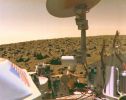
vl2_22a158.jpgThe "Rocky Horizon" of Utopia Planitia - Frame Viking Lander 2 n. 22a158 (Natural Colors - credits: NASA/JPL)59 visitenessun commento
|
|
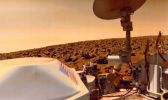
vl2_22a158_old.jpgThe "Rocky Horizon" of Utopia Planitia - Frame Viking Lander 2 n. 22a158 (Natural Colors - credits: NASA/JPL)59 visitenessun commento
|
|
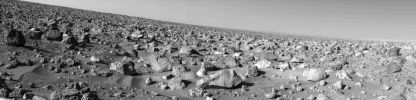
vl2_p17688.jpgUtopia Planitia - Frame Viking Lander 2 n. p1768859 visitenessun commento
|
|
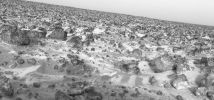
vl2_p21841.jpgMorning "frost" over Utopia Planitia - Frame Viking Lander 2 n. p21841 (Original NASA RAW b/w Frame)59 visitenessun commento
|
|

vl1_p20453.jpgFeatures of Chrise Planitia - Frame Viking Lander 1 n. p20453 59 visitenessun commento
|
|

APOLLO 17 AS 17-M-0446-1.jpgAS 17-m-0446 - metric frames (1)59 visite
|
|
APOLLO 17 AS 17-M-0447-2.jpgAS 17-m-0447 - metric frames (2)59 visite
|
|

002-vg2_2670443.jpg002-Approaching Uranus...59 visite
|
|

m10_aom_18.jpgMercury's "Inbound" view and Kuiper Crater59 visiteThis is a mosaic of images taken of Mercury taken from 125.000 miles away. The tiny, brightly rayed crater (just below center top) was the first recognizable feature on the Planet's surface and was named in memory of astronomer Gerard Kuiper, a Mariner 10 team member.
|
|

m10_aom_19.jpgMercury's "Outbound" view59 visiteAfter passing on the darkside of the Planet, Mariner 10 photographed the other, somewhat more illuminated Hemisphere of Mercury.
The North Pole is at the top, two-thirds down from which is the Equator.
|
|
| 25353 immagini su 2113 pagina(e) |
 |
|
|
|
|
1287 | |
|
|
|
|





