| Piú viste |

N-Mariner4-67.jpgGlobal Sand&Dust-storm from Mariner 459 visitenessun commento
|
|

N-Mariner4-66.jpgGlobal Sand&Dust-storm from Mariner 4 (possible thick clouds)59 visitenessun commento
|
|

O-Mariner9-04.jpgMars from Mariner 9: the North Pole of Mars59 visitenessun commento
|
|

O-Mariner9-03.jpgMars from Mariner 9: Collapsed terrain59 visitenessun commento
|
|

The_Sun_and_Mercury.jpgThe Sun and Mercury59 visiteEnjoying the transit of Mercury from Dallas, Texas, astronomer Phil Jones recorded this detailed image of the Sun. Along with a silhouette of the innermost Planet, a network of cells and dark filaments can be seen against a bright solar disk with spicules and prominences along the Sun's edge. The composited image was taken through a telescope equiped with an H-alpha filter that narrowly transmits only the red light from Hydrogen atoms. Such images emphasize the Solar Chromosphere, the region of the Sun's atmosphere immediately above its Photosphere or normally visible surface. Left of center, the tiny disk of Mercury seems to be imitating a small sunspot that looks a little too round. But in H-alpha pictures, sunspot regions are usually dominated by bright splotches (called plages) on the Solar Chromosphere.
|
|
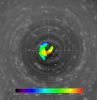
Saturn-PIA08334.jpgThe temperature of Saturn's "Stormy" South Pole59 visiteThe Cassini data presented in this view appear to confirm a region of warm atmospheric descent into the eye of a hurricane-like storm locked to Saturn's south pole. The view shows temperature data from the Cassini spacecraft composite infrared spectrometer overlaid onto an image from the imaging science subsystem wide-angle camera.
The composite infrared spectrometer data refer to a depth in Saturn's upper stratosphere where the pressure is 0.5 millibars (324 kilometers above the 1-bar level), a region higher than that imaged by the imaging camera and visual and infrared spectrometer during the same observation period. The composite infrared spectrometer data show a very small hot spot over the pole, similar in size to the "eye" of the storm seen in the imaging science subsystem images. See also Looking Saturn in the Eye and Saturn's Surprisingly Stormy South for related images.
The color scale at the bottom indicates the temperature in Kelvin corresponding to the colors of the temperature map. Numbers on the grid correspond to lines of latitude and longitude on the planet.
Infrared images taken through the Keck I telescope by ground-based observers had previously shown the south polar spot to be warm. Cassini's composite infrared spectrometer has confirmed this with higher resolution temperature maps of the area (like the map displayed here) and sees a temperature increase of about 2 Kelvin (4 degrees Fahrenheit) at the pole.
The temperatures are in the stratosphere and higher up than the clouds seen by the Cassini imaging and visual and infrared mapping spectrometer instruments, but they suggest that the atmosphere sinks over the south pole. Because the pressure increases with depth, the descending atmosphere compresses and heats up. The warmer temperatures over the south pole also indicate that the vortex winds are decaying with height in the stratosphere. The descent implied by the temperatures nicely supports the lower cloud altitudes observed by the imaging camera and visual and infrared spectrometer instruments at the pole.
The image and atmospheric data were acquired on Oct. 11, 2006, when Cassini was approximately 340,000 kilometers (210,000 miles) from Saturn. The wide-angle camera image was taken using a spectral filter sensitive to wavelengths of infrared light centered at 752 nanometers. The image has been contrast enhanced using digital image processing techniques. The unprocessed image shows an oblique view toward the pole, and was reprojected to show the planet from a perspective directly over the south pole. Scale in the original image was about 17 kilometers (11 miles) per pixel.
|
|

N-Mariner6-01_enf_08.jpgMars from Mariner 6: approaching Mars59 visitevedasi quanto dedotto in sede di commento al frame precedente
|
|
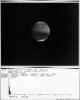
N-Mariner6-01_cof_15d.jpgMars from Mariner 6: approaching Mars59 visiteLa distanza da cui questa spettacolare immagine è stata ripresa è di poco superiore ad 1 MKM.
Vi suggeriamo di notare l'incredibile ampiezza del Polo Sud e quindi di paragonare questo frame con altri frames similari ottenuti negli Anni '90 e quindi con le immagini MGS (o MRO o anche - sebbene trattasi di immagini inattendibili - Mars Express) che rappresentano la medesima Regione.
Le conclusioni primarie ed interlocutorie - ma comunque significative - le lasciamo a Voi.
|
|

N-Mariner6-02_enn_06.jpgMars from Mariner 6: Martian Landscape59 visitenessun commento
|
|

N-Mariner7-05_enf_59.jpgMars from Mariner 7: approaching Mars (5)59 visitenessun commento
|
|

N-Mariner7-02_cof_32c.jpgMars from Mariner 7: approaching Mars (2)59 visitenessun commento
|
|

N-Mariner7-09_enn_21.jpgMars from Mariner 7: Craters and Ridges59 visitenessun commento
|
|
| 25353 immagini su 2113 pagina(e) |
 |
|
|
|
|
1285 | |
|
|
|
|





