| Piú viste |

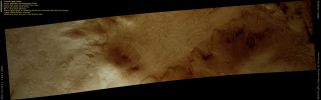
ESP_012853_1480_RED_abrowse-00.jpgTerra Cimmeria (ctx frame - Natural Colors; credits: Lunar Explorer Italia)59 visiteThis image shows a network of small valleys in the Terra Cimmeria Region of the Martian Southern Highlands. This location is approx. 1000 Km (about 600 miles) South of Gusev Crater, the Landing Site of the Mars Exploration Rover Spirit.
The valleys in this image are carved into light-toned bedrock exhibiting a range of colors, which likely reflect a range of mineralogical compositions. The bedrock is pervasively fractured, and some of the fractures appear to be filled with material of a different color, possibly composed of minerals that crystallized or were cemented together when fluids (perhaps water) circulated through the fractures.MareKromium
|
|

ESP_012271_0940_RED_abrowse.jpgSouth Polar "Swiss-Cheese Surface Features" (Natural Colors; credits: Lunar Explorer Italia)59 visiteThis image represents a Martian Terrain containing "Swiss Cheese" features. This Terrain is found only within the residue of the Southern Polar Cap, which comprises of mostly frozen CO2 and H2O.
These particular features are flat-floored, circular depressions that are believed to form from different rates in the seasonal changes of the CO2 and H2O ices. Varying rates in sublimation (when these ices change directly to vapors upon heat and back to deposited solids upon cooling) produces these rimmed depressions from the flat polar ice plane. It is hypothesized that the depression areas are made up of dry ice - such as Carbon Dioxide - and the material below consists of the water ice.
This Carbon Dioxide solid rises and slightly evaporates into the thin Atmosphere in the Summer while the water layer remains in place. As the South Pole cools with seasonal change, the "Swiss Cheese" formation is obtained with risen CO2 rimmed depressions and flat water mesas.
The Martian North Pole will evaporate all of its CO2 in the Summer; however the South Pole is colder and this may explain why this Terrain is only found in this area.
Some of the circular features in the full image show distinct cusps that point in the direction of the Pole. These cusps suggest insolation, a measure of solar radiation that is pushing the movement/formation of these depressions away from the Pole. There is also an observed lateral outward growth of the features at the rate of about 1-to-3 meters a year, indicating to scientists that the depressions must form in a CO2 medium.MareKromium
|
|

ZO-Saturn_New_Moon-S2008-S1-PIA11503.jpgSaturn's New Moon S/2008 S159 visiteCaption NASA:"A bright arc within Saturn's faint G-Ring holds a tiny gift: a small moonlet is just visible as a short streak near the ansa of the G-Ring Arc in the top of two versions of the same image.
The second (bottom) version of the image has been brightened to enhance the visibility of the G-Ring. The other streaks in this version of the image are stars smeared by the camera's long exposure time of 26". This version of the image shows a gap in the G-Ring which was faintly visible in an earlier Cassini movie (see PIA08327).
This view looks toward the sunlit side of the Rings from about 1° below the Ring-Plane. The image was taken in Visible Light with the Cassini Spacecraft narrow-angle camera on Jan. 28, 2009. The view was acquired at a distance of approx. 1,2 MKM (such as about 746.000 miles) from Saturn and at a Sun-Saturn-Spacecraft, or Phase, Angle of 27°.
Image scale is roughly 7 Km (a little more than 4 miles) per pixel".MareKromium
|
|

APOLLO_15_-_AS15-84-11311_HR.jpgAS 15-84-11311 - Mount Hadley59 visitenessun commentoMareKromium
|
|

APOLLO_15_-_AS15-84-11294_HR.jpgAS 15-84-11294 - Mount Hadley (partially Sunstruck)59 visitenessun commentoMareKromium
|
|
ESP_013071_1365_RED_abrowse.jpgCentral Peak Gullies (Natural Colors; credits: Lunar Explorer Italia)59 visitenessun commentoMareKromium
|
|

ESP_012926_1365_RED_abrowse.jpgLohse Crater (Natural Colors; credits: Lunar Explorer Italia)59 visiteThis image is of the Eastern half of the Central Peak of Lohse Crater located in the Southern Hemisphere.
The crater itself is highly degraded and is roughly 80 miles in diameter. Of specific interest are the pristine looking Gullies that appear to have sourced from layers below the top of this uplifted region.
Smaller Gullies appear to emanate in all directions from the uplifted region, but of special interest is the larger Gully located on the northern most slope of the Central Peak. This Gully has a larger alcove and a better developed debris apron than surrounding Gullies. This implies that either this gully formed over a longer time period or that more fluid was involved in its formation.
Gullies are present on many slopes on Mars, especially between the latitudes of 30 and 70° in both Hemispheres. Gullies are formed by fluids and have three distinct parts to them: an eroded “alcove” at the top, a sometimes sinuous “channel” section, and finally a large “debris apron” where the material eroded by the Gully is deposited.MareKromium
|
|

NGC-6726-6727-6729.jpgNGC 6726, 6727 and 6729 - Nebulae in Corona Australis59 visite"...Continual eloquence is tedious..."
Blaise Pascal (1623 - 1662; from "Pensées" - 1670)MareKromium
|
|
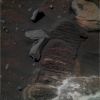
SOL1910-GB2.jpgThe unbelievable True Colors of Gusev's Surface - Sol 1910 (possible True Colors; credits: Dr G. Barca & Lunar Explorer Italia)59 visitenessun commentoMareKromium
|
|

Titan-PIA11508.jpgTitan in Eclipse59 visiteCaption NASA:"The Cassini spacecraft captured this image of a dimly lit Titan as Saturn's largest moon was eclipsed by the Planet.
This view looks up toward the South Pole of Titan which lies on the Terminator about a quarter of the way inward from the right of the visible disk. Lit terrain seen here is on the Saturn-facing side of Titan. In Saturn's shadow, the Southern Hemisphere of Titan is lit by two sources: sunlight scattered through the Planet's Rings and refracted sunlight passing through the edge of Saturn's Atmosphere.
Stars in this image are smeared by the long camera exposure time of 560" needed to capture the faint light on Titan. The image was taken in Visible Light with the Cassini Spacecraft wide-angle camera on May 7, 2009. The view was acquired at a distance of approx. 667.000 Km (about 414.000 miles) from Titan and at a Phase Angle of 58°.
Image scale is roughly 40 Km (about 25 miles) per pixel".MareKromium
|
|

Titan-Clouds-02.jpgTitan's South Polar Cloud Burst59 visiteThis InfraRed image of Saturn's moon Titan shows a large burst of clouds in the moon's South Polar Region. These clouds form and move much like those on Earth, but in a much slower, more lingering fashion, new results from NASA's Cassini Spacecraft show.
This image is a color composite, with red shown at a 5-micron wavelength, green at 2.7 microns and blue at 2 microns. An InfraRed color mosaic is also used as a background image (red at 5 microns, green at 2 microns, blue at 1.3 microns).
The images were taken by Cassini's visual and InfraRed Mapping Spectrometer during a flyby of Titan on March 26, 2007, known as T27.
Titan's Southern Hemisphere still shows a very active meteorology (the cloud appears in white-reddish tones) even in 2007. According to climate models, these clouds should have faded out since 2005.
Scientists have monitored Titan's Atmosphere for 3-and-a-half years, between July 2004 and December 2007, and observed more than 200 clouds.
The way these clouds are distributed around Titan matches scientists' global circulation models. The only exception is timing — clouds are still noticeable in the Southern Hemisphere while Fall is approaching.
Scientists will continue to observe the long-term changes during Cassini's extended mission, which runs until the fall of 2010.MareKromium
|
|
SOL1929-2P297619962EFFB1DQP2148L7M1.jpgA Little Spark on Spirit's Joints - Sol 1929 (Natural Colors; credits: Lunar Explorer Italia)59 visitenessun commentoMareKromium
|
|
| 25353 immagini su 2113 pagina(e) |
 |
|
|
|
|
1279 | |
|
|
|
|





