| Piú viste |

North_Polar_Features-Dunes-MGS-08.jpgNorth Polar Dunes (Natural Colors; credits for the additional process. and color.: Dr Paolo C. Fienga - Lunexit Team)59 visiteCaption NASA originale:"This MGS-MOC image shows dunes in the Martian North Polar Region. The dunes are composed of dark, coarse (--> ruvido, di tessitura grossolana) sand. The white areas around the dunes are the last remaining areas of seasonal CO2 frost cover.
The solid CO2 accumulates during the Autumn and Winter and sublimes (goes from solid to gas) away in the Spring.
This image was taken near the end of the Northern Spring".
Location near: 78,0° North; 244,5° West
Image width: ~3 Km (~1,9 mi)
Illumination from: lower left
Season: Northern SpringMareKromium
|
|

North_Polar_Features-Dunes-MGS-04.jpgNorth Polar Dunes (Natural Colors; credits for the additional process. and color.: Dr Paolo C. Fienga - Lunexit Team)59 visitenessun commentoMareKromium
|
|
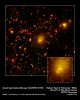
PIA09955_fig1.jpgFearsome Foursome (Figure 1)59 visiteOne of the biggest galaxy collisions ever observed is taking place at the center of this image. The four yellow blobs in the middle are large galaxies that have begun to tangle and ultimately merge into a single gargantuan galaxy. The yellowish cloud around the colliding galaxies contains billions of stars tossed out during the messy encounter. Other galaxies and stars appear in yellow and orange hues.
NASA's Spitzer Space Telescope spotted the four-way collision, or merger, in a giant cluster of galaxies, called CL0958+4702, located nearly 5 BLY away.
The dots in the picture are a combination of galaxies in the cluster; background galaxies located behind the cluster; and foreground stars in our own Milky Way galaxy.
Infrared data from Spitzer are colored red in this picture, while visible-light data from a telescope known as WIYN are green. Areas where green and red overlap appear orange or yellow.
Since most galaxies in the cluster contain old stars that are visible to Spitzer and WIYN, those galaxies appear orange.
MareKromium
|
|

M-067-0.jpgM 67 - Semi-Globular Star Cluster59 visite"...God saw everything that He had made, and indeed, it was very good..."
- Genesis, 1:31MareKromium
|
|
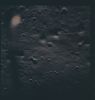
APOLLO_15_AS_15-96-13064.JPGAS 15-96-13064 - EVA Floodlight near Herodotus "H" and Vallis Schroteri (2)59 visiteImage Collection: 70mm Hasselblad
Mission: 15
Magazine: 96
Magazine Letter: Q
Latitude: 26° North
Longitude: 51° West
Description: EVA FLOODLIGHT
Film Type: SO-368
Film Width: 70 mm
Film Color: colorMareKromium
|
|

PSP_004324_1060_RED_browse.jpgPolygons on South Polar Layered Deposits59 visiteThis image shows an exposure of south polar layered deposits, thought to record recent global climate changes on Mars.
The layers were probably laid down over the past few million years over a large area near the south pole, then eroded to show the layering visible in this image.
The layers appear brighter where their slopes are steeper and facing the Sun.
Within the brighter, steeper part of the layered deposits, a network of polygonal fractures is visible. The polygons outlined by the fractures are typically a few hundred meters (approx. 1000 feet) across, and traverse layer boundaries. Such polygonal fractures are seen on Earth in places where ground ice is present, and previous Mars orbiters have found evidence for abundant ground ice in the south polar region of Mars. So it is not surprising to see polygonal fractures here; what is unusual is that they cross layer boundaries, apparently unaffected by the changes in slope across them.
This suggests that the polygonal fractures formed after the scarp exposing the south polar layered deposits was formed by erosion. This indicates, possibly, that the scarp has been stable for some time, allowing the polygonal fractures to form.
MareKromium
|
|
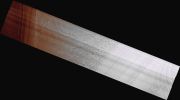
PSP_004664_0955_RED_browse.jpgOutcrops of Layers in the South Polar Layered Deposits59 visiteThis image spans a section of the South Polar Layered Deposits (SPLD). The SPLD are composed of layers of water ice mixed with impurities (probably mostly dust). The most similar terrestrial analog to the SPLD are ice sheets, like those covering most of Greenland and Antarctica.
The materials of ice sheets are deposited by freezing of atmospheric water vapor on dust particles and precipitation of those water/dust particles (snow), by direct condensation (freezing) of atmospheric water vapor onto the surface, and by fallout of dust. Together, these processes cause an ice sheet to undergo accumulation (build-up). Ablation (removal of material, also called erosion) of an ice sheet can also occur. If more accumulation happens than ablation, the ice sheet grows; if reversed, the ice sheet shrinks, as is the case for many of Earth’s glaciers due to global warming. Each year, the amount of accumulation and ablation varies, so layers of different thicknesses and different amounts of impurities (dust) will be deposited onto the ice sheet.
Volcanic eruptions anywhere on the planet can also potentially spew ash high into the atmosphere, where it can travel great distances and fall onto an ice sheet surface. Later accumulations of water ice can then trap this volcanic ash as a layer within the ice sheet. Thus, layers in an ice sheet can originate through a variety of means and occur at a variety of scales (thicknesses).
This particular image is interesting because many layers are exposed and because more than one outcrop (exposure of layering) is visible—at the top of the image and at the bottom. You can imagine the outcrops at the top and bottom of the image as if you are looking down on a staircase. The approximately horizontal lines are the edges of the layers (the risers), and the flat areas between them are the layer surfaces (the flat parts of the steps). The middle of the image is the top of the staircase. At the bottom, the staircase of layers goes down again.
The layers in this image are on the scale of meters (several to tens of feet) in thickness and are much thicker than one might expect from annual accumulation (which might be about 0.5 millimeters per year, or 0.02 inch per year). So the layers we see in this image may be packages of thinner, annual layers. The reason that we can distinguish between different packages of annual layers (in other words, the reason that we can see layering at this scale) is because the rates of accumulation and ablation change not only yearly, but also on much longer time scales. Imagine drilling into the SPLD and looking at the walls of the hole with a microscope. Within the large-scale layering we see in this image, we might see annual accumulation layers, dusty layers created during large dust storms, and maybe even volcanic ash layers.MareKromium
|
|
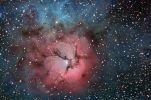
M-020-0.jpgM 20 - The "Trifid Nebula"59 visite"...I read your letter; who wrote it for you?..."
"...And who read it for you?!?..."
Mark "Airball" Acey & Jim "Cheeseball" Kraft - "Garfield's Insults, Put-downs & Slams"MareKromium
|
|
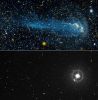
Mira-PIA09961.jpgMira's Tail59 visiteCaption NASA:"NASA's Galaxy Evolution Explorer discovered an exceptionally long comet-like tail of material trailing behind Mira -- a star that has been studied thoroughly for about 400 years.
So, why had this tail gone unnoticed for so long? The answer is that nobody had scanned the extended region around Mira in ultraviolet light until now.
As this composite demonstrates, the tail is only visible in ultraviolet light (top), and does not show up in visible light (bottom). Incidentally, Mira is much brighter in visible than ultraviolet light due to its low surface temperature of about 3000 Kelvin (about 5000° Fahrenheit)".MareKromium
|
|
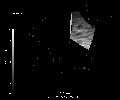
Venusian_Clouds-VI410_411_23_tot.gifVenusian Cloud Structure (GIF-movie)59 visiteCaption ESA:"This movie consists of a sequence of six images obtained by the VIRTIS imaging spectrometer on board ESA’s Venus Express on 5 and 6 June 2007, before and after NASA MESSENGER’s closest approach to the Planet. The image sequence, obtained by VIRTIS, provides a night-side view of the same region that Messenger flew over and imaged.
They were obtained at 1,7 micrometres, revealing atmospheric details down to an altitude of 50 Km from the surface".MareKromium
|
|

ZZ-ZZ-RoverTracks-R9.jpgRover Tracks (natural colors - elab. Lunexit)59 visitenessun commentoMareKromium
|
|

ZZ-ZZ-RoverTracks-R6.jpgRover Tracks (natural colors - elab. Keith Laney)59 visitenessun commentoMareKromium
|
|
| 25353 immagini su 2113 pagina(e) |
 |
|
|
|
|
1276 | |
|
|
|
|





