| Piú viste |

APOLLO 15 AS 15-9287.jpgAS 15-9287 - A "Middle-aged" Crater59 visiteRemarkable detail is shown in this enlargement of a small part of a panoramic camera frame. In most respects, the crater itself is typical of a great many craters its size-about 1,2 Km. Because it does not have rays, it is believed to be older than most other Lunar craters. Its rounded rim crest and slightly raised rim (extending outward to the arrow, on the West side) also point to its greater age. On the other hand, it is young enough that some of the original dunelike texture of the ejecta blanket is preserved (especially to the West), a great many large blocks of ejecta are still visible, and the original depth of the crater has not been greatly lessened by infalling debris. The largest blocks, which are about 30 mt in size, occur near the rim. The terrace (T) extending partly around the wall about 100 mt below the surface probably marks the top of a resistant rock layer. However, if there were other signs of bedrock stratification within this crater, they have been obscured by the movement of debris down the walls. The very smooth floor is the only unusual feature of this crater. It may consist of a solidified pool of rock melted by heat generated from the impact.
|
|

South_Polar_Features-Fans-PIA08658.jpgSouth Polar Fans (Original NASA/MGS/MSSS b/w Frames)59 visiteCaption NASA originale:"Dark spots (left) and 'Fans' appear to scribble dusty hieroglyphics on top of the Martian South Polar Cap in two High-Resolution MGS-MOC images taken in Southern Spring. Each image is about 3-Km wide".
|
|

APOLLO 17 AS 17-149-22838.jpgAS 17-49-22838 - Crater Chain (Far-Side)59 visiteThis oblique view taken with the Hasselblad camera shows a crater chain on the Far-Side, about 500 Km North of Tsiolkovsky. For an idea of the scale, the large crater near the upper left corner is about 26 Km wide. The origin of this chain is controversial. To some geologists, the irregular shape of many of the craters suggests that the chain was formed by the impact of a stream of ejecta from a large primary crater. The presence of herringbone ridges would have strengthened this interpretation, but none are visible; perhaps the high Sun angle and the oblique viewing angle of this scene have obscured them. To others the simple geometry of the chain suggests a volcanic origin. However, there is an apparent lack of faulting to control the alinement of the craters and an apparent absence of a blanket of volcanic ejecta.
The origin of this chain may not be decipherable until, and unless, additional photography becomes available.
|
|

APOLLO 16 AS 16-4530.jpgAS 16-4530 - Seconday impact craters, faults and rifles59 visiteLinear features of external and internal origin are contrasted in this area of Southernmost Mare Tranquillitatis.
The North-trending line of overlapping, very irregular craters along the East edge of the picture is clearly a chain of secondary impact craters. Its trend is radial to Theophilus, a large crater of early Copernican age that lies about 105 Km south of this area. The flaring shapes of some of the craters and their state of preservation also suggest that Theophilus is the primary crater. The narrow, straight rifle or graben that extends westward across the picture is clearly of internal origin. It formed when tensional forces ruptured the crust, causing the floor of the rifle to subside along faults.
Straight rifles are commonly the sites of volcanic cones or of blankets of volcanic ejecta; however, there are no signs of volcanism here that can be related to this rifle.
|
|

APOLLO 15 AS 15-0274.jpgAS 15-0274 - Euler Crater59 visiteIn this oblique view of Euler, some details are shown that are not visible in other pictures. Note, for example, the ledges (L) of bedrock cropping out along the South Wall and the low terraces (T) at the points of contact between the slump masses and the floor. They may be aprons of debris or "bathtub rings" of lava. This oblique viewing angle also enhances the polygonal outline of Euler's rim crest and the size and ruggedness of the huge masses that have slumped from the walls.
|
|

APOLLO 15 AS 15-9866.jpgAS 15-9866 - Jansen "B" Crater59 visiteHigh Sun views such as this often show fascinating dark and bright patterns that would be overwhelmed by highlights or shadows if the Sun were lower in the sky. This view of the 17-Km-wide crater Jansen "B" shows numerous bright avalanche deposits on the steep crater walls, apparently originating at outcrop ledges near the top of the wall. Most avalanches stop in a moat at the base of the wall, but a few in the foreground extend out onto the irregular, inward- sloping floor.
The floor is a jumble of slump blocks.
Avalanching appears to be a major means of erosion on steep lunar slopes.
|
|

APOLLO 15 AS 15-9874.jpgAS 15-9874 - Dawes Crater59 visiteThis is a near vertical view of the crater Dawes, 18 Km in diameter. Morphologically it is typical of many lunar craters in the 15- to 20-Km size range. It lacks terraced walls and distinct central peaks but has an extremely rough floor. Small terracelike structures on the crater floor (upper left, lower right) occur where the wall is bowed outward and probably represent slump deposits where portions of the crater wall have collapsed into the crater. Local stratigraphy is revealed in the walls of the crater, and material of different albedo is seen streaming down into the crater from various levels. The dark layer clearly visible in the upper part of the crater wall represents the thin mare deposits in this part of Northern Mare Tranquillitatis. The lighter gray material below it is a combination of underlying submare material and talus from units higher on the crater wall. The highest unit (white and gray) probably represents the ejecta blanket and may consist primarily of lighter lunar crustal material excavated from beneath the mare.
|
|

APOLLO 17 AS 17-3081.jpgAS 17-3081 - Pytheas Crater (HR)59 visiteThe Apollo 17 Panoramic Camera provided this high-resolution, enlarged view of the South Wall of Pytheas. Pytheas is about the same size as Bessel, but is located in South-Central Mare Imbrium, almost 1100 km West of Bessel.
The outcrops in the walls of the two craters are remarkably similar.
These and the many other craters in mare areas that contain outcrops of dark horizontally layered rock demonstrate the moonwide uniformity of conditions in the upper part of the mare basins.
|
|
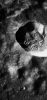
APOLLO 17 AS 17-2265.jpgAS 17-2265 - Proclus Crater59 visiteThis oblique view looks South over the 26-Km-diameter crater Proclus in the highlands at the Western edge of Mare Crisium. Proclus is a young rayed crater that is distinctive because of the marked asymmetry of its ray system-a characteristic visible even in Earth-based telescopic views. The excluded zone is along the South-West edge (top of photograph) but is visible in this moderate Sun photo only as a slight albedo change. Laboratory experiments suggest that a low trajectory angle might account for the asymmetry. A number of large blocks can be seen at the edge of the crater rim. The exceptionally large block (arrow) is about 200 mt wide and, judging from the length of the shadow it casts, nearly as high. As in several other craters shown in this chapter, a darker layer is present in the upper part of the crater wall.
|
|

Titan-PIA08246.jpgTitan59 visiteCaption NASA:"This remarkably clear view from that flyby shows the moon's characteristically dark Mid-Latitudes, and more Southern Terrain than the Cassini spacecraft has usually been able to glimpse. This was the first in a series of "illuminated outbound flybys" of Titan where the illuminated Hemisphere was visible following the closest approach. Cassini's flyby of Titan on July 22, 2006 sent the spacecraft into a more inclined orbit about Saturn.
The image was taken in polarized infrared light with the Cassini spacecraft wide-angle camera on July 22, 2006 at a distance of approx. 148.000 Km (about 92.000 miles) from Titan.
Image scale is roughly 9 Km (about 5 miles) per pixel".
|
|

41-Mezentzev Crater.jpgCraters Mezentsev, Niepce and Merril59 visiteThis image was taken by the Advanced Moon Imaging Experiment (AMIE) on 16 May 2006. The imaged area is centred at a Latitude of 73° North and a Longitude of 124° West, on the Far-Side of the Moon.
Normally, the AMIE camera is pointed straight down at the Lunar Surface, in the Nadir pointing mode. In this image, AMIE was pointed towards the horizon, showing the Lunar Surface in an oblique view.
The largest craters in this image are Mezentsev, Niepce and Merrill. Mezentsev is an eroded crater 89 Km in diameter and centred at 72,1° N, and 128,7° W.
A smaller cup-shaped crater resides inside Mezentsev. Niepce and Merrill both have a diameter of 57 Km and are located at 72,7° N-119,1° W and 75,2° N and 116,3° W, respectively.
Mezentsev Crater is named after Yourij Mezentsev, a Soviet engineer (1929 - 1965) who was one of the first people to design rocket launchers, while Joseph Niepce was the French inventor of photography (1765 - 1833); Paul Merrill was an American astronomer (1887 - 1961).
|
|

M-008-3.jpgM 8 - The "Lagoon" Nebula59 visite"...But now we are...dead to that which held us captive, so that we are slaves not under the old written Code, but in the new Life of the Spirit..."
Romans - 7:6
|
|
| 25353 immagini su 2113 pagina(e) |
 |
|
|
|
|
1275 | |
|
|
|
|





