| Piú viste |

OPP-SOL489-1.jpgDeep, deep Rover Track - Sol 489 (True Colors; credits: Dr Gianluigi Barca)59 visitenessun commentoMareKromium
|
|

APOLLO_14_AS_14-77-10366a.JPGAS 14-77-10366 (a) - Thermal Degradation Sample59 visiteThermal Degradation Sample; taken in the vicinity of Station "A".MareKromium
|
|

PSP_005574_1720_RED_abrowse-01.jpgLayers and Slope-Streaks within Valleys along the Highland-Lowland Boundary (extra-detail mgnf - MULTISPECTRUM; credits: Lunexit)59 visiteSlope Streak formation is among the few known processes currently active on Mars. Since the Slope Streaks in this image appear to superpose (lie on top of) the surfaces between individual dunes, the Streaks most likely formed more recently and are younger than the dunes.
Many hypotheses have been proposed for the formation of Slope Streaks including dry avalanching, geochemical weathering, liquid stains or flows, and moisture wickering.
Recent observations from HiRISE images have revealed that the dark interior of Slope Streaks is lower in elevation than the surroundings, suggesting that material must have been removed in the formation of the streak.MareKromium
|
|

SOL422-1.jpgSolar Panels, Rover Tracks and "Brown Dust" - Sol 422 (True Colors; credits: Dr Gianluigi Barca)59 visitenessun commentoMareKromium
|
|

Enceladus-PIA10356.jpgWhat's in "Enceladus Plume"?59 visiteCaption NASA:"The lower panel is a Mass Spectrum that shows the chemical constituents sampled in Enceladus' plume by Cassini's Ion and Neutral Mass Spectrometer during its fly-through of the plume on Mar. 12, 2008.
Shown are the amounts, in atomic mass per elementary charge (Daltons [Da]), of Water Vapor, Methane, Carbon Monoxide, Carbon Dioxide, simple organics and complex organics identified in the plume".MareKromium
|
|

SOU-SOL019-81945_full.jpgThe Spectral Mapping of the Soujourner-Pathfinder Landing Site - Sol 19 (credits: NASA)59 visitenessun commentoMareKromium
|
|

SOU-SOL079-TwinPeaks_right.jpgTwin Peaks...In the distance - Sol 7959 visitenessun commentoMareKromium
|
|
SOL579-1.jpgSkyline... - Sol 579 (True Colors + MULTISPECTRUM; credits: Dr G. Barca & Lunexit)59 visitenessun commentoMareKromium
|
|

SOU-SOL019-81992_full.jpgRocky Landscape and a distant hill - Sol 19 (MULTISPECTRUM; credits: Lunexit)59 visitenessun commentoMareKromium
|
|
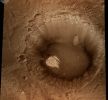
Craters-Pollack_Crater-H1201_0001_ND3_crop_wide-3.jpgPollack Crater and "White Rock" (Natural Colors - Tri-Chromatic Version; credits for the additional process. and color.: Dr Paolo C. Fienga - Lunexit Team)59 visitenessun commentoMareKromium
|
|
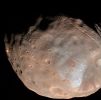
PSP_007769_9015_IRB.jpgPhobos (Natural Colors; credits: NASA)59 visitePhobos, and the second Martian moon, Deimos, are interesting for several reasons. Both objects are small, with average diameters of just 22 and 12 Km, respectively.
At this size, their gravity is insufficient (less than 1/1000th of Earth) to pull them into spherical shapes, in contrast to the larger moons and planets in the Solar System.
Both moons are tidally locked to Mars, meaning, like our own moon relative to Earth, they present the same side to Mars all the time. The small size and composition (determined from spectroscopy) of Phobos and Deimos make them very similar to some asteroids.
Most asteroids are located in a belt between Mars and Jupiter, with others having orbits that cross that of Mars. Therefore, it is possible that Phobos and Deimos are captured asteroids.
Other hypotheses are that they formed with Mars in the early Solar System, or are composed of material blasted off of Mars by impacts.MareKromium
|
|

Sun-N00107152.jpgSunshine through the Rings... (natural colors; credits: Lunexit)59 visiteCaption NASA:"Caption NASA:"N00107152.jpg was taken on April 10, 2008 and received on Earth on April 11, 2008. The camera was pointing toward SATURN, F-RING that, at the time, was approx. 611.114 Km away, and the image was taken using the CL1 and CL2 filters. This image has not been validated or calibrated".MareKromium
|
|
| 25353 immagini su 2113 pagina(e) |
 |
|
|
|
|
1272 | |
|
|
|
|





