| Piú viste |

The_Scorpius.jpgThe Scorpius Region59 visite"...Nemo sibi tantummodo errat, sed alieni erroris et causa et auctor est..."
(Seneca)
"...Chi sbaglia, non sbaglia solo in suo danno poichè - sovente - egli è anche causa ed origine di errori altrui..." (trad. libera)MareKromium
|
|

Japetus-N00092235.jpgRough Terrain and Canyons of Japetus (possible natural colors - elab. Lunexit)59 visiteCaption NASA:"N00092235.jpg was taken on September 10, 2007 and received on Earth September 12, 2007. The camera was pointing toward Japetus that, at the time, was approximately 22.704 Km away, and the image was taken using the CL1 and CL2 filters. This image has not been validated or calibrated".MareKromium
|
|

Uranus-2007-01.jpgGoing, Going, Gone: Hubble captures Uranus's Rings on Edge (4)59 visitenessun commentoMareKromium
|
|

Uranus-2007-00.jpgGoing, Going, Gone: Hubble captures Uranus's Rings on Edge (3)59 visiteCaption NASA:"Showalter is a member of a team led by Imke de Pater of the University of California, Berkeley, who reported that the Rings of micron-sized dust have changed significantly since the Voyager 2 spacecraft photographed the Uranus System 21 years ago. Observations were also gleaned from near-infrared adaptive optics observations with the Keck II telescope on May 28, 2007, and reported in an article appearing on August 23 in Science Express, the online edition of Science Magazine".MareKromium
|
|

Uranus-2005.jpgGoing, Going, Gone: Hubble captures Uranus' Rings on Edge (2)59 visiteCaption NASA:"With further analysis of the Hubble data, Astronomer Mark Showalter of the SETI Institute in Mountain View, Calif., hopes to detect some of the small moons that may shepherd the debris into distinct rings.
Until Voyager 2 flew by Uranus in January 1986, the Rings were only known from the way they temporarily blocked the light of stars passing behind the Planet. Hubble provided some of the first images of the Ring System as viewed from Earth's distance of approx. 2 BMs.
The advent of adaptive optics gave ground-based observers using large telescopes comparatively sharp views.
The Rings were discovered in 1977, so this is the first time for a Uranus Ring crossing to be observed from Earth. Earth's orbit around the Sun permits 3 opportunities to view the Rings in an "edge-on" configuration: Uranus made its first ring crossing as seen from Earth on May 3; it made its second crossing on August 16 and will cross for the third time on February 20, 2008.
Though the last ring crossing relative to Earth will be hidden behind the Sun, most of Earth's premier telescopes, including Keck, Hubble, the European Southern Observatory's Very Large Telescope and the Hale Telescope on Mt. Palomar, plan to focus on the planet again in the days following December 7, 2007. On December 7 the rings will be perfectly edge-on to the Sun".MareKromium
|
|

Uranus-2003.jpgGoing, Going, Gone: Hubble captures Uranus's Rings on Edge (1)59 visiteCaption NASA:"This series of images from NASA's HST shows how the Ring System around the distant planet Uranus appears at ever more oblique (shallower) tilts as viewed from Earth - culminating in the Rings being seen edge-on in 3 observing opportunities in 2007. The best of these events appears in the frame n. 3, taken with Hubble's Wide Field Planetary Camera 2 on August 14, 2007.
The "Edge-On Rings" appear as two spikes above and below the Planet. The Rings cannot be seen running fully across the face of the Planet because the bright glare of the planet has been blocked out in the Hubble photo (a small amount of residual glare appears as a fan-shaped image artifact). A much shorter color exposure of the Planet has been photo-composited to show its size and position relative to the Ring-Plane.
Earthbound astronomers only see Uranus Rings' edge every 42 years as the Planet follows a leisurely 84-year orbit about the Sun. However (and hironically), the last time the Rings were tilted Edge-On to Earth, astronomers didn't even know they existed".MareKromium
|
|

VA-UranusRings-1.jpgUranus' Rings: yesterday, today, tomorrow59 visiteThe position of the Rings of Uranus from AD 1965 up to 2028.MareKromium
|
|

OPP-SOL1293-PIA09928.jpgInside Victoria - Sol 129359 visiteCaption NASA:"After a finishing an in-and-out maneuver to check wheel slippage near the rim of Victoria Crater, NASA's Mars Exploration Rover Opportunity re-entered the Crater during the Rover's 1293rd Sol (such as Sept. 13, 2007) to begin a weeks-long exploration of the inner slope.
Opportunity's Front Hazard-Identification Camera (HazCam) recorded this wide-angle view looking down into and across the Crater at the end of the day's drive. The Rover's position was about 6 meters (20 feet) inside the rim, in the "Duck Bay" alcove of the Crater".MareKromium
|
|

SOL1313-2P242923915EFFAV00P2629L6M1-2.jpgLate morning fogs over Gusev - Sol 131359 visitenessun commentoMareKromium
|
|
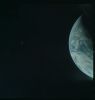
as04-01-201.JPGAS 04-01-0201 - Crescent Mother Earth59 visitenessun commentoMareKromium
|
|

as12-46-6740.JPGAS 12-46-6740 - The Lunar Module59 visiteCaption NASA:"116:22:29 MT - Rightward of 6739. View past the south (minus-Y) LM strut toward Surveyor III. As Pete mentions at 118:27:12, he mistakenly took the pan at 15-foot focus instead of 74-foot focus".MareKromium
|
|

PSP_004959_0865_RED_browse.jpgPolygonal Fracturing of South Polar Layered Deposits59 visiteThis image shows the South Polar Layered Deposits, with curving layer outcrops caused by erosion of valleys into the Deposits.
On closer inspection, polygonal (mostly rectangular) fractures are visible, mostly near the center of the image. Polygonal fractures are also observed in the North Polar Layered Deposits, but typically on a much smaller scale.
Here in the South, the fractures cross layer boundaries, while in the North the fractures are usually confined to a single layer.
Therefore, the fractures in the South Polar Layered Deposits formed after the surface was eroded to the configuration seen here, probably due to expansion and contraction of water ice below the surface.MareKromium
|
|
| 25353 immagini su 2113 pagina(e) |
 |
|
|
|
|
1270 | |
|
|
|
|





