| Piú viste |
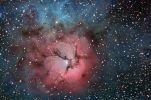
M-020-0.jpgM 20 - The "Trifid Nebula"60 visite"...I read your letter; who wrote it for you?..."
"...And who read it for you?!?..."
Mark "Airball" Acey & Jim "Cheeseball" Kraft - "Garfield's Insults, Put-downs & Slams"MareKromium
|
|
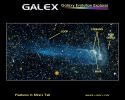
Mira-PIA09959.jpgMira: anatomy of a "Celestial Shooting Star"...60 visiteA close-up view of a star racing through space faster than a speeding bullet can be seen in this image from NASA's Galaxy Evolution Explorer. The star, called Mira (pronounced My-rah), is traveling at 130 kilometers per second, or 291,000 miles per hour. As it hurls along, it sheds material that will be recycled into new stars, planets and possibly even life.
In this image, Mira is moving from left to right. It is visible as the pinkish dot in the bulb shape at right. The yellow dot below is a foreground star. Mira is traveling so fast that it's creating a bow shock, or build-up of gas, in front of it, as can be seen here at right.
Like a boat traveling through water, a bow shock forms ahead of the star in the direction of its motion. Gas in the bow shock is heated and then mixes with the cool hydrogen gas in the wind that is blowing off Mira. This heated hydrogen gas then flows around behind the star, forming a wake.
Why is the wake of material glowing? When the hydrogen gas is heated, it transitions into a higher-energy state, which then loses energy by emitting ultraviolet light - a process called fluorescence. The Galaxy Evolution Explorer has special instruments that can detect this ultraviolet light.
A similar fluorescence process is responsible for the Northern Lights -- a glowing, green aurora that can be seen from northern latitudes. However, in that case nitrogen and oxygen gas are fluorescing with visible light.
Streams and a loop of material can also be seen coming off Mira. Astronomers are still investigating what these streams are, but they suspect that they are denser parts of Mira's wind perhaps flowing out of the star's poles.
This image consists of data captured by both the far- and near-ultraviolet detectors on the Galaxy Evolution Explorer between November 18 and December 15, 2006. It has a total exposure time of about 3 hours.
MareKromium
|
|
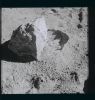
as16-107-17573.jpgAS 16-107-17573 - Unusual boulder at Station 9 (additional processing by Lunexit)60 visiteCaption NASA:"148:14:17 MT - Cross-Sun "after" of the tipped boulder at Station 9".
MareKromium
|
|

as14-66-09320.JPGAS 14-66-9320 (1) - LM's Shadow and a (maybe genuine) Blue Flare60 visitenessun commentoMareKromium
|
|

OPP-SOL207-1N146560905EFF35B8P0643L0M1-2.jpgSunshine over Endurance60 visitenessun commentoMareKromium
|
|

Tethys-N00090940.jpgTethys (natural colors; elab. Lunexit)60 visiteCaption NASA:"N00090940.jpg was taken on August 29, 2007 and received on Earth August 30, 2007. The camera was pointing toward TETHYS that, at the time, was approx. 48.664 Km away, and the image was taken using the CL1 and CL2 filters. This image has not been validated or calibrated".MareKromium
|
|

Titan-N00091161.jpgTitan60 visiteCaption NASA:"N00091161.jpg was taken on September 02, 2007 and received on Earth September 03, 2007. The camera was pointing toward TITAN that, at the time, was approximately 1.313.086 Km away, and the image was taken using the CL1 and UV3 filters. This image has not been validated or calibrated".MareKromium
|
|

Rhea-W00034589.jpgOn Rhea's Terminator (natural colors: elab. Lunexit)60 visiteCaption NASA:"W00034589.jpg was taken on August 30, 2007 and received on Earth August 30, 2007. The camera was pointing toward RHEA that, at the time, was approximately 17.527 Km away, and the image was taken using the CL1 and CL2 filters.
This image has not been validated or calibrated".MareKromium
|
|
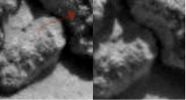
SOL620-623-C1.jpgMisleading "Lights & Shadows"...60 visiteSempre dal nostro caro ed attento Amico e Socio, Antonio Fedele, una coppia di frames che mostra - linea rossa - una possibile incongruenza. O meglio: la possibile presenza di una minuscola roccia (o, forse, di un grumo di polveri - o una serie di extra-pixels posizionati caoticamente?!?) nel frame a Sx, diviene un "nulla" nel frame di Dx. Effetto dell'ombra, di uno shift prospettico, di una manipolazione, o di un reale cambiamento? In questo caso, noi propenderemmo per una combinazione di fattori, ma senza "interventi umani" e senza "Anomalìe Superficiali": ombra + shift = visione ingannevole.
Una coppia di frames da guardare, comunque, con grande attenzione ed umiltà per capire quanto sia difficile e rischioso (in termini di credibilità), ma anche istruttivo e costruttivo (a condizione di essere e rimanere sempre intellettualmente onesti e pragmatici) il Lavoro dell'Anomaly Hunter.
MareKromium
|
|
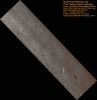
PSP_004673_0935_RED_browse.jpgSouth Pole Residual Cap - Swiss-Cheese Terrain Monitoring (Natural Colors; credits for the additional process. and color.: Dr Paolo C. Fienga - Lunexit Team)60 visitenessun commentoMareKromium
|
|
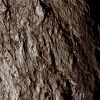
Japetus-N00092235.jpgRough Terrain and Canyons of Japetus (possible natural colors - elab. Lunexit)60 visiteCaption NASA:"N00092235.jpg was taken on September 10, 2007 and received on Earth September 12, 2007. The camera was pointing toward Japetus that, at the time, was approximately 22.704 Km away, and the image was taken using the CL1 and CL2 filters. This image has not been validated or calibrated".MareKromium
|
|

Uranus-2007-01.jpgGoing, Going, Gone: Hubble captures Uranus's Rings on Edge (4)60 visitenessun commentoMareKromium
|
|
| 25353 immagini su 2113 pagina(e) |
 |
|
|
|
|
1268 | |
|
|
|
|





