| Piú viste |

M-081-1.jpgM 81 & M 82 - Spiral Galaxies59 visite"...Molto spesso le Religioni, che di norma dovrebbero inchiodare l’individuo a responsabilità non contrattabili con la sua coscienza, prevedono sanatorie e condoni che lasciano ampio margine di redenzione anche all'anima più nera qualora, questa, sentendo avvicinarsi l'ora della chiamata in giudizio si decidesse per un opportuno quanto tempestivo ravvedimento...
Si potrebbe dire che, in fondo, certi adattamenti normativi che alcuni Governi adottano nei confronti dei Cittadini meno morigerati, più che opportuni sono sacrosanti, essendo ispirati e perfettamente accordati a quanto le stesse leggi di Dio suggeriscono e prevedono. Chissà quale strana idea di giustizia ispirò gli egizi quando, al cospetto del Dio, guai a quell'uomo il cui cuore fosse stato più pesante di una piuma.
Giuseppe Spina - "Il Passato"
|
|

M-082-2.jpgM 82 - Barred Spiral Galaxy59 visite"...L'intransigenza e l'austerità sono fondamenta che mal si adattano a costruzioni con vistosi vizi di progettazione e l'uomo che, per sua natura, porta in sé il seme della trasgressione è destinato a rovinare malamente se gli si chiede di fare di queste fondamenta l'edificio della sua esistenza. Questa incapacità di abbracciare con rigore molle scelte porta, ognuno di noi, a sentirsi in qualche modo "costretto" nelle proprie azioni, facendoci apparire questa Vita come qualcosa che ci sovrasta e ci travolge costringendoci a difenderci più che a viverla.
Per imparare a vivere, una sola vita non basta; da giovani mancano la consapevolezza e la saggezza che vengono dell'esperienza, da vecchi le prove che ci aspettano sono altre e quanto abbiamo imparato, spesso è solo un tragico connubio tra memoria e coscienza, che costringe ad una esperienza completamente nuova ..."
Giuseppe Spina - "Il Passato"
|
|

M-043-91.jpgBarnard's Loop and M 4359 visite"...Lectio quae placuit semel, decies repetita placebit..."
(Orazio)
"...La lettura che sia piaciuta una volta, piacerà (anche se) ripetuta dieci volte (e cioè piacerà sempre)..."
Caption NASA originale:"Why is the Horsehead Nebula surrounded by a bubble? Although glowing like an emission nebula, the origin of the bubble, known as Barnard's Loop, is currently unknown.
Progenitor hypotheses include the winds from bright Orion stars and the supernovas of stars long gone. Barnard's Loop is too faint to be identified with the unaided eye. The nebula was discovered only in 1895 by E. E. Barnard on long duration film exposures. The above image was taken in a single specific color emitted by hydrogen to bring out detail. To the left of the Horsehead Nebula, visible as the small dark indentation near the image top, is the photogenic Flame Nebula".
|
|

OPP-SOL795-1N198755870EFF6900P1775L0M1.jpgSomething stands down there... - Sol 79559 visiteQuesto frame, segnalatoci dal nostro Collaboratore Gianluigi Barca, ci propone due interessanti rilievi: nella Cerchiatura Verde, due "torrette" (purtroppo indefinibili nella loro essenza reale, ma talmente peculiari da poter meritare il titolo di Anomalie Superficiali) sembrano ergersi dalle sabbie di Meridiani (dettaglio confermato anche dal successivo frame Left NavCam di Opportunity); nella Cerchiatura Fucsia, quadrante inferiore Sx, circa ad ore 7, una squadratura del Pavimento Marziano incredibilmente netta.
Come sempre, un ottimo lavoro del Dr Barca.
|
|

Saturn-PIA08159.jpgCrescent Moons (1)59 visiteCaption NASA originale:"The tilted crescent of Saturn displays lacy cloud bands here along with a bright Equatorial Region and threadlike ring shadows on the Northern Hemisphere. Three moons are visible here: Mimas (397 Km, or about 247 miles across) at left and faint, is aligned with the Ring-Plane. At right are Rhea (1.528 Km, or about 949 miles across, at top) and Tethys (1.071 Km, or 665 miles across, below Rhea).
The image was taken in polarized infrared light with the Cassini spacecraft wide-angle camera on March 11, 2006, at a distance of approximately 2,8 MKM (approx. 1,8 MMs) from Saturn.
The image scale is roughly 166 Km (about 103 miles) per pixel".
|
|

Europa-PIA01401.jpgThe frozen Ocean of Europa59 visiteThis complex area on the side of Europa which faces away from Jupiter shows several types of features that are formed by disruptions of Europa's icy crust. North is to the top of the image, taken by NASA's Galileo spacecraft, and the Sun illuminates the surface from the left. The prominent wide, dark bands are up to 20 Km (about 12 miles) wide and over 50 Km (appx. 30 miles) long. They are believed to have formed when Europa's icy crust fractured, separated and filled in with darker, "dirtier" ice or slush from below. A relatively rare type of feature on Europa is the 15-Km-diameter (about 9,3-mile) impact crater in the lower left corner. The small number of impact craters on Europa's surface is an indication of its relatively young age. A region of chaotic terrain south of this impact crater contains crustal plates which have broken apart and rafted into new positions. Some of these "ice rafts" are nearly 1 Km (about 1/2 a mile) across.
Other regions of chaotic terrain are visible and indicate heating and disruption of Europa's icy crust from below. The youngest features in this scene are the long, narrow cracks in the ice which cut across all other features. One of these cracks is about 30 kilometers (18 miles) to the right of the impact crater and extends for hundreds of miles from the top to the bottom of the image.
|
|
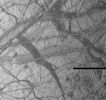
Europa-Ridges-PIA00518.jpgRidges on Europa59 visiteThis view of Jupiter's moon Europa shows a portion of the surface that has been highly disrupted by fractures and ridges. This picture covers an area about 238 Km (approx. 150 miles) wide by 225 Km (about 140 miles); in other words, the distance between Los Angeles and San Diego. Symmetric ridges in the dark bands suggest that the surface crust was separated and filled with darker material, somewhat analogous to spreading centers in the ocean basins of Earth. Although some impact craters are visible, their general absence indicates a youthful surface. The youngest ridges, such as the two features that cross the center of the picture, have central fractures, aligned knobs, and irregular dark patches. These and other features could indicate cryovolcanism, or processes related to eruption of ice and gases.
This picture, centered at 16° South Lat. and 196° West Long., was taken at a distance of 40.973 Km (about 25.290 mi) on November 6, 1996, by the Galileo spacecraft Solid State Imaging Television Camera.
|
|

Europa-PIA01126.jpgEuropa's Lanscape (HR)59 visiteThis mosaic shows some of the highest resolution images obtained by the Solid State Imaging (SSI) System on NASA's Galileo spacecraft during its 11th orbit around Jupiter. North is to the top of the image. The Sun illuminates the scene from the left, showing hundreds of ridges that cut across each other, indicating multiple episodes of ridge formation either by volcanic or tectonic activity within the ice. Also visible in the image are numerous isolated mountains or "massifs". The highest of these, located in the upper right corner and lower center of the mosaic, are approx. 500 mt (about 1.640 feet) high. Irregularly shaped areas where the ice surface appears to be lower than the surrounding plains (e.g., in the left-center and lower left corner of the mosaic) may be related to the "chaos" areas of iceberg-like features seen in earlier SSI images of Europa.
The mosaic, centered at 35,4° North Lat. and 86,8° West Long., covers an area of 108 by 90 Km (about 66 x 55 miles).
The smallest distinguishable features in the image are about 68 meters (223 feet) across. These images were obtained on November 6, 1997, when the Galileo spacecraft was approximately 3,250 kilometers (1,983 miles) from Europa.
|
|

M-082-0.jpgM 82 - Barred Spiral Galaxy (HST)59 visite"...Ab ovo usque ad mala..."
(Orazio)
"...Dall'uovo alle mele..." (trad. libera: "dall'inizio alla fine")
nota: la cena romana tipica (per la classe medio-alta) cominciava con le uova e finiva con le mele
|
|

VAA-Uranus Rings.2jpg.jpgBeautiful Starfield, through Uranus' Rings59 visitenessun commento
|
|

Craters-Unnamed_Crater-Terra_Cimmeria.JPGUnnamed Crater with Gullies in Terra Cimmeria (Original NASA/MGS/MSSS b/w Frame)59 visiteCaption NASA originale:"This MGS-MOC image shows an array of gullies in the North-NorthWest wall of a crater in Terra Cimmeria. These features may have been formed through the interaction of several processes including, but not limited to, mass wasting and/or seepage and runoff of groundwater".
Location near: 33,5° South Lat. and 207,2° West Long.
Image width: ~3 Km (~1,9 mi)
Illumination from: upper left
Season: Southern Summer
|
|

NGC-7635-1.jpgNGC 7635 (the "Bubble Nebula") and Star Cluster M 5259 visite"Il Passato non è, ma se lo pinge
La viva Rimembranza:
Il Futuro non è, ma se lo pinge
La credula Speranza:
Il Presente sol è, che in un baleno
Passa del nulla in seno.
Adunque il Tempo è appunto
Una Memoria, una Speranza, un Punto".
Rossetti - "Poesie"
|
|
| 25353 immagini su 2113 pagina(e) |
 |
|
|
|
|
1267 | |
|
|
|
|





