| Piú viste |

Kaguya-031-Tycho-tc_012_d_l.jpgTycho: the Inner Rim (perspective view - natural colors; credits: Lunexit)59 visitenessun commentoMareKromium
|
|

SOL1332-1.jpgLayers... - Sol 1322 (natural colors; credits: Dr G. Barca)59 visitenessun commentoMareKromium
|
|

SOL1395-1.jpgRocks... - Sol 1395 (natural colors; credits: Dr G. Barca)59 visitenessun commentoMareKromium
|
|
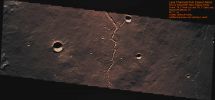
Volcanic_Features-Lava_Flows-Elysium_Mons-PCF-LXTT-20080325a.jpgLava Channels from Elysium Mons (Enhanced Absolute Natural Colors; credits for the additional process. and color.: Dr Paolo C. Fienga - Lunexit Team)59 visitenessun commentoMareKromium
|
|

PSP_009396_2590_red.jpgDefrosted Margin of the North Polar Erg (natural colors; credits: Lunexit)59 visiteThis image shows a traverse across a section of the North Polar Erg, a vast Sea of Sand that surrounds the Polar Cap.
The source of the dunes may be from the eroding North Polar Layered Deposits. Wind, acting on this mixture of sand, dust and ice, has formed several dune types on top of bright megaripples and polygons. A dark mantle of sand lies beyond the dunes.
The central part of the field contains transverse dunes with the dominant wind direction coming from the North/West-West. The outer edges of the Dunefield transition into "Star Dunes" (with multiple arms) and "Barchanoid Dunes" (crescent-like shape). The Star Dunes indicate a multidirectional wind regime or a change in wind direction over the Dunefield’s evolution.
The dunes are somewhat confined to their location and may have taken hundreds of years to form.MareKromium
|
|

PHOE-SOL094-PIA11060.gifIce Clouds over Vastitas - Sol 94 (GIF-Movie; credits: NASA)59 visiteClouds scoot across the Martian Sky in a movie clip consisting of 10 frames taken by the Surface Stereo Imager on NASA's Phoenix Mars Lander.
This clip accelerates the motion. The camera took these 10 frames over a 10-minute period from 14:52 to 15:02 M.LT. at the Phoenix Site during Sol 94 (Aug. 29), the 94th Martian day since landing.
Particles of water-ice make up these clouds, like ice-crystal cirrus clouds on Earth. Ice hazes have been common at the Phoenix site in recent days. The camera took these images as part of a campaign by the Phoenix team to see clouds and track winds. The view is toward slightly West of due South, so the clouds are moving Westward or West-NorthWestward.
The clouds are a dramatic visualization of the Martian Water Cycle. The water vapor comes off the North Pole during the peak of Summer. The Northern-Mars Summer has just passed its peak water-vapor abundance at the Phoenix Site. The atmospheric water is available to form into clouds, fog and frost, such as the Lander has been observing recently. MareKromium
|
|

APOLLO_16_AS_16-113-18325.jpgAS 16-113-18325 - EVA-1 : Panorama (natural colors; credits: Lunexit)59 visiteRightward of 18324, toward Stone Mountain. This picture also shows the brightly-lit Western Wall of the crater behind the LM.
MareKromium
|
|

PHOE-SOL101-MF-LXT.jpgFrosty Rocks - Sol 101 (natural colors; credits: Dr M. Faccin)59 visitenessun commentoMareKromium
|
|

SOL1651-MF-LXT.jpgColours' Variety... - Sol 1651 (True - but enhanced - Colors; credits: Dr M. Faccin)59 visitenessun commentoMareKromium
|
|
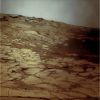
OPP-SOL1423-1.jpgVictoria's Paving - Sol 1423 (natural Colors; credits: Dr G. Barca)59 visitenessun commentoMareKromium
|
|

Panoramic-AS15-89-12132-12140-2.jpgFrom AS 15-89-12132 until 12140 (EVA-3 - Outcrop)59 visiteMareKromium
|
|

Panoramic-AS17-147-22558-22561-3.jpgFrom AS 17-147-22558 until 22561 (EVA-1; Geophone 3)59 visitenessun commentoMareKromium
|
|
| 25353 immagini su 2113 pagina(e) |
 |
|
|
|
|
1266 | |
|
|
|
|





