| Piú viste |
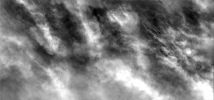
Clouds-South_Polar_Regions-PIA02182-1.jpgThick Clouds over the South Pole (Original NASA/MGS/MSSS b/w Frame)59 visiteCaption originale:"In this image the Martian Surface is completely hidden from view by thick clouds. The thickness of the clouds indicates the dust is a major component of the clouds. Images like this one can provide vital information about the atmosphere and climate of Mars today. This image was collected during late Summer near the South Pole".
Image information: VIS instrument;
Latitude: - 69,9° N;
Longitude: 235,3° E;
Resolution: 17 meter/pixel.
|
|
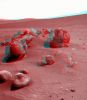
SOL143-3D.jpgBoulders, like "sleeping bears"... - Sol 14359 visiteUn frame 3D tra i più spettacolari, a nostro parere, mai realizzati dagli Amici di Mars Unearthed.
|
|
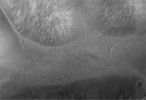
Chaotic_Terrain-Aram_Chaos-R2200155-02.jpgThe "Many Faces" of Aram Chaos (3 - EDM n. 2 - Original NASA/MGS/MSSS b/w Frame)59 visiteUna speculazione ulteriore del Dr Skipper è che una possibile forma di Civiltà Indigena Marziana stia cercando di "salvare il salvabile", ossìa - impiegando sistemi e tecnologie che non riusciamo a comprendere (nè a vedere) - stia tentando in tutti i modi di mantenere almeno un minimo di acque correnti sulla superficie di Marte.
"If so and there are actually extensive civilization populations on Mars, it may seem strange at first blush that so many of them appear to be so focused on water on such a generally arid planet to the point of even getting in the water that is left with their developments. On the other hand, if these populations have historically been part of this drying planetary reality for a very long time and have a historical memory base of more water plentiful times, it may be understandable that they may a bit compulsively try to preserve as much as possible a current semblance of the older loved conditions. Of course there may be other reasons as well"
|
|

Chaotic_Terrain-Aram_Chaos-R2200155-09.jpgThe "Many Faces" of Aram Chaos (10 - EDM n. 9 - Original NASA/MGS/MSSS b/w Frame)59 visiteE dunque, alla fine, qual'è il "vero volto" di Aram Chaos, come del resto di Marte? Noi non lo sappiamo, ovviamente, però, come fa il Dr Skipper (che comunque stimiamo) e tanti altri Ricercatori, noi continuiamo a cercarlo...
|
|

Titan-W00013655.jpgThe "bright light" is gone59 visiteFrame immediatamente successivo a quello che evidenziava un luce bianca e brillante (8 pixels) negli strati superiori dell'atmosfera di Titano: ora tutto appare "normale". Si trattava dunque di un photoartifact o di un oggetto reale?
Caption originale:"W00013655.jpg was taken on February 27, 2006 and received on Earth February 27, 2006. The camera was pointing toward TITAN at approximately 32.110 Km away, and the image was taken using the CB3 and CL2 filters. This image has not been validated or calibrated".
|
|

Comets-Comet_Pojmanski-2.jpgThe "Pojmanski" Comet59 visiteE' passata inosservata, lontana dalla nostra Terra, ed è stata ben lungi dall'essere spettacolare come lo fu, qualche anno fa, la meravigliosa Hale-Bopp.
Certo, la cometina Pojmanski non aveva - forse - i numeri giusti per entrare nell'Albo delle (cosiddette) Grandi Comete, ma certo è che i media (TUTTI!) se ne sono guardati bene dal pubblicizzarla. E la NASA? Leggerete Voi stessi le scarne note prodotte al riguardo nel "NASA - Picture of the Day" del giorno 6 Marzo 2006. Noi, nel nostro piccolo, dato che ci meravigliamo per niente, siamo andati in cerca di fotografie di questa cometa ed abbiamo "scoperto" una straordinaria somiglianza fra C/2006 A1 (la Pojmanski Comet appunto) e la C/2004 Q2 (meglio nota come Machholz Comet). Uguale tipologia - o classe visuale - di appartenenza (nucleo sferico e chioma filiforme) e, soprattutto, uguale colore (ergo uguale - o comunque molto simile - composizione chimica). Deduzione logica: si tratta di "Sister-Comets". Domanda: ci sono altre "sorelle" in arrivo?!?
Have you ever seen a comet? Comets bright enough to be visible to the unaided eye appear only every few years. Right now, however, a new comet has brightened unexpectedly and is visible as a faint streak to the unaided northern observer in the eastern morning sky just before sunrise. Binoculars may help. Comet Pojmanski, officially designated C/2006 A1 and discovered only in January, now sports a turquoise tail several times longer than the full moon. Comet Pojmanski's ion tail is due to gas particles expelled by the comet being pushed away from the Sun by the solar wind, the same wind that ionizes gas in the tail causing its blue tint. Pictured above as it appeared only last week, Comet Pojmanski has now begun to fade as its orbit around the Sun takes it further from the Earth.
|
|
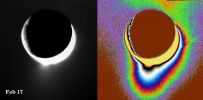
Enceladus-PIA07798.jpgEnceladus' active South Pole (1)59 visitePlumes of icy material extend above the Southern Polar Region of Enceladus, as imaged by the Cassini spacecraft in February 2005. The monochrome view is presented along with a color-coded version on the right. The latter reveals a fainter and much more extended plume component.
Images like these are being analyzed by scientists as they seek to explain the processes that could be producing such incredible features. As reported in the journal Science on March 10, 2006, imaging scientists believe that the plumes are geysers erupting from pressurized subsurface reservoirs of liquid water above 273 degrees Kelvin (0° C.).
Another plume view was taken 1 month earlier and looks broadside at the moon's prominent "Tiger Stripe" fractures. In the January view, the plume appears to have a single component. The February view looks along the Tiger Stripe fractures and reveals both a large and a small component to the plume; the smaller, fainter component is separated from the main plume by about 100 Km.
|
|

OPP-SOL753-1N195036614EFF64__P1784R0M1.jpgLike an island, in a Sea of Dust... (2) - Sol 75359 visitenessun commento
|
|

SOU-SOL075-Npeak_glyph.jpgNorth Peak and boulder field (3D) - Sol 7559 visiteCaption NASA originale:"This stereo Soujourner Rover image taken on Sol 75 shows foreground rocks and, on the horizon, "North Peak" (0,86 Km away)".
|
|

SOU-SOL080.jpgRocks and boulders - Sol 8059 visitenessun commento
|
|

Titan-PIA08137.jpgHaze-layers and a bright "spot", from 2,3 MKM!59 visiteLe nebbie di Titano sono ormai una realtà acquisita e consolidata, ma le Singolarità Atmosferiche (non sappiamo come altro chiamarle, per ora...) che la Sonda Cassini, di tanto in tanto, riesce a fotografare mentre si sporgono attraverso le nuvole di questo pianeta, costituiscono ancora un mistero. In questo frame, cerchiato in bianco, un "qualcosa" che emerge dalla densa atmosfera di Titano e che non è stato censurato dagli "Amici di Pasadena". Non si tratta, per ovvi motivi, di un rilievo superficiale e non è neppure un photoartifact (ormai avete anche Voi esperienza sufficiente per riconoscere "ictu oculi" un artefatto fotografico da un oggetto reale).
E' una Sonda Aliena in ricognizione? E' una "plume" vulcanica o magari una "nuvola colonnare" (evento più unico che raro nell'intero Sistema Solare)?
Che cosa stiamo guardando, in realtà?!?...
This composite of 24 images from the Cassini spacecraft shows multiple layers in Titan's stratospheric haze. The most prominent layer is located about 500 Km above the surface and is seen at all latitudes, encircling the moon. The material in this layer is probably a condensed substance, possibly water ice.
Several other layers are most apparent in the north polar hood (at top), but this view also shows some at other latitudes. The mechanisms that produce these layers are not understood, but waves in the atmosphere are thought to play a significant role.
The images in this composite were taken over a period of 23 minutes. The images were processed to enhance fine detail and then were combined to create this view. North on Titan (5,150 kilometers, or 3,200 miles across) is up.
The images were taken in visible light with the narrow-angle camera on Jan. 27, 2006 at a distance of approximately 2.3 million kilometers (1.4 million miles) from Titan and at a Sun-Titan-spacecraft, or phase, angle of 155 degrees. Image scale is 13 kilometers (8 miles) per pixel.
|
|

Terra_Cimmeria-Gullies-PIA02919-1.jpgGullies in Terra Cimmeria (Original RAW Frame)59 visiteCaption originale NASA:"This MGS-MOC image shows two suites of gullies within a single impact crater in the Terra Cimmeria Region. The gullies near the top of the image are located on the northern wall of the crater, while the lower suite resides on a lower bench in the crater's northern wall complex. Gully erosion has cut into the layered rock exposed on the crater wall. Water may have been involved in their formation".
Location near: 38,2° South; 190,6° West
Image width: ~3 Km (~1,9 mi)
Illumination from: upper left
Season: Southern Summer
|
|
| 25353 immagini su 2113 pagina(e) |
 |
|
|
|
|
1263 | |
|
|
|
|





