| Piú viste |

vo1-PIA00300-PCF-LXTT.jpgOlympus Mons (Natural Colors; credits for the additional process. and color.: Dr Paolo C. Fienga - Lunexit Team)60 visitenessun commentoMareKromium
|
|
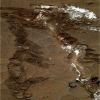
SOL1098-3.jpgRover Tracks, Salt and Sulphates - Sol 1098 (possible True Colors; credits: Dr G. Barca & Lunexit)60 visitenessun commentoMareKromium
|
|

SOU-SOL016-PCF-LXTT.jpgUs, beyond the Martian Clouds... - Sol 16 (Absolute Natural Colors; credits for the additional process. and color.: Dr Paolo C. Fienga - Lunar Explorer Italia)60 visitenessun commentoMareKromium
|
|

Channels-Unnamed_Channel_in_Terra_Sabaea.jpgUnnamed Channel in Terra Sabaea (Natural Colors/Tri-Chromatic Version; credits: Dr Paolo C. Fienga - Lunexit Team)60 visitenessun commentoMareKromium
|
|
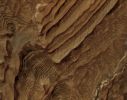
PSP_004078_2015_RED_browse-01.jpgLayered Rocks within Becquerel Crater (enhanced natural colors; credits: Lunar Explorer Italia)60 visiteRhythmic bedding in sedimentary bedrock within Becquerel Crater on Mars is suggested by the patterns in this image from the High Resolution Imaging Science Experiment (HiRISE) camera on NASA's Mars Reconnaissance Orbiter.
Three dimensional analysis based on stereo pairs of images confirmed the regularity of repetition in the thickness of the beds. In the left half of this image, some of the rhythm is apparent as a series of bundles of about 10 individual layers per bundle. By corresponding to a known 10-to-one pattern in changes in the tilt of Mars' Rotation Axis, this pattern suggests the periodicity in the rock layers results from cyclical changes in the Planet's tilt.
This view covers an area about 1150 meters (0,7 miles) wide. Individual layers in the scence average 3,6 meters (12 feet) thick. The view is presented in enhanced natural colors emphasizing the differing compositions of surface material. Sand trapped in relative low points in the terrain appears grey-blueish. Sedimentary rocks appear brown.
Faulting apparent in the image suggests that the deposits are hardened rock, not softer material. Tilting of the layers in different ways and the surface topography made the three-dimensional analysis necessary for determining the thickness of layers.
This image is a portion of the HiRISE image catalogued as PSP_004078_2015, taken on June 10, 2007.
The location of the imaged area is at 22° North Latitude, 352° East Longitude, within the Arabia Terra Region.MareKromium
|
|
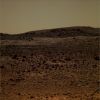
SOL1377-4.jpgRocky Landscape - Sol 1377 (possible True Colors; credits: Dr G. Barca & Lunexit)60 visitenessun commentoMareKromium
|
|

Titan-N00124864.jpgTitan in possible True Colors (credits by Lunar Explorer Italia)60 visiteCaption NASA:"N00124864.jpg was taken on December 05, 2008 and received on Earth December 06, 2008. The camera was pointing toward TITAN that, at the time, was approximately 171.534 Km away.
The image was taken using the CL1 and CB3 filters".MareKromium
|
|

Titan-W00051746.jpgCrescent Titan (possible True Colors; credits: Lunar Explorer Italia)60 visiteCaption NASA:"W00051746.jpg was taken on December 06, 2008 and received on Earth December 06, 2008. The camera was pointing toward TITAN that, at the time, was approx. 313.546 Km away.
The image was taken using the CL1 and CL2 filters".MareKromium
|
|
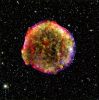
SNR-Tycho-SR-PIA11435.jpgTycho: the most colourful Supernova Remnant60 visiteThis composite image of the Tycho Supernova Remnant combines InfraRed and X-Ray observations obtained with NASA's Spitzer and Chandra space observatories, respectively, and the Calar Alto observatory, Spain.
It shows the scene more than four centuries after the brilliant star explosion witnessed by Tycho Brahe and other astronomers of that era.
The explosion has left a blazing hot cloud of expanding debris (green and yellow). The location of the blast's outer shock wave can be seen as a blue sphere of ultra-energetic electrons. Newly synthesized dust in the ejected material and heated pre-existing dust from the area around the supernova radiate at infrared wavelengths of 24 microns (red).
Foreground and background stars in the image are white.MareKromium
|
|

Moon_Halo.jpgSpanish Moon60 visitenessun commentoMareKromium
|
|
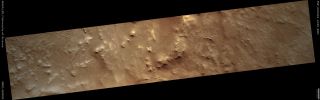
Psp_009442_2030_red.jpgAntoniadi Crater (possible True Colors; credits: Lunar Explorer Italia)60 visiteMars Local Time: 15:22 (early afternoon)
Coord. (centered): 22,9° North Lat. and 53,5° East Long.
Spacecraft altitude: 282,0 Km (such as about 176,2 miles)
Original image scale range: 56,4 cm/pixel (with 1 x 1 binning) so objects ~1,69 mt across are resolved
Map projected scale: 50 cm/pixel
Map projection: EQUIRECTANGULAR
Emission Angle: 0,3°
Phase Angle: 46,1°
Solar Incidence Angle: 46° (meaning that the Sun is about 44° above the Local Horizon)
Solar Longitude: 106,5° (Northern Summer)
Credits: NASA/JPL/University of Arizona
Additional process. and coloring: Lunar Explorer ItaliaMareKromium
|
|
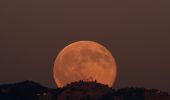
Moonrise.JPGMoonrise over Lick Observatory60 visitenessun commentoMareKromium
|
|
| 25353 immagini su 2113 pagina(e) |
 |
|
|
|
|
1258 | |
|
|
|
|





