| Piú viste |

Europa-PIA01126.jpgEuropa's Lanscape (HR)60 visiteThis mosaic shows some of the highest resolution images obtained by the Solid State Imaging (SSI) System on NASA's Galileo spacecraft during its 11th orbit around Jupiter. North is to the top of the image. The Sun illuminates the scene from the left, showing hundreds of ridges that cut across each other, indicating multiple episodes of ridge formation either by volcanic or tectonic activity within the ice. Also visible in the image are numerous isolated mountains or "massifs". The highest of these, located in the upper right corner and lower center of the mosaic, are approx. 500 mt (about 1.640 feet) high. Irregularly shaped areas where the ice surface appears to be lower than the surrounding plains (e.g., in the left-center and lower left corner of the mosaic) may be related to the "chaos" areas of iceberg-like features seen in earlier SSI images of Europa.
The mosaic, centered at 35,4° North Lat. and 86,8° West Long., covers an area of 108 by 90 Km (about 66 x 55 miles).
The smallest distinguishable features in the image are about 68 meters (223 feet) across. These images were obtained on November 6, 1997, when the Galileo spacecraft was approximately 3,250 kilometers (1,983 miles) from Europa.
|
|

Saturn-PIA08162.jpgSaturnian (swirling) clouds60 visiteCaption NASA originale:"The bright whorls and small-scale specks of convective clouds drift through a Region just North of Saturn's bright Equatorial Band. Observers have seen major storms develop in this Region in the past 15-20 years.
The image was taken in visible red light with the Cassini spacecraft narrow-angle camera on March 13, 2006, at a distance of approximately 2,6 MKM (about 1,6 MMs) from Saturn. The image scale is approx. 15 Km (about 9 miles) per pixel".
|
|

M-082-0.jpgM 82 - Barred Spiral Galaxy (HST)60 visite"...Ab ovo usque ad mala..."
(Orazio)
"...Dall'uovo alle mele..." (trad. libera: "dall'inizio alla fine")
nota: la cena romana tipica (per la classe medio-alta) cominciava con le uova e finiva con le mele
|
|

VAA-Uranus Rings.2jpg.jpgBeautiful Starfield, through Uranus' Rings60 visitenessun commento
|
|

Tempel1-ZZ-ZL-PIA02132_fig1.jpgThe "Sunny Side" of Comet Tempel-160 visiteCaption originale:"This image composite shows comet Tempel 1 in visible (left) and infrared (right) light. The infrared picture highlights the warm, or sunlit, side of the comet, exactly where NASA's Deep Impact probe hit. These data were acquired about six minutes before impact.
The visible image was taken by the medium-resolution camera on the mission's flyby spacecraft, and the infrared data were acquired by the flyby craft's infrared spectrometer".
|
|

OPP-SOL806-1M199735971EFF69RRP2956M2M1.jpgUp-close and personal (5) - Sol 80660 visitenessun commento
|
|

Jupiter~1.jpgThe "Eyes" of Jupiter: a change of colors could mean a climate change?60 visiteJupiter's Great Red Spot is a swirling storm seen for over 300 years, since the beginning of telescopic observations. But in February 2006, planetary imager Christopher Go noticed it had been joined by Red Spot Jr - formed as smaller whitish oval-shaped storms merged and then developed the remarkable reddish hue. This sharp HST image showing the two salmon-colored Jovian storms was recorded in April 2006. About half the size of the original Red Spot, Red Spot Jr. is similar in diameter to planet Earth. Seen here below and left of the ancient storm system, it trails the Great Red Spot by about an hour as the planet rotates from left to right. While astronomers still don't exactly understand why Jupiter's red spots are red, they do think the appearance of Red Spot Jr. provides evidence for climate change on the Solar System's ruling Gas Giant.
|
|

Titan-Atmosphere.jpgAtmospheres...60 visitenessun commento
|
|
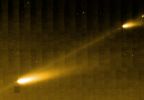
Comets-Schwassmann_Wachmann_1-04.jpgComet Schwassmann-Wachmann 3 from SST60 visiteThis image from NASA's Spitzer Space Telescope (SST) shows three of the many fragments making up Comet 73P/Schwassman-Wachmann 3. The infrared picture also provides the best look yet at the crumbling comet's trail of debris, seen here as a bridge connecting the larger fragments.
The comet circles around our Sun every 5,4 years.
In 1995, it splintered apart into four pieces, labeled "A" through "D", with "C" being the biggest. Since then, the comet has continued to fracture into dozens of additional pieces. This image is centered about midway between fragments "C" and "B"; fragment "G" can be seen in the upper right corner.
The comet's trail is made of dust, pebbles and rocks left in the comet's wake during its numerous journeys around the sun. Such debris can become the stuff of spectacular meteor showers on Earth.
This image was taken on April 1, 2006, by Spitzer's Multi-Band Imaging Photometer using the 24-micron wavelength channel.
|
|

Comets-Schwassmann_Wachmann_1-06.jpgComet Schwassmann-Wachmann 3 and M 5760 visiteMoving rapidly through planet Earth's night sky, Fragment "C" of crumbling comet 73P/Schwassmann-Wachmann 3 passed almost directly in front of M 57 - the "Ring Nebula" - and faint spiral galaxy IC 1296 on May 8, 2006. In fact, in this gorgeous view, the bright head of mentioned Fragment "C" is separated by only about 0,1° from M 57, with the tail apparently engulfing nebula and galaxy.
Recorded from Elizabeth, Illinois, USA, this picture corresponds to the cosmic scene only 30 minutes after yesterday's picture of the approaching alignment. The relative motion of the comet against the background stars and nebulae is easy to see when comparing the two images. This comet's fragments will be near their closest approach in the coming days, about 10 MKM away, and none pose any danger to our fair planet.
|
|

OPP-SOL818-1P200803304EFF70VMP2410L2M1.jpgBad tampering... - Sol 81860 visiteCerchiatura Blu: un rilievo bizzarro...ma credibile.
Cerchiatura Verde: un rilievo assurdo...ed impossibile.
|
|

Large Magellanic Cloud-1.jpgThe Large Cloud of Magellan (HR)60 visiteAn alluring sight in dark Southern skies, the Large Magellanic Cloud (LMC) is seen here through a narrow filter that transmits only the red light of Hydrogen Atoms. Ionized by energetic starlight, a Hydrogen Atom emits the characteristic red H-alpha light as its single electron is recaptured and transitions to lower energy states. As a result, this image of the LMC seems covered with shell-shaped clouds of Hydrogen gas surrounding massive, young stars. Sculpted by the strong stellar winds and ultraviolet radiation, the glowing Hydrogen clouds are known as "H-II" (such as Ionized Hydrogen) Regions. This HR mosaic view was recorded in 6 segments, each with 200 minutes of exposure time. Itself composed of many overlapping shells, the Tarantula Nebula, is the large star forming Region near top center. A satellite of our Milky Way Galaxy, the LMC is about 15,000 light-years across and lies a mere 180.000 LY away in the constellation known as Dorado.
|
|
| 25353 immagini su 2113 pagina(e) |
 |
|
|
|
|
1256 | |
|
|
|
|





