| Piú viste |

Saturn-W00003147.jpgSaturn's Rings overexposed (4)59 visiteUn'ennesima - curiosissima, dobbiamo ammetterlo - versione degli Anelli di Saturno ampiamente sovraesposti. Che cosa sia il "raggio" di luce che sembra avere origine dagli Anelli stessi, ci è impossibile dirlo. Se andate a guardare il Sito dedicato alla Sonda Cassini-Huygens e, in particolare, quella sua sezione dedicata alle "last 500 raw images" della Sonda, avrete l'opportunità di notare il quantitativo sempre crescente, negli ultimi tempi, di questo tipo di immagine sovraesposta la quale, come ha fatto con noi, ha tratto in inganno tanti Ricercatori ed Appassionati. Questo tipo di immagini "strane" ed "ingannevoli", dunque, è salito (molto), ma il quantitativo globale di immagini in arrivo da Saturno si è paurosamente abbassato. Per questa volta evitiamo speculazioni che sarebbero (forse) troppo ovvie, però non possiamo non notare che questo nuovo trend è decisamente inusuale.
|
|
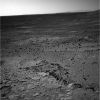
SOL310-2N153890893EFF9100P0645L0M1.jpgDust (?) in the distance... (1)59 visiteDal Sol 310 di Spirit arriva questo suggestivo contro-luce (relativo alle prime ore del pomeriggio di Marte - h. 14.38 locali) il quale ci mostra un orizzonte velato da foschie che coprono in parte i rilievi più distanti. Si tratta di immagini, come sempre, di grande valore e bellezza, ma molto difficili da interpretare: come ormai sapete molto bene il nostro (ma non solo nostro...) dubbio più grande attiene la composizione di questa "foschia". Si tratta solo di polveri in sospensione o di umidità vera e propria o di entrambe le cose? La logica ed i dati (spezzettati, discutibili e molto spesso contraddittori) che la NASA ci fornisce di quando in quando, non sono sufficienti per operare valutazioni scientificamente corrette. Non possiamo fare altro che sottoporVi le immagini ed invitarVi a riflettere...
|
|

Rhea-PIA06525_modest.jpgRhea from about 1.700.000 Km59 visiteCaption NASA originale:"Saturn's moon Rhea shows off the moon equivalent of a black eye: a bright, rayed crater near its eastern limb.
Rhea is about half the size of Earth's moon. At 1.528 Km across, it is the second-largest moon orbiting Saturn.
The image was taken in visible light with the Cassini spacecraft narrow angle camera on Oct. 24, 2004, at a distance of about 1.7 MKMs from Rhea and at a Sun-Rhea-spacecraft, or phase, angle of 40°. The image scale is approximately 10 Km per pixel. Cassini will image this hemisphere of Rhea again in mid-January 2005 with an approx. 1 Km resolution".
|
|
SOL317-2N154515740EFF9400P0745R0M1.jpgPanorama from Sol 317 (7) - Sun's going down...59 visitenessun commento
|
|

Hyperion-PIA06527.jpgHyperion from approx. 2.200.000 Km59 visiteCaption NASA originale:"This image reveals the odd shape of Saturn's moon Hyperion and an intriguing variation in brightness across its surface (ndr: just like Japetus?!?).
The diameter of Hyperion is 266 Km.
The image was taken in visible light with the Cassini spacecraft narrow angle camera on Oct. 20, 2004, at a distance of about 2.2 MKM from Hyperion and at a Sun-Hyperion-spacecraft, or phase, angle of 50°. The image scale is 13 Km per pixel".
|
|

Saturn-the Encke Gap-PIA06534_modest.jpgThe "Encke Gap" of Saturn's Rings59 visiteCaption NASA originale:"An intriguing knotted ringlet within the Encke Gap is the main attraction in this Cassini image. The Encke Gap is a small division near the outer edge of Saturn's rings that is about 300 Km wide. The tiny moon Pan (20 Km across) orbits within the gap and maintains it.
Many waves produced by orbiting moons are also visible.
The image was taken in visible light with the Cassini spacecraft narrow angle camera on Oct. 29, 2004, at a distance of about 807,000 Km from Saturn. The image scale is 4,5 Km per pixel".
|
|

Japetus-PIA06145_modest.jpgSharp views of Japetus59 visiteIn sequenza, alcune delle migliori immagini di Giapeto ottenute da Cassini e superiori, per qualità e dettaglio, a quelle ottenute dalla Sonda Voyager 2 qualche anno fa. Le immagini a colori visibili sulla Sn dell'Osservatore ed al centro sono state ottenute usando (e combinando) i filtri per l'ultravioletto (a 338 Nnmts), il verde (a 568 Nnmts) e l'infrarosso (a 930 Nnmts); l'immagine a Dx è stata ottenuta riprendendo nel cosiddetto "spettro visibile". Le immagini sono state riprese da una distanza oscillante fra gli 1,1 e gli 1,3 MKMs; Giapeto si caratterizza sia per il gigantesco cratere da impatto visibile nell'emisfero sud (400 Km di diametro), sia per alcune notevoli differenze di albedo fra diverse zone della sua superficie (il che ci fa supporre che esistano aree ricoperte, probabilmente, da vasti depositi di polveri - che sono causa di una bassa riflessione della luce ergo di una bassa albedo - ed altre aree che, forse, sono costituite da rocce o addirittura da depositi di ghiaccio).
|
|

OPP-SOL317-1N156329337EFF3940P0705L0M1.jpgOut of Endurance Crater: the "orange" desert, again!59 visiteVeduta di Meridiani Planum, ovvero il "deserto arancione" (ma sarà poi davvero arancione?!?) che circonda il Cratere Endurance. Alla NASA dicono che il primo obbiettivo di Opportunity sarà lo Scudo Termico e poi...Avanti in direzione Sud, senza una mèta in particolare. Ora il Rover è fermo ed ha aperto i suoi pannelli per ricaricarsi; nei prossimi Soles, vedremo che cosa Marte ha in serbo per noi...
|
|

Titan-Clouds-PIA06157.jpgTitan: Mid-Latitude Clouds59 visiteCaption NASA originale:"The Clouds seen here are at about 38° South Latitude on Titan. The Clouds across the middle of the frame extend about 250 Km (approx. 155 miles). The image scale is about 0,6 Km (approx. 0,4 miles) per pixel".
|
|

Titan-Clouds-PIA06158.jpgTitanian Clouds (October 2004 fly-by)59 visiteCaption NASA originale:"Cutting through the middle of the image is a sharp boundary between the bright region known as Xanadu Regio on the right and dark terrain to the left. Several smaller bright features, between 30 and 200 Km across are seen within the dark terrain. These intriguing features are a focus of further research and observations for Cassini scientists. One clue to their origin and history is the presence of bright "trails" within the dark material on the eastern sides of the bright spots. A mottled texture is seen within Xanadu, including dark, crisscrossing lines, suggestive of tectonic activity. No definitive craters have been found in these images, though several bright rings or circular features are seen in the dark terrain. However, without topographic shading, their identification as impact structures can not be confirmed. The images in this mosaic have been processed to enhance surface features and sharpen boundaries".
|
|

Dione-PIA06542_modest.jpgA line of craters on Dione and a crater with "something" inside...59 visiteAl di là della oggettiva bellezza e della grande suggestione che suscita questa immagine, la domanda (scherzosa, naturalmente) sorge in noi spontanea: ma dentro il "cratere maggiore" (proprio in centro, a ridosso del terminatore), che cosa c'è?!?
|
|

Saturn-PIA06164-br500.jpgSaturn, Titan and Mimas in real colors59 visiteCaption NASA originale:"From its station nearly 1,2 BKMs (or 746 MMs) from Earth, the stalwart Cassini spacecraft sends holiday greetings to Earth with this lovely color portrait of Saturn and two of its moons. This color portrait serves as reminder of the Saturnian places we have already seen and the promise of future discovery at Titan when the European Space Agency's Huygens probe arrives at Titan on Jan. 14, 2005. A grayish, oval-shaped storm is visible in Saturn's southern hemisphere and is easily 475 Km across - the size of some hurricanes on Earth. Titan is visible near lower right with its thick, orange-colored atmosphere, and faint Mimas (398 Km across) appears just right of the rings' outer edge. Images taken in the red, green and blue filters with the Cassini spacecraft wide angle camera on Dec. 14, 2004, were combined to create this color view at a distance of approximately 719.000 Km from Saturn. The image scale is 43 Km (or 27 miles) per pixel".
|
|
| 25353 immagini su 2113 pagina(e) |
 |
|
|
|
|
1252 | |
|
|
|
|





