| Piú viste |

Enceladus-PIA06191.jpgEnceladus: photomosaic59 visiteCaption NASA originale:"The view is about 300 Km across and shows the myriad of faults, fractures, folds, troughs and craters that make this Saturnian Satellite especially intriguing to planetary scientists. More than 20 years ago, NASA's Voyager spacecraft gave hints of a surface cut by tectonic features and subsequent images of other icy moons have revealed many different ways that stresses have acted on icy moon crusts. The new close-up images of Enceladus, which has a diameter of 505 Km, show some familiar-looking features and others that are brand new. Extending downward from the top center of the mosaic for hundreds of kilometers is a broad belt of complex, interwoven fractures. A huge rift 5 Km-wide dissects this belt and extends into several older-looking, distinct regions or "cells" of terrain that themselves exhibit distinct fracture patterns. The work required to unravel their origins, their formation sequence, and the implications for the evolution of icy Solar System bodies is just beginning...".
|
|

Enceladus-PIA06188.jpgEnceladus "tormented" surface59 visiteCaption NASA originale:"This HR image from Cassini shows a region of "smooth plains" terrain on the surface of Saturn's moon Enceladus, located slightly north of the equator on the moon's Saturn-facing hemisphere. The area is about 70 by 84 Km.
The image shows a variety of tectonic features that attest to Enceladus' dynamic geological history. At the top of the image is a relatively fresh-looking crevasse system with individual fractures more than a kilometer wide. The crevasse system cross-cuts a complex NE-to-SW-trending system of older faults. A 12-Km-wide band of crudely aligned, chevron-shaped features runs down the center of the image. Among the most intriguing features in this view are a series of dark, small spots, 125 to 750 meters in diameter.
The "dark spots" often seem to be aligned in chains parallel to narrow fractures. The contrast of the dark features with the surrounding bright terrain suggests that they may be compositionally distinct, but their origin is a new mystery".
|
|

Rings-PIA06588.jpgThe "rings" and a "string" of Moons...59 visiteCaption NASA originale:"Moons visible in this image: Mimas (398 Km, or 247 miles across) at right, Pandora (84 Km, or 52 miles across) near center and Janus (181 Km, or 113 miles across) in the lower left corner. Mimas' orbit inclination of 1,6° relative to Saturn's equator is enough to make it appear as if it orbits just beyond the F-Ring when viewed from this vantage point of 5° below the Rings. In fact, it is 34.000 Km (such as approx. 21.000 miles) more distant than Janus".
|
|
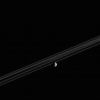
Mimas-N00028766.jpgMimas and the Rings, from approx. 1.378.000 Km59 visiteUna splendida immagine, che non serve commentare.
|
|

Janus-N00028725.jpgJanus and the "Lord of the Rings"59 visitenessun commento
|
|

Saturn-W00005056.jpgSaturn, from approx. 1.130.000 Km59 visitenessun commento
|
|

Saturn-PIA06194.jpgAre these "anomalies" the clock-tracks of a New Moon?59 visiteUna piccola premessa: le irregolarità fisiche del margine esterno dell'Anello A, situate in prossimità di quella zona conosciuta come Divisione Keeler (larga circa 42 Km), sono ritenute dalla NASA una evidenza indiretta (o prova circostanziale) dell'esistenza di una nuova 'luna nascosta'. In realtà, queste alterazioni fisiche - le quali altro non sono che il riflesso visibile delle interazioni gravitazionali esercitate da corpi sufficientemente vicini - allorchè i corpi interagenti sono, almeno relativamente, "stabili" (come dobbiamo ragionevolmente supporre che sia nel nostro caso), si caratterizzano per una sostanziale regolarità e ripetitività. Ora nell'immagine di riferimento, come potete vedere Voi stessi, questa 'anomalia gravitazionale' sembra tutt'altro che regolare e ripetitiva. Perchè non provare a pensare, dunque, ad una vera e propria 'interazione complessa' (possibile indice della presenza di più lune) o, magari, a qualcosa di diverso (per esempio ad un - raro - Fenomeno Transitorio)?
|
|
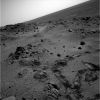
SOL409-2N162678514EFFA800P0705R0M1.jpgAnomalous stones (6)59 visiteE con questo frame - un pò più "scuro" degli altri - che ci offre una diversa prospettiva del "Nido", chiudiamo la panoramica relativa alle "Singolarità" riprese durante il Sol 409 del Rover Spirit.
Difficile fare altri commenti...
|
|

Enceladus-PIA06597.jpgEnceladus and Tethys59 visiteCaption NASA originale:"In this unusual view, Cassini captured two icy moons of Saturn, Tethys and Enceladus, in a single narrow-angle frame. Little detail is visible on the surface of bright Enceladus, but battered Tethys shows many craters and the huge canyon system, Ithaca Chasma. Tethys has a diameter of 1.071 Km (approx. 665 miles) across, while Enceladus is 505 Km (approx. 314 miles) across.
The image was taken in visible light with the Cassini spacecraft narrow-angle camera on Jan. 29, 2005, at a distance of approx. 3,7 MKM (approx. 2,3 MMs) from Tethys and 3,5 MKM (approx. 2,2 MMs) from Enceladus. Resolution in the original image was 22 Km (approx. 14 miles) per pixel on Tethys and 21 Km (approx. 13 miles) per pixel on Enceladus. The image has been contrast-enhanced and magnified by a factor of two to aid visibility".
|
|
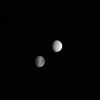
Tethys and Dione-N00029831.jpgTethys and Dione59 visiteUno dei tanti "incroci" fra le lune di Saturno, al quale la Sonda Cassini ha avuto l'onore di assistere da una distanza - per così dire... - ragionevole: in fondo, fra Cassini e Tethys, ci sono solo un milione e mezzo di km...
|
|

Enceladus-N00030084.jpgEnceladus, from approx. 17.000 Km59 visiteAncora il grande cratere che avevamo visto nel frame precedente, più vicino di oltre 4000 Km. Stupenda, semplicemente, la visione del terminatore di Encelado ed i conseguenti grandi contrasti luce-ombra, determinati dalle differenti altezze dei rilievi fotografati.
|
|

Epimetheus-PIA06605.jpgEpimetheus, from approx. 2,5 MKM59 visiteCaption NASA originale:"One of Saturn's strange co-orbital moons, Epimetheus, was captured by Cassini in this view. Irregularly shaped Epimetheus occasionally swaps orbits with nearby Janus and both moons play a role in maintaining the outer edge of Saturn's bright A-Ring. Epimetheus is 116 Km (approx. 72 miles) across.
The image was taken in visible light with the Cassini spacecraft narrow-angle camera on Jan. 22, 2005, at a distance of approximately 2,5 MKM (approx. 1,6 MMs) from Epimetheus and at a phase angle of 90°.
Resolution in the image is 15 Km (approx. 9 miles) per pixel.
The image has been contrast-enhanced to aid visibility".
|
|
| 25353 immagini su 2113 pagina(e) |
 |
|
|
|
|
1250 | |
|
|
|
|





