| Piú viste |

B-Mercury-PIA02418.jpgMercury: the "outgoing" hemisphere59 visiteCaption NASA originale:"This mosaic shows the planet Mercury as seen by Mariner 10 as it sped away from the planet on March 29, 1974. The mosaic was made from over 140 individual TV frames taken about two hours after encounter, at a range of 37.300 miles (60.000 Km ). North is at top. The limb is at right, as is the illuminating sunlight. The equator crosses the planet about two-thirds of the way from the top of the disc. The terminator - such as the line-separating day from night - is about 190° West longitude. The planet shows a gibbous disc-more than half-illuminated. This hemisphere is dominated by smooth plains, rather than heavily cratered terrain, and resembles portions of the Moon's maria in general shape. Half of a very large, multi-ringed basin named Caloris Basin appears near the center of the disc near the terminator. Its surrounding mountain ring is 800 miles (1.300 Km) in diameter".
|
|

Comets-Machholz___Meteor.jpgComet Machholz and a "corkscrew" meteor59 visiteCaption NASA originale:"Meteor trains (train--->trajectory) that twist noticeably are rare but have been noted before. The underlying reason for unusual meteors trains is that many meteors are markedly non-spherical in shape and non-uniform in composition. Meteors, usually sand sized grains that originate in comets, will disintegrate as they enter the Earth's atmosphere. Non-uniform meteors may evaporate more on one side than another. This may cause a rotating meteor to wobble slightly in its path, and also to spray fast moving debris in a nearly spiral path. The fast moving meteor debris ionizes molecules in the Earth's atmosphere that subsequently glow when they reacquire elections. Surely no meteor is perfectly uniform and spherical, so that a slight swagger that is below perceptibility is likely typical. Meteors may well have seeded Earth with the prebiotic molecules that allowed for the development of life".
|
|
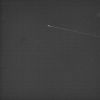
Unexplainable-N00027253.jpgSomething's moving in the Space of Saturn59 visiteImmagine ripresa dalla Sonda Cassini il 31 Gennaio 2005 e ricevuta a Terra il 1mo Febbraio.
Che cosa mostra? Si tratta, evidentemente, di un fenomeno - per noi - "unexplainable", come molti altri.
Le ipotesi sono le solite: 1) immagine "mossa" di una stella o di un piccolo satellite di Saturno (ipotesi più probabile); 2) oggetto in movimento "di passaggio" accanto alla Sonda - un UFO? - (ipotesi leggermente meno probabile); 3) artefatto fotografico (ipotesi decisamente improbabile). Noi saremmo propensi, per una molteplicità di fattori, a considerare l'ipotesi 1) come la più probabile (almeno in questo frangente).
|
|

Saturn-PIA07008.jpgSaturn's temperature emissions (upper troposphere)59 visiteCaption NASA originale:"This is the sharpest image of Saturn's temperature emissions taken from the ground; it is a mosaic of 35 individual exposures made at the W.M. Keck I Observatory, Mauna Kea, Hawaii on Feb. 4, 2004.
The images to create this mosaic were taken with infrared radiation. The mosaic was taken at a wavelength near 17,65 microns and is sensitive to temperatures in Saturn's upper troposphere. The prominent hot spot at the bottom of the image is right at Saturn's South Pole. The warming of the Southern Hemisphere was expected, as Saturn was just past Southern Summer Solstice, but the abrupt changes in temperature with latitude were NOT expected. The tropospheric temperature increases toward the pole abruptly near 70° latitude from 88° to 89° Kelvin (-301° to -299° Fahrenheit) and then to 91° Kelvin (-296° degrees Fahrenheit) right at the Pole. Ring particles are not at a uniform temperature: they are obviously coldest just after having cooled down in Saturn's shadow (lower left)".
|
|
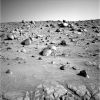
SOL387-2N160729178EFFA2K5P1818R0M1~0.jpgAnother "rocky panorama" full of perspective "artifacts"...59 visiteCi sono, in questo frame relativo al Sol 387 del Rover Spirit, almeno 3 massi che, a giudicare dalle loro forme e dalle incisioni che ne caratterizzano la superficie, potrebbero sembrare "parte di manufatti" (sia pure ormai in rovina). Noi siamo dell'idea che si tratti di semplici illusioni ottiche, però non si può mai dire...
Riuscite a vederli anche Voi?!?...
|
|

SOL059-061-Spirit_Legacy_1-L256-A392R1_br2-00.jpgLegacy Panorama - Soles 59 to 61 (Approximate True Colors; credits: NASA/JPL-Caltech)59 visiteCaption NASA originale:"This is view captured by the panoramic camera on NASA's Mars Exploration Rover Spirit nearly a year ago is called Spirit's "Legacy" panorama. It combines many frames acquired during Spirit's 59th through 61st martian days, or sols (March 3 to 5, 2004) from a position about halfway between the landing site and the rim of "Bonneville Crater." The location is within the transition from the relatively smooth plains to the more rocky and rugged blanket of material ejected from Bonneville by the force of the impact that dug the crater".
|
|
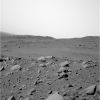
SOL391-2P161076229EFFA300P2367R1M1.jpgImpressive "Rocky Panorama" from Soles 391 and 392 (1)59 visiteLe immagini che Vi offriamo oggi provengono dai Soles 391 e 392 di Spirit. Noi ci aspettavamo qualche ripresa (e magari anche qualche close-up...) della roccia "squadrata" e invece...Nulla.
Rocce. Stranissime, come sempre, ma non correlate alla roccia che abbiamo provocatoriamente definito "pyramid". Guardate Voi stessi questa selezione...
|
|

Epimetheus-N00027756.jpgEpimetheus at the boundaries of the "Ringed Kingdom"59 visitenessun commento
|
|

RHEA~0.jpgRhea: a Moon made of "frozen water"! (possible ANOMALY)59 visiteDa "NASA - Picture of the Day" del 15 Febbraio 2005:"Rhea, Saturn's second largest moon behind Titan, shows unusual wisps (wisp---> piccola striscia), visible above as light colored streaks. HR images of the wisps show them to be made of long braided fractures. Rhea is composed mostly of water ice, but likely has a small rocky core. Rhea's rotation and orbit are locked together, just like Earth's Moon, so that one side always faces Saturn; a consequence of this is that one side always leads the other. Rhea's leading surface is much more heavily cratered than the above pictured trailing surface".
Vi segnaliamo inoltre una possibile "Anomalia" (e non crediamo che si tratti di un photo-artifact o di un difetto del frame derivante da un'incompleta trasmissione dei dati): se osservate il lato Sn di Rhea, in prossimità del bordo e circa ad ore 8, vedrete un "disco scuro" stagliarsi contro il grigio della sua superficie. Noi crediamo che sia un "corpo in transito" (magari una "luna di Rhea!).
|
|
SOL398-2N161703755EFFA500P0874L0M1.jpgWhere's the "pyramid"?!? (8)59 visitenessun commento
|
|

Enceladus-N00028181.jpgEnceladus: from VERY close! (1)59 visiteUna serie di 4 immagini ravvicinate (riprese da una distanza media di circa 1200 Km dalla superficie di questa "Luna di ghiaccio" la quale - a detta degli Scienziati - riflette la luce come se fosse "neve fresca") che ci mostrano lo stupefacente volto di Encelado.
In tutte le 4 immagini che Vi proponiamo sono chiaramente visibili delle lunghissime (ed intricate!) reti di crepacci ("cracks" e/o "chasmas") i quali, nel caratterizzare questa piccola Luna, la rendono, in qualche maniera, piuttosto simile - visivamente - alla Luna Gioviana "Europa".
In questo primissimo frame, inoltre, si può notare una sostanziale mancanza di crateri; una mancanza che, talvolta, può essere indice di una (relativa) 'gioventù geologica' della superficie!
|
|
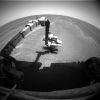
OPP-SOL380-1F161916844EDN4303P1131L0M1.jpgSol 380: is there another "meteorite" on Mars?!? (3)59 visiteIl braccio metallico del Rover si stende verso la roccia isolata che avevamo visto piuttosto bene nel frame precedente: la nostra convinzione, dopo aver visionato tutti i frames relativi al Sol 379, è che Opportunity, effettivamente, abbia dapprima "guardato" verso una roccia (quella che riteniamo essere "estranea" al panorama di Meridiani Planum), ma si sia poi "diretto" verso una roccia DIVERSA, anch'essa comunque - guardatela bene! - dalle caratteristiche esteriori davvero straordinarie.
Certo è che il modo usato dai Tecnici del Controllo Missione per manovrare il "robottino" ci pare, sempre più spesso, davvero strano...
|
|
| 25353 immagini su 2113 pagina(e) |
 |
|
|
|
|
1249 | |
|
|
|
|





