| |
| Piú viste |
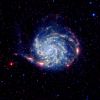
M-101-PIA10968.jpgM 101 - The "Pinwheel Galaxy"59 visiteThe Pinwheel Galaxy, otherwise known as Messier 101, sports bright reddish edges in this new infrared image from NASA's Spitzer Space Telescope. Research from Spitzer has revealed that this outer red zone lacks organic molecules present in the rest of the galaxy. The red and blue spots outside of the spiral galaxy are either foreground stars or more distant galaxies.
The organics, called Polycyclic Aromatic Hydrocarbons (PAH), are dusty, carbon-containing molecules that help in the formation of stars. On Earth, they are found anywhere combustion reactions take place, such as barbeque pits and exhaust pipes. Scientists also believe this space dust has the potential to be converted into the stuff of life.
Spitzer found that the PAH decrease in concentration toward the outer portion of the Pinwheel Galaxy, then quickly drop off and are no longer detected at its very outer rim. According to astronomers, there's a threshold at the rim where the organic material is being destroyed by harsh radiation from stars. Radiation is more damaging at the far reaches of a galaxy because the stars there have less heavy metals, and metals dampen the radiation.
The findings help researchers understand how stars can form in these harsh environments, where PAH are lacking. Under normal circumstances, the PAH help cool down star-forming clouds, allowing them to collapse into stars. In regions like the rim of the Pinwheel — as well as the very early universe — stars form without the organic dust. Astronomers don't know precisely how this works, so the rim of the Pinwheel provides them with a laboratory for examining the process relatively close up.
In this image, infrared light with a wavelength of 3,6 microns is colored blue; 8-micron light is green; and 24-micron light is red.
All three of Spitzer's instruments were used in the study: the infrared array camera, the multiband imaging photometer and the infrared spectrograph.MareKromium
|
|

W5-PIA11047.jpgW 5 - Stellar "Nursery" (natural colors)59 visiteGenerations of stars can be seen in this new infrared portrait from NASA's Spitzer Space Telescope. In this wispy star-forming region, called W5, the oldest stars can be seen as blue dots in the centers of the two hollow cavities (other blue dots are background and foreground stars not associated with the region). Younger stars line the rims of the cavities, and some can be seen as dots at the tips of the elephant-trunk-like pillars. The white knotty areas are where the youngest stars are forming.
W5 spans an area of sky equivalent to four full moons and is about 6500 Light-Years away in the constellation Cassiopeia. The Spitzer picture was taken over a period of 24 hours.
Like other massive star-forming regions, such as Orion and Carina, W5 contains large cavities that were carved out by radiation and winds from the region's most massive stars. According to the theory of triggered star-formation, the carving out of these cavities pushes gas together, causing it to ignite into successive generations of new stars.
This image contains some of the best evidence yet for the triggered star-formation theory. Scientists analyzing the photo have been able to show that the ages of the stars become progressively and systematically younger with distance from the center of the cavities.
This picture was taken with Spitzer's infrared array camera. It is a four-color composite, in which light with a wavelength of 3,6 microns is blue; 4,5-micron light is green; 5,8-micron light is orange; and 8-micron light is red.MareKromium
|
|
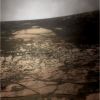
OPP-SOL1510-1.jpgVictoria's Paving - Sol 1510 (natural Colors; credits: Dr G. Barca)59 visitenessun commentoMareKromium
|
|
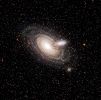
NGC-0253-HST.jpgCosmic Alignment! (2MASX J00482185-2507365)59 visiteNASA's Hubble Space Telescope has captured a rare alignment between two spiral galaxies. The outer rim of a small, foreground galaxy is silhouetted in front of a larger background galaxy. Skeletal tentacles of dust can be seen extending beyond the small galaxy's disk of starlight.
Such outer dark dusty structures, which appear to be devoid of stars, like barren branches, are rarely so visible in a galaxy because there is usually nothing behind them to illuminate them. Astronomers have never seen dust this far beyond the visible edge of a galaxy. They do not know if these dusty structures are common features in galaxies.
Understanding a galaxy's color and how dust affects and dims that color are crucial to measuring a galaxy's true brightness. By knowing the true brightness, astronomers can calculate the galaxy's distance from Earth.
Astronomers calculated that the background galaxy is 780 MLY away. They have not as yet calculated the distance between the two galaxies, although they think the two are relatively close, but not close enough to interact. The background galaxy is about the size of the Milky Way Galaxy and is about 10 times larger than the foreground galaxy.
Most of the stars speckled across this image belong to the nearby spiral galaxy NGC 253, which is out of view to the right. Astronomers used Hubble's Advanced Camera for Surveys to snap images of NGC 253 when they spied the two galaxies in the background. From ground-based telescopes, the two galaxies look like a single blob. But the Advanced Camera's sharp "eye" distinguished the blob as two galaxies, cataloged as 2MASX J00482185-2507365. The images were taken on Sept. 19, 2006.
The results have been submitted for publication in The Astronomical Journal.
For additional information, contact:
Donna Weaver/Ray Villard
Space Telescope Science Institute, Baltimore, Md.
410-338-4493 / 410-338-4514
dweaver@stsci.edu / villard@stsci.edu
Benne Holwerda
Space Telescope Science Institute, Baltimore, Md.
/University of Cape Town, South Africa
holwerda@stsci.edu
Object Name: 2MASX J00482185-2507365
MareKromium
|
|

Mimas-intransit-N00119952-N00119954.gifQuick Transit! (GIF-Movie; credits: Dr G. Barca)59 visite...Sembra un UFO...Ma non lo è! Si tratta, a nostro avviso, della luna Saturniana Mimas, ben riconoscibile a causa della sua forma oblunga e del suo "occhio" (!) che appare - relativamente chiaro - a ridosso del Terminatore.
Un intrigante - e MOLTO ISTRUTTIVO! - GIF-Movie, del sempre puntualissimo Dr Barca!MareKromium
|
|
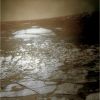
OPP-SOL1521-1.jpgVictoria's Paving - Sol 1521 (True Colors; credits: Dr G. Barca)59 visitenessun commentoMareKromium
|
|
OPP-SOL1638-1_copia2.jpgDistant Horizon... - Sol 1638 (natural colors; credits: Dr G. Barca)59 visitenessun commentoMareKromium
|
|

SOU-SOL080-LXT.jpgAres' Horizon and a "tired" Soujourner ... - Sol 80 (natural colors; credits: Lunexit)59 visitenessun commentoMareKromium
|
|

PHOE-SOL122-lg35921-35922-35923-2.jpgMicroscopic Vastitas - Sol 122 (Superdefinition and possible True Colors; credits: Dr G. Barca & Lunexit)59 visitenessun commentoMareKromium
|
|
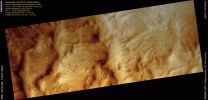
Psp_009548_1420_red.jpgEnigmatic Terrain in Hellas Planitia (Saturated Natural Colors; credits for the additional process. and color.: Dr Paolo C. Fienga - Lunexit Team)59 visiteHellas Planitia is the low-lying plain on the floor of the Hellas Basin, an ancient impact crater over 2000 Km wide. This Basin includes the lowest point on the surface of Mars.
A variety of unusual landforms occur on the floor of the basin due to the low elevation. One hypothesis is that Hellas may once have held lakes or seas, possibly with thick ice that might account for some of these features.
This image shows a small portion of Western Hellas, in a Region of "Enigmatic Ridges".
These ridges form an intricate pattern, enclosing kilometer-wide depressions. These strange features are still not well-understood; one possibility is that they formed in lake-bottom sediments when ice covering the lake touched bottom and shoved wet, loose material to the side.
This HiRISE image reveals that the ridges contain many boulders; sediments deposited on the bottom of a lake might be fine-grained, although they may have hardened to rock later. The image also shows lineations, probably outcropping layers, running between the large ridges.
Because the resolution of HiRISE images is sufficient to see details such as the abundance of boulders and the presence of thin sedimentary layers, images of this and other poorly-understood terrains will be important in interpreting the geological and climatological history of Mars.
This observation is part of a stereo pair along with PSP_007834_1420.MareKromium
|
|
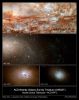
Galaxies-HST.jpgGalaxies!59 visiteThese images taken with NASA's Hubble Space Telescope are close-up views of four galaxies from a large survey of nearby galaxies.
The galaxies have very different masses and sizes and showcase the diversity of galaxies found in the ANGST study. Although the galaxies are separated by many light-years, they are presented as if they are all at the same distance to show their relative sizes.
The images, taken with Hubble's Advanced Camera for Surveys, reveal rich detail in the stellar populations and in the interstellar dust scattered between the stars. Hubble's sharp views reveal the colors and brightnesses of individual stars, which astronomers used to derive the history of star formation in each galaxy.
In the composite image at the top, NGC 253 is ablaze with the light from thousands of young, blue stars. The spiral galaxy is undergoing intense star formation. The image demonstrates the sharp "eye" of the Advanced Camera, which resolved individual stars. The dark filaments are clouds of dust and gas. NGC 253 is the dominant galaxy in the Sculptor Group of galaxies and it resides about 13 million light-years from Earth.
In the view of the spiral galaxy NGC 300, second from top, young, blue stars are concentrated in spiral arms that sweep diagonally through the image. The yellow blobs are glowing hot gas that has been heated by radiation from the nearest young, blue stars. NGC 300 is a member of the Sculptor Group of galaxies and it is located 7 million light-years away.
The dark clumps of material scattered around the bright nucleus of NGC 3077, the small, dense galaxy at bottom, left, are pieces of wreckage from the galaxy's interactions with its larger neighbors. NGC 3077 is a member of the M81 group of galaxies and it resides 12.5 million light-years from Earth.
The image at bottom, right, shows a swarm of young, blue stars in the diffuse dwarf irregular galaxy NGC 4163. NGC 4163 is a member of a group of dwarf galaxies near our Milky Way and is located roughly 10 million light-years away.
These galaxies are part of a detailed survey called the ACS Nearby Galaxy Survey Treasury program (ANGST). In the census, Hubble observed roughly 14 million stars in 69 galaxies. The survey explored a region called the "Local Volume," and the galaxy distances ranged from 6.5 million light-years to 13 million light-years from Earth. The Local Volume resides beyond the Local Group of galaxies, an even nearer collection of a few dozen galaxies within about 3 million light-years of our Milky Way Galaxy.
The natural-color images were constructed using observations taken in infrared, visible, and blue light. The observations of NGC 253 and NGC 300 were taken in September 2006; of NGC 3077 in November 2006; and of NGC 4163 in December 2006.
Object Names: NGC 253, NGC 300, NGC 3077, NGC 4163
MareKromium
|
|

NGC-3324-HST.jpgNGC 3324 - Star-forming Region59 visiteThe landmark 10th anniversary of the Hubble Space Telescope's Hubble Heritage Project is being celebrated with a 'landscape' image from the cosmos. Cutting across a nearby star-forming region are the "hills and valleys" of gas and dust displayed in intricate detail. Set amid a backdrop of soft, glowing blue light are wispy tendrils of gas as well as dark trunks of dust that are light-years in height.
The Hubble Heritage Project, which began in October 1998, has released nearly 130 images mined from the Hubble data archive as well as a number of observations taken specifically for the project. By releasing a new, previously unseen Hubble image every month, the team's intent was to showcase some of the most attractive images ever taken by the Hubble telescope, and share them with a wide audience. The Heritage team continues to create aesthetic images that present the universe from an artistic perspective.
This month's three-dimensional-looking Hubble image shows the edge of the giant gaseous cavity within the star-forming region called NGC 3324. The glowing nebula has been carved out by intense ultraviolet radiation and stellar winds from several hot, young stars. A cluster of extremely massive stars, located well outside this image in the center of the nebula, is responsible for the ionization of the nebula and excavation of the cavity.
The image also reveals dramatic dark towers of cool gas and dust that rise above the glowing wall of gas. The dense gas at the top resists the blistering ultraviolet radiation from the central stars, and creates a tower that points in the direction of the energy flow. The high-energy radiation blazing out from the hot, young stars in NGC 3324 is sculpting the wall of the nebula by slowly eroding it away.
Located in the Southern Hemisphere, NGC 3324 is at the northwest corner of the Carina Nebula (NGC 3372), home of the Keyhole Nebula and the active, outbursting star Eta Carinae. The entire Carina Nebula complex is located at a distance of roughly 7,200 light-years, and lies in the constellation Carina.
This image is a composite of data taken with two of Hubble's science instruments. Data taken with the Advanced Camera for Surveys (ACS) in 2006 isolated light emitted by hydrogen. More recent data, taken in 2008 with the Wide Field Planetary Camera 2 (WFPC2), isolated light emitted by sulfur and oxygen gas. To create a color composite, the data from the sulfur filter are represented by red, from the oxygen filter by blue, and from the hydrogen filter by green.
The Heritage project has released images using several of Hubble's optical cameras: the Wide Field Planetary Camera (WF/PC), which was installed when the telescope was first deployed in 1990; WFPC2, which replaced WFPC in 1993 and is still in service today; and ACS, which was added in 2002. After the Hubble Servicing Mission in early 2009, the Hubble Heritage team hopes to continue using ACS as well as the newest of the optical cameras, Wide Field Camera 3.
MareKromium
|
|
| 25353 immagini su 2113 pagina(e) |
 |
|
|
|
|
1247 | |
|
|
|
|
|
|





