| Piú viste |

GALEX Portrait-PIA03295.jpgPortrait of the Universe59 visiteFrom sparkling blue rings to dazzling golden disks, Galaxy Evolution Explorer (Galex) scientists are handing out a collection of their finest galactic treasures at the January 2006 American Astronomical Society meeting in Washington, D.C.
Mined from the mission's Survey of Nearby Galaxies data, these cosmic gems were collected with the telescope's sensitive ultraviolet instruments. The gallery of galaxies has been made into a poster for meeting attendees visiting the mission's booth. Organized from far-ultraviolet to near-ultraviolet bright galaxies, this poster encapsulates the heart of the mission to study how galaxies and star formation rates have changed over the past 10 billion years.
Events in space take millions or billions of years to unfold, which means that astronomers can't watch individual galaxies and stars age over time. Luckily, because the physics of light travel dictates that the farther away an object is from Earth, the longer it takes for its light to travel to us, the universe can be thought of as a time machine. By building telescopes sensitive enough to capture objects that are 10 billion light-years away, astronomers can essentially see an object the way it looked 10 billion years ago. Galex astronomers are using this phenomenon to their advantage by taking snapshots of different galaxies at various distances in space. By comparing portraits of numerous objects at various times in the universe's history, the team can begin to piece together the life cycle of stars and galaxies.
For the poster, Galex scientists organized 196 different nearby galaxies in bins of increasing ultraviolet color. By placing the various snapshots side by side, astronomers can see how galaxies age differently. When viewed in ultraviolet, active star-forming regions in galaxies can be seen as glittering blue structures, while a soft, golden glow indicates the presence of older stars.
The 196 galaxies represented in the poster were selected from more than 1,000 galaxies in the "Ultraviolet Atlas of Nearby Galaxies." So far, the Galex mission has surveyed more than 100 million galaxies.
|
|

PIA07854.jpgA beautiful "Asteroid Belt"59 visiteThis artist's animation illustrates a massive asteroid belt in orbit around a star the same age and size as our Sun. Evidence for this possible belt was discovered by NASA's Spitzer Space Telescope when it spotted warm dust around the star, presumably from asteroids smashing together.
The view starts from outside the belt, where planets like the one shown here might possibly reside, then moves into to the dusty belt itself. A collision between two asteroids is depicted near the end of the movie. Collisions like this replenish the dust in the asteroid belt, making it detectable to Spitzer.
The alien belt circles a faint, nearby star called HD 69830 located 41 light-years away in the constellation Puppis. Compared to our own solar system's asteroid belt, this one is larger and closer to its star - it is 25 times as massive, and lies just inside an orbit equivalent to that of Venus. Our asteroid belt circles between the orbits of Mars and Jupiter.
Because Jupiter acts as an outer wall to our asteroid belt, shepherding its debris into a series of bands, it is possible that an unseen planet is likewise marshalling this belt's rubble. Previous observations using the radial velocity technique did not locate any large gas giant planets, indicating that any planets present in this system would have to be the size of Saturn or smaller.
Asteroids are chunks of rock from "failed" planets, which never managed to coalesce into full-sized planets. Asteroid belts can be thought of as construction sites that accompany the building of rocky planets.
|
|

as15-87-11725.JPGAS 15-87-11725 - Thomson Crater and a strange "light"59 visiteLM - Rev 13. Beautiful oblique photo of Thomson Crater, Sea of Ingenuity.
|
|

as11-40-5936.JPGAS 11-40-5936 - Up-Sun (2)59 visite110:55:49 MT. Rightward of 5935 but without overlap because Neil has avoided the up-Sun view. The Southern part of East Crater on the lefthand side of the image. Part of the rim of West Crater can be seen faintly just above center. We can locate the approximate azimuths of the north and South rims of West Crater from Figure 3-15 in the Apollo 11 Preliminary Science Report and a detail from the USGS site map.
As indicated in Figure 3-15, Neil took the minus-Z pan from a location about 20 meters roughly southeast of the LM. The exact location has been added to the inset at the upper right, which shows that Neil was about 55 meters due west of the south rim of East Crater. From the site map detail we see that, from the south rim of East Crater, the north rim of West Crater is about 460 meters away on an azimuth of about 92.7 degrees. With the help of a little trigonometry, this information gives an azimuth of the north rim of West Crater from Neil's location of 92.4 degrees, with the south rim azimuth being about 112.4 degrees. During the Apollo 11 EVA, the solar azimuth was 88.1 degrees, which allows us to plot the relevant azimuths on a detail from 5936. The plotted azimuth for the south rim is very close to the lefthand edge of the horizon feature that is obviously a partly shadowed portion of the rim while the plotted north rim azimuth is close to the righthand edge of what is probably a sunlit, rock-strewn portion of the rim.
|
|
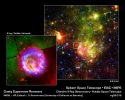
N76-PIA08516-2.jpgThe "N 76 Nebula"59 visiteThe supernova remnant1E0102.2-7219 sits next to the Nebula N76 in a bright, Star-Forming Region of the Small Magellanic Cloud, a satellite galaxy to our Milky Way galaxy located about 200.000 LY from Earth. A Supernova Remnant is made up of the messy bits and pieces of a massive star that exploded, or went Supernova. This image shows glowing dust grains in three wavelengths of infrared radiation: 24 microns (red) measured by the Multiband Imaging Photometer aboard NASA's Spitzer Space Telescope; and 8.0 microns (green) and 3.6 microns (blue) measured by Spitzer's infrared array camera. The red bubble is a dust envelope around the supernova remnant E0102, which is being heated by the shock wave created in the explosion of the remnant's massive progenitor star some 1,000 years ago. Most of the blue stars are in the Small Magellanic Cloud, though some are in our own galaxy.
|
|

vl2_22a158.jpgThe "Rocky Horizon" of Utopia Planitia - Frame Viking Lander 2 n. 22a158 (Natural Colors - credits: NASA/JPL)59 visitenessun commento
|
|

vl2_22a158_old.jpgThe "Rocky Horizon" of Utopia Planitia - Frame Viking Lander 2 n. 22a158 (Natural Colors - credits: NASA/JPL)59 visitenessun commento
|
|

vl2_p17688.jpgUtopia Planitia - Frame Viking Lander 2 n. p1768859 visitenessun commento
|
|

vl1_p20453.jpgFeatures of Chrise Planitia - Frame Viking Lander 1 n. p20453 59 visitenessun commento
|
|

APOLLO 17 AS 17-M-0446-1.jpgAS 17-m-0446 - metric frames (1)59 visite
|
|
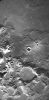
APOLLO 17 AS 17-M-0447-2.jpgAS 17-m-0447 - metric frames (2)59 visite
|
|

m10_aom_3_a.jpg59 visitenessun commento
|
|
| 25353 immagini su 2113 pagina(e) |
 |
|
|
|
|
1246 | |
|
|
|
|





