| Piú viste |
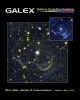
Z-Camelopardalis-PIA09219.jpgZ-Camelopardalis59 visiteThis composite image shows Z Camelopardalis, or Z Cam, a double-star system featuring a collapsed, dead star, called a white dwarf, and a companion star, as well as a ghostly shell around the system. The massive shell provides evidence of lingering material ejected during and swept up by a powerful classical nova explosion that occurred probably a few thousand years ago.
The image combines data gathered from the far-ultraviolet and near-ultraviolet detectors on NASA's Galaxy Evolution Explorer on Jan. 25, 2004. The orbiting observatory first began imaging Z Cam in 2003.
Z Cam is the largest white object in the image, located near the center. Parts of the shell are seen as a lobe-like, wispy, yellowish feature below and to the right of Z Cam, and as two large, whitish, perpendicular lines on the left.
Z Cam was one of the first known recurrent dwarf nova, meaning it erupts in a series of small, "hiccup-like" blasts, unlike classical novae, which undergo a massive explosion. That's why the huge shell around Z Cam caught the eye of astronomer Dr. Mark Seibert of Carnegie Institution of Washington in Pasadena, Calif. - it could only be explained as the remnant of a full-blown classical nova explosion. This finding provides the first evidence that some binary systems undergo both types of explosions. Previously, a link between the two types of novae had been predicted, but there was no evidence to support the theory.
The faint bluish streak in the bottom right corner of the image is ultraviolet light reflected by dust that may or may not be related to Z Cam. Numerous foreground and background stars and galaxies are visible as yellow and white spots. The yellow objects are strong near-ultraviolet emitters; blue features have strong far-ultraviolet emission; and white objects have nearly equal amounts of near-ultraviolet and far-ultraviolet emission.
|
|
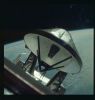
as09-19-2973.jpgAS 09-19-2973 - Outside the Spacecraft59 visitenessun commento
|
|
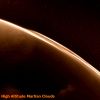
Martian_Limb-Upper_Atmosphere.jpgHigh Altitude Clouds (Contrast Enhanced Natural Colors; credits for the additional process. and color.: Dr Paolo C. Fienga - Lunexit Team)59 visitenessun commento
|
|

SOL1140-2N227570102ESFAS2JP1561L0M1-01.jpgMartian Horizon (2): the colors of the early morning - Sol 114059 visitenessun commento
|
|

AlienWorld-PIA09228.jpgTwin Suns' Sunset59 visiteOur solitary sunsets here on Earth might not be all that common in the grand scheme of things. New observations from NASA's Spitzer Space Telescope have revealed that mature planetary systems -- dusty disks of asteroids, comets and possibly planets -- are more frequent around close-knit twin, or binary, stars than single stars like our sun. That means sunsets like the one portrayed in this artist's photo concept, and more famously in the movie "Star Wars," might be quite commonplace in the universe.
Binary and multiple-star systems are about twice as abundant as single-star systems in our galaxy, and, in theory, other galaxies. In a typical binary system, two stars of roughly similar masses twirl around each other like pair-figure skaters. In some systems, the two stars are very far apart and barely interact with each other. In other cases, the stellar twins are intricately linked, whipping around each other quickly due to the force of gravity.
Astronomers have discovered dozens of planets that orbit around a single member of a very wide stellar duo. Sunsets from these worlds would look like our own, and the second sun would just look like a bright star in the night sky.
But do planets exist in the tighter systems, where two suns would dip below a planet's horizon one by one? Unveiling planets in these systems is tricky, so astronomers used Spitzer to look for disks of swirling planetary debris instead. These disks are made of asteroids, comets and possibly planets. The rocky material in them bangs together and kicks up dust that Spitzer's infrared eyes can see. Our own solar system is swaddled in a similar type of disk.
Surprisingly, Spitzer found more debris disks around the tightest binaries it studied (about 20 stars) than in a comparable sample of single stars. About 60 percent of the tight binaries had disks, while the single stars only had about 20 percent. These snug binary systems are as close or closer than just three times the distance between Earth and the sun. And the disks in these systems were found to circumnavigate both members of the star pair, rather than just one.
Though follow-up studies are needed, the results could mean that planet formation is more common around extra-tight binary stars than single stars. Since these types of systems would experience double sunsets, the artistic view portrayed here might not be fiction.
The original sunset photo used in this artist's concept was taken by Robert Hurt of the Spitzer Science Center at the California Institute of Technology, Pasadena, Calif.
|
|

Eternity.jpgBeyond...59 visite"...A well-written Life is almost as rare as a well-spent one..."
Thomas Carlyle (1795 - 1881) - "Critical and Miscellaneous Essays" (1838) MareKromium
|
|

Io-032807.jpgBurning Io!59 visiteNew Horizons captured this unique view of Jupiter's moon Io with its color camera - the Multispectral Visible Imaging Camera (MVIC) - at 00:25 UT on March 1, 2007, from a range of 2,3 MKM (about 1,4 MMs). The image is centered at Io coordinates 4°South lat. and 162° West Long., and was taken shortly before the complementary Long Range Reconnaissance Imager (LORRI) photo of Io released on March 13, which had higher resolution but was not in color.
Like that LORRI picture, this processed image shows the nighttime glow of the Tvashtar volcano and its plume rising 330 kilometers (200 miles) into sunlight above Io's north pole. However, the MVIC picture reveals the intense red of the glowing lava at the plume source and the contrasting blue of the fine dust particles in the plume (similar to the bluish color of smoke), as well as more subtle colors on Io's sunlit crescent. The lower parts of the plume in Io's shadow, lit only by the much fainter light from Jupiter, are almost invisible in this rendition. Contrast has been reduced to show the large range of brightness between the plume and Io's disk.
A component of the Ralph imaging instrument, MVIC has three broadband color filters: blue (480 nanometers), red (620 nm) and infrared (850 nm); as well as a narrow methane filter (890 nm). Because the camera was designed for the dim illumination at Pluto, not the much brighter sunlight at Jupiter, the red and infrared filters are overexposed on Io's dayside. This image is therefore composed from the blue and methane filters only, and the colors shown are only approximations to those that the eye would see. Nevertheless, the human eye would easily see the red color of the volcano and the blue color of the plume.
|
|

Sunspot~0.jpgAn Active Sunspot Viewed Sideways59 visiteCaption NASA:"Why are there dark spots on the Sun? Although noted for thousands of years, sunspots have been known for decades to be regions of the Sun that are slightly depressed and cooled by the Sun's complex and changing Magnetic Field.
High resolution pictures like the above image from Japan's new Sun-watching Hinode satellite, however, are helping to increase modern understanding. In the center of the above image is a sunspot, but not seen in the usual orientation - this sunspot is seen sideways.
Of particular interest is erupting glowing gas that shows how the Sun's Magnetic Field comes right out of the spot center, but curves markedly around the spot edges. Better understanding of how the Sun ejects particles into space may result in more accurate predictions of solar storms that affect satellites, astronauts and even power grids on Earth".
|
|

CometHale-Bopp-970401C_lodriguss.jpgOn the edge of Oblivion...59 visite"...Mi dispiace vedere che gran parte delle persone vivano la loro Vita non secondo un modello personale - magari discutibile, ma proprio -, bensì secondo il modello creato solo ed esclusivamente dalla televisione (o da chi per essa).
Un modello orrendo e della razza peggiore.
Certo, non esiste un modello predefinito di "Vita" e allora ognuno di noi cresce assieme a quello che gli sta attorno, aiutandosi con quanto si trova in giro. Però...
Però vedo sempre più maiali inconsapevoli di viaggiare verso il mattatoio e, anche se dovrei (forse) preoccuparmi più di me stesso, questa visione - un pò - mi duole..."
Giorgio Picciau - "Lettere"MareKromium
|
|

as14-69-9620.jpgAS 14-69-9620 - Lansberg B and D59 visiteImage Collection: 70mm Hasselblad
Mission: Apollo 14
Magazine: 69
Magazine Letter: P
Latitude: 2,5° South
Longitude: 29,5° West
Lens Focal Length: 500 mm
Quality: Fair
Film Type: 3400
Film Width: 70 mm
Film Color: black & white
Feature(s): Lansberg B and DMareKromium
|
|

as14-72-10026.jpgAS 14-72-10026 - Hirayama and Mare Smythii59 visiteImage Collection: 70mm Hasselblad
Mission: Apollo 14
Magazine: 72
Magazine Letter: L
Latitude: 3° South
Longitude: 86,5° East
Film Type: SO-368
Film Width: 70 mm
Film Color: color
Feature(s): Hirayama Area and Mare SmythiiMareKromium
|
|

as15-81-10976.jpgAS 15-81-10976 - Mare Imbrium and Helicon Crater59 visiteImage Collection: 70mm Hasselblad
Mission: Apollo 15
Magazine: 81
Magazine Letter: QQ
Latitude: 40° North
Longitude: 22,5° West
Lens Focal Length: 500 mm
Camera Look: n.a.
Camera Tilt: 75°
Camera Azimuth: 358
Camera Altitude: 109 Km
Sun Elevation (on local horizon): 27°
Film Type: 3401
Film Width: 70 mm
Film Color: black & white
Feature(s): Helicon Crater and Mare Imbrium
|
|
| 25353 immagini su 2113 pagina(e) |
 |
|
|
|
|
1244 | |
|
|
|
|





