| Piú viste |

The Sun-EitplumeG.jpgOur "restless" Sun... (9)59 visitenessun commento
|
|

The Sun-TricutG-1.jpgOur "restless" Sun... (11)59 visitenesun commento
|
|

The Sun-UvcseitG_c.jpgOur "restless" Sun... (12)59 visitenessun commento
|
|

Comets-Comet_SWAN-3.jpgComet "SWAN"59 visiteDa "NASA - Picture of the Day" del 4 Ottobre 2006:"A newly discovered comet has brightened enough to be visible this week with binoculars. The picturesque comet is already becoming a favored target for northern sky imagers. Pictured above just last week, Comet SWAN showed a bright blue-green coma and an impressive tail. Comet C/2006 M4 (SWAN) was discovered in June in public images from the Solar Wind Anisotropies (SWAN) instrument of NASA and ESA's Sun-orbiting SOHO spacecraft. Comet SWAN, near magnitude six, will be visible with binoculars in the North-Eastern sky not far from the Big Dipper over the next few days before dawn. The comet is expected to reach its peak brightness this week. Passing its closest to the Sun two days ago, Comet SWAN and will be at its closest to the Earth toward the end of this month. Comet SWAN's unusual orbit appears to be hyperbolic, meaning that it will likely go off into interstellar space, never to return".
|
|
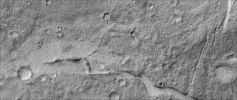
T-TRA_000834_1835_RED.jpgAram Chaos59 visiteAram Chaos is thought to be a degraded impact crater that was once filled with water and sedimentary units. The term "chaos" refers to the cracks and angled blocks formed perhaps by withdrawl of subsurface material. This sub-image covers only a small portion of Aram Chaos and illustrates the modification of the crater by fracturing, younger impact craters, and wind. A linear fracture cuts through the center of the image while a more sinuous depression filled with bright ripples or dunes is located towards the bottom of the image. Both depressions could have resulted from collapse associated with modification of the impact crater that created Aram Chaos or later disruption when water and sediment covered some of the crater floor. Impact craters of many shapes and sizes can be seen across the image, indicating a relatively older surface that has seen little modification since its formation. The bright ripples or dunes appear to cluster in low-lying topography, such as the sinuous depression and a larger impact crater in the lower right of the image, suggesting that wind has moved fine material along the surface until it becomes trapped in low spots where it collects to form ripples or dunes.
|
|
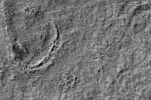
T-TRA_000830_1440_RED_NigerVallis_01.jpgNiger Vallis59 visiteThis image shows a portion of the floor of Niger Vallis, an ancient Martian outflow channel. Niger Vallis originates on the flanks of the volcano Hadriaca Patera, and empties into the Hellas impact basin. Outflow channels are observed in many regions of the planet, and may have been carved by brief eruptions of liquid water from beneath the surface. Since Niger Vallis formed, impacts have cratered the channel floor, and fine-grained wind-blown debris has been transported across the surface, eroding and burying all but the freshest craters. The curved ridge in the scene may be the remnant of a large crater rim. At the high resolution of this image, a pattern of parallel dunes and ripples can be seen, as well as individual boulders as large as two meters across.
|
|

NGC-2237_and_NGC_2244-4.jpgNGC 2237 - The "Rosette Nebula", and Globular Star Cluster NGC 224459 visite"...Acerba semper et inmatura Mors eorum qui immortale aliquid parant..."
(Plinio)
"...La morte di coloro che hanno fatto qualcosa di grande (di "immortale") appare sempre acerba e prematura..."
|
|

Titan-Lakes-Unnamed_North_Polar_Lakes-02-PIA01942.jpgTitanian Northern Lakes (3)59 visiteCaption NASA originale:"Using its radar system, the Cassini spacecraft has imaged new lakes on Titan.
The large dark patch seen on this image, at high latitudes surrounding Titan's North Pole, is most likely a hydrocarbon lake. Several dark channels can be seen; the longest one at the left meanders over almost 100 Km (about 62 miles), and appears to drain into the lake. Some dark channels are remarkably straight, suggesting possible faulting in the subsurface. The bright landforms jutting into the lake indicate that old, eroded landforms may have flooded.
This radar image was acquired by the Cassini radar instrument in synthetic aperture mode on Oct. 9, 2006. The image is centered near 73° North Latitude and 343° West Longitude; it measures about 300 by 140 Km (such as about 190 by 90 miles). Smallest details in this image are about 500 mt (approx. 1.640 feet) across".
|
|

Upsilon Andromedae-PIA01938.jpgUpsilon Andromedae59 visite"...Quod ratio non quit, saepe sanavit mora..."
(Seneca)
"...Ciò che la Ragione non comprese, spesso venne chiarito dal Tempo..."
|
|

Craters-Becquerel_Crater_mound_6m-01.jpgBeautiful Becquerel Crater (2)59 visitenessun commento
|
|

Rho Ophiuci.jpgRho Ophiuci59 visite"...May I return, to the beginning,
The light was dimming, and the Dream was too,
The World and I, we are still waiting,
Still hesitating,
Any Dream will do..."
Dal Musical "Joseph and the Amazing Technicolor Dreamcoat"
|
|

Earth&Sun-000-sunearth_01G.jpgMagnetic Fields... (1)59 visitenessun commento
|
|
| 25353 immagini su 2113 pagina(e) |
 |
|
|
|
|
1242 | |
|
|
|
|





