| Piú viste |
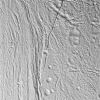
Enceladus-PIA06215.jpgCracks on Enceladus (and possible Anomaly)59 visiteCaption NASA originale:"This view of Enceladus shows an area that has undergone a very intriguing sequence of events. The craters here are subdued, as seen elsewhere on Enceladus and most, but not all, are older than the fractures. Fracturing has occurred at a wide variety of scales, from the wide rift running through the center of the image to much narrower sets of shorter fractures that crosscut the craters (and each other) to the left. This region is a transition from cratered to wrinkled terrain. Westward (left) of the central rift that divides the 2 regions are relatively parallel grooves and ridges that are reminiscent of terrain on Jupiter's large moon Ganymede. Very few craters are seen in this area of Enceladus. Right of the large rift the terrain becomes more cratered, although the craters are quite degraded. A prominent fracture runs North-South to the center of the image".
Nota: guardate bene che cosa c'è all'interno di questo crepaccio, in alto, proprio a ridosso del bordo superiore del frame!
|
|
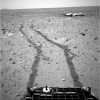
SOL039-2N129824874EFF0426P1883L0M1.jpgLeaving the "nest"...59 visiteSiamo nel Sol 39 di Spirit ed il "nido" è già alle sue spalle. Un nido al quale il Rover, probabilmente, non farà mai più ritorno.
|
|
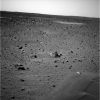
SOL039-2N129837559EFF0500P1835R0M1.jpgA lonely boulder's on the way59 visitenessun commento
|
|

SOL064-2P132046789EFF1500P2445L7M1.jpgRocky panorama on Sol 64 (2)59 visiteIn questo frame, in alto, proprio a ridosso della linea dello skyline e leggermente verso la Vostra Dx, c'è un boulder la cui forma è davvero molto strana: noi notiamo che c'è un rilievo (una specie di scanalatura") che lo cinge e che sembra dividerlo in 2 sezioni: una più liscia ed una più "lavorata".
Attenzione: noi non crediamo che si tratti di un manufatto - non ci sono elementi per supportare una simile idea -; noi ci limitiamo a chiederci che tipo di evento possa aver segnato questa roccia in una maniera così peculiare. La scanalatura, infatti (e se elaborate un pò l'immagine lo noterete subito...), è precisa e lineare: essa, insomma, non sembra proprio opera della Natura.
|
|
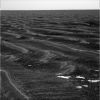
OPP-SOL409-1P164493401EFF5100P2291R2M1.jpgPanorama - Sol 409 (4)59 visitenessun commento
|
|
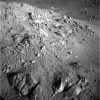
SOL434-2N164905486EFFA8EBP1997R0M1.jpgUnusual rocks, just rocks... (4)59 visitenessun commento
|
|

Rings-PIA06616.jpgDistances...59 visiteCaption NASA originale:"This sweeping view from Cassini gives a sense of the awesome scale of the planet's disk-like ring system, which stretches many thousands of kilometers into the distance. The shepherd moon Prometheus maintains a lonely sojourn with the thin, outer F-Ring.
A notable brightening of the F-Ring material is visible ahead of Prometheus in its orbit, near the right side of this image.
The view was obtained in visible light with the Cassini spacecraft narrow-angle camera on Feb. 18, 2005, at a distance of approximately 1 MKM (approx. 621.000 miles) from Prometheus and at a phase angle of 105°. The image scale is 6 Km per pixel".
|
|
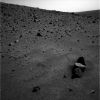
SOL439-2N165342666EFFA912P0695R0M1.jpgUnusual rocks, just rocks... (17)59 visitenessun commento
|
|
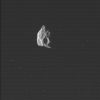
Epimetheus-N00030856.jpgEpimetheus, from approx. 75.000 Km59 visiteLa forma di Epimetheus, assolutamente irregolare, ci suggerisce una sua possibile origine "traumatica": forse si tratta, infatti, di un semplice frammento di un corpo celeste più grande il quale, in tempi lontani, andò in pezzi a seguito di una collisione con un grande asteroide. Non è neppure da escludere che Epimetheus sia un residuo di cospicue dimensioni della collisione che generò gli stessi Anelli di Saturno e questa ipotesi, laddove (in un futuro) venisse verificata ed accolta, ci spiegherebbe, in parte, le cause dell'attuale posizione e del ruolo di questa luna negli equilibri del complesso Sistema Saturniano. La superficie di Epimetheus, fortemente craterizzata, ci suggerisce un'età molto avanzata per questa luna; in primo piano, poi, notiamo un grande cratere da impatto che ricorda, per forma e dimensioni, lo Stickney Crater di Phobos.
|
|
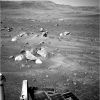
SOL441-2N165519907EFFA928P0695L0M1.jpgSame rocks, different angles (1)59 visitenessun commento
|
|
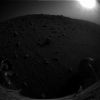
SOL442-2F165614342EFFA978P1212R0M1.jpgSetting Sun on Gusev Crater59 visiteUn frame molto bello e suggestivo ripreso dalla Right Front Hazard Camera approssimativamente alle ore 16:18:31 MLT.
|
|

Titan-PIA06220.jpgA New Continent on Titan (from 130.000 up to 146.000 Km)59 visiteCaption NASA originale:"This view of Titan uncovers new territory not previously seen at this resolution by Cassini's cameras. The view is a composite of 4 nearly identical wide-angle camera images, all taken using a filter sensitive to wavelengths of infrared light centered at 939 nnmts. The individual images have been combined and contrast-enhanced in such a way as to sharpen surface features and enhance overall brightness variations. Some of the territory in this view was covered by observations made by the Cassini synthetic aperture radar in October 2004 and February 2005. At large scales, there are similarities between the views taken by the imaging science subsystem cameras and the radar results, but there also are differences. For example, the center of the floor of the approximately 80-kilometer-wide (50-mile) crater identified by the radar team in February (near the center in this image, see PIA07368 for the radar image) is relatively bright at 2.2 centimeters, the wavelength of the radar experiment, but dark in the near-infrared wavelengths used here by Cassini's optical cameras. This brightness difference is also apparent for some of the surrounding material and could indicate differences in surface composition or roughness".
|
|
| 25353 immagini su 2113 pagina(e) |
 |
|
|
|
|
1239 | |
|
|
|
|





