| Piú viste |
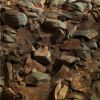
SOL1788-EB-PCF5-LXTT.jpgRock Garden (3 - Absolute Natural Colors; credits for the additional process. and color.: Elisabetta Bonora & Paolo C. Fienga - Lunexit Team)60 visitenessun commentoMareKromium
|
|

SOL0392-2P161170457EFFA400P2369L7M1.jpgGusev's Skyline - Sol 392 (Absolute Natural Colors; credits for the additional process. and color.: Dr Paolo C. Fienga - Lunexit Team)60 visitenessun commentoMareKromium
|
|

SOL0398-2N161704422EFFA500P1775R0M1.jpgThe Brown-Orange Plain of Gusev Crater - Sol 398 (Absolute Natural Colors; credits for the additional process. and color.: Dr Paolo C. Fienga - Lunexit Team)60 visitenessun commentoMareKromium
|
|

SOL0407-2N162504460EFFA776P1875L0M1.jpgTwilights - Sol 407 (Absolute Natural Colors; credits for the additional process. and color.: Dr Paolo C. Fienga - Lunexit Team)60 visitenessun commentoMareKromium
|
|
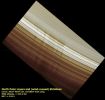
Psp_001488_2665_red.jpgNorth Polar Layers and WInd-caused Striations (Natural Colors; credits for the additional process. and color.: Dr Paolo C. Fienga - Lunexit Team)60 visitenessun commentoMareKromium
|
|

Dunes-PIA13268-PCF-LXTT.jpgDunes in Richardson Crater (EDM - Natural Colors; credits for the additional process. and color.: Dr Paolo C. Fienga - Lunexit Team)60 visiteThis observation from NASA's Mars Reconnaissance Orbiter (MRO) is a view of the Sand Dunefield in Richardson Crater, still partually covered with seasonal frost.
This EDM is a close-up view of defrosting patterns on the Dunes. The frost is a combination of frozen CO2 and some water ice that covers the Dunes in the Winter and Spring. As the seasonal frost sublimes away, odd features such as spots, fans, and streaks form.
Small dark streaks on the dune slip-face slopes may be where recent avalanches of sand, or perhaps wind, has moved the dark sand underlying the frost, or where frost has been removed to expose the sand. Alternatively, the dark streaks may be patches of coarse-grained ice that are clear enough so that the dark material below the ice is visible.
The slip-faces indicate the general direction of sand transport.
It has been hypothesized that the Dark Spots and Fans may be "geysers" or "cold gas jets" that form when sublimation processes trap gas at the bottom of the ice. The gas is released through cracks in the ice, entraining dust from below the ice and scattering it onto the Surface to form the Dark Spots and Fans.MareKromium
|
|
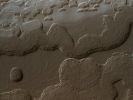
SPLD-PIA13269-PCF-LXTT3.jpgSouth Polar Layered Deposits and Residual Cap (Natural Colors; credits for the additional process. and color.: Dr Paolo C. Fienga - Lunexit Team)60 visiteThis image from NASA's Mars Reconnaissance Orbiter (MRO) shows a variety of surface textures within the South Polar Residual Cap of Mars.
It was taken during the Southern Spring, when the Surface was covered by seasonal CO2 Frost, so that Surface relief is easily seen. Illumination is from the bottom left, highlighting long Troughs at to the right and round pits and irregular Mesas to the left of center.
These unique landforms are common in the South Polar Residual Cap, which is known from previous Mars Global Surveyor images to be eroding rapidly in places. Right of center, SPLDs are exposed on a Sun-facing Scarp. These Deposits are older than the Residual Ice Cap, and the Layers are thought to record climate variations on Mars similar to ice ages on Earth.MareKromium
|
|

Titan-Lakes-Ontario_Lacus-01-PIA13173.jpgOntario Lacus60 visiteThis is Ontario Lacus, the largest lake on the Southern Hemisphere of Saturn's moon Titan. It is based on overlapping radar images obtained by NASA's Cassini Spacecraft on June 22, 2009, July 8, 2009 and Jan. 12, 2010. The images were synthesized into stereoscopic images by the Cassini radar team.
The Northern Shoreline features low Hills, probably about 1 Km (3000 feet) in altitude, and flooded River Valleys. A smooth, wave-sculpted Shoreline, like that seen on the South-Eastern side of Lake Michigan, can be seen on the North-Eastern side of the Lake.
The South-Eastern shore features a round-headed bay intruding into the shore. The middle part of the Western Shoreline shows the first well-developed delta observed on Titan.
Topography has been vertically exaggerated by a factor of roughly 10 times. Titan's solid Surface and Atmosphere are portrayed in shades of brown, approximating their appearance as measured by the descent imager and spectral radiometer on board the Huygens probe, which landed on Titan in 2005. Scientists surmise the liquid Methane, ethane and propane in the lake would look black to the human eye, but this is a hypothesis based on the best available data.
The Sun was placed low on the horizon, at an angle similar to where it was during the Cassini Fly-Bys.MareKromium
|
|
Titan-N00156684-85-86-MF-PCF-LXTT.jpgWatching through the Fog... (Absolute Natural Colors; credits for the additional process. and color.: Drr Marco Faccin and Paolo C. Fienga - Lunexit Team)60 visitenessun commentoMareKromium
|
|

PSP_002922_1725-1.jpgPossible Volcanic "Mouth", on Arsia Mons' Flank (EDM n.1 - credits for the additional process.: Dr Gianluigi Barca)60 visitenessun commentoMareKromium
|
|
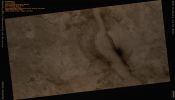
ESP_018161_2270_RED_abrowse-1.jpgFuture Mars Landing Site in Acidalia Mensa (Natural Colors; credits for the additional process. and color.: Dr Paolo C. Fienga - Lunexit Team)60 visitenessun commentoMareKromium
|
|

OPP-SOL2300-1P332372912EFFALFJP2367R1M1.jpgThe Ocean of Ripples of Meridiani Planum - Sol 2300 (Absolute Natural Colors; credits for the additional process. and color.: Dr Paolo C. Fienga - Lunexit Team)60 visitenessun commentoMareKromium
|
|
| 25353 immagini su 2113 pagina(e) |
 |
|
|
|
|
1238 | |
|
|
|
|





