| Piú viste |

PSP_004965_0980_RED_abrowse-01.jpgSouth Polar Layered Deposits (SPLD; extra-detail mgnf - MULTISPECTRUM; credits: Lunexit)60 visiteThe exposure of South Polar Layered Deposits shown here also appears to be partly covered by additional debris.
The layers appear to have been offset by a fault near the upper right corner.
The faulting and burial visible here complicates the interpretation of the climate history of Mars based on observations of layering.MareKromium
|
|

SOL1408-2.jpgThe terrain near Spirit: a "colourful comparison" - Sol 1408 (Credits: Dr Gianluigi Barca & Lunexit - for the inset)60 visitenessun commentoMareKromium
|
|
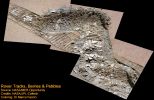
OPP-SOL836-1.jpgRover Tracks; Berries and Pebbles - Sol 836 (natural colors; credits: Dr Marco Faccin)60 visitenessun commentoMareKromium
|
|
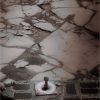
OPP-SOL1390-2.jpgVictoria's Paving - Sol 1390 (natural colors + MULTISPECTRUM; credits: Dr Gianluigi Barca & Lunexit)60 visitenessun commentoMareKromium
|
|

OPP-SOL1099-2.jpgBerries and Pebbles - Sol 1099 (natural colors + MULTISPECTRUM; credits: Dr G. Barca & Lunexit)60 visitenessun commentoMareKromium
|
|
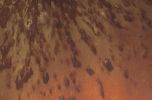
PSP_004313_1760_RED_abrowse-01.jpgWinslow Crater - extra-detail mgnf from frame n. 1: the "Herringbone Pattern" (MULTISPECTRUM; credits: Lunexit)60 visitenessun commentoMareKromium
|
|

Sunset.jpgCrescent Moon and Mercury at Sunset60 visite"...Is anything too wonderful for the Lord?..."
Genesis - 18:14MareKromium
|
|

ZO-Mercury01_Messenger.jpgApproaching Mercury60 visiteDa "NASA - Picture of the Day", del 16 Gennaio 2008:"Two days ago, the MESSENGER Spacecraft became only the second in Human History to swoop past Mercury. The last spacecraft to visit the Sun's closest Planet was Mariner 10, over 35 years ago.
Mariner 10 was not able to photograph Mercury's entire surface, and the images it did send back raised many questions. Therefore, much about planet Mercury remains unknown. This week's MESSENGER flyby was only the first of three. Over the next few years MESSENGER will swing past Mercury twice more and finally orbit in 2011, but MESSENGER is currently moving too fast to enter orbit around Mercury now.
This image was taken by MESSENGER two days ago upon approach to Mercury.
Many detailed images of Mercury are expected to be sent back over the next few days. The data acquired by MESSENGER will help better understand how Mercury's surface was formed, and why it is so dense".MareKromium
|
|

Horizon.gifDistant Winds... (credits: Dr M. Faccin)60 visiteColonne di sabbia e polverri si alzano in prossimità dell'orizzonte (regione alla Dx dell'Osservatore), ma c'è anche dell'altro...Osservate bene!
Un nuovo Grande (ed Acuto!) Lavoro del Dr Faccin, per tutti gli Amici di Lunar Explorer Italia.MareKromium
|
|
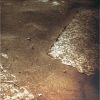
OPP-SOL1419-1P254154396EFF8884P2418R2M1.jpgRazorblades, on the edge of Victoria - Sol 1419 (MULTISPECTRUM; credits: Lunexit)60 visiteLa roccia che vedete alla Dx del frame presenta, sul suo lato lungo, una lunga serie di quelle curiose escrescenze lamellari che gli Scienziati di Pasadena hanno battezzato, sin dai tempi dell'esplorazione del Cratere Endurance, come "Razorblades" (ossìa: "lamette da/per rasoio").
La motivazione scientifica di supporto alla spiegazione relativa alla formazione delle "Razorblades" di Endurance fu in individuata nell'esistenza e nel transito di acque correnti, in epoche remote, lungo le pareti ed i Pavimenti del Cratere stesso (nota: le Razorblades, secondo a questa teoria, sarebbero la rimanenza visibile di un accumulo di sali e detriti vari i quali, trasportati da correnti "vive" (ma meglio sarebbe dire "modestissimi rivoli d'acqua"), si sono - nel tempo - ammassati e compattati sui lati dei pavimenti (i quali, di fatto, fungevano da "miniargini" per questi rivoletti di acqua sporca) sino a formare, sui loro bordi, queste "escrescenze".
La costruzione NASA a noi è sempre sembrata ragionevole (soprattutto avendo ben presente la morfologia delle Razorblades di Endurance e la loro collocazione sul suo Paving); tuttavia, se osservate le Razorblades di questo frame - e di altri relativi al Cratere Victoria - non dovrebbe risultarVi difficile notare come l'ipotesi degli Amici di Pasadena, vista la configurazione dei Pavimenti di Victoria, improvvisamente viene a perdere credibilità ed "appeal".
E si: perchè se le Razorblades si fossero formate davvero a seguito di depositi di sali e detriti trasportati da rivoli (anche deboli, ma certo duraturi) d'acqua corrente, allora dovrebbe essere anche possibile individuare, tramite le immagini, il "letto" - piccolo sinchè si vuole, ma certo esistente - del rivolo d'acqua che concorse alla loro formazione.
Minuscoli "letti" che, per Endurance, erano - in parte - visibili, ma che qui, su Victoria, non si vedono proprio.
Certo, l'ipotesi NASA resta - lo riconosciamo tranquillamente - resta la più logica e la più sensata; però un'ipotesi che sia foriera di Verità Scientifiche dovrebbe resistere e confermarsi al sussistere di condizioni di riferimento analoghe od affini.
Il che, purtroppo, in questo caso di specie sembra proprio che non avvenga.MareKromium
|
|

Jupiter-02.jpgInternal Heat Drives Jupiter's Giant Storm Eruption (IR + VL)60 visiteDetailed analysis of two continent-sized storms that erupted in Jupiter's Atmosphere in March 2007 shows that Jupiter's internal heat plays a significant role in generating atmospheric disturbances. Understanding this outbreak could be the key to unlock the mysteries buried in the deep Jovian Atmosphere, say astronomers.
Understanding these phenomena is important for Earth's meteorology where storms are present everywhere and jet streams dominate the atmospheric circulation. Jupiter is a natural laboratory where atmospheric scientists study the nature and interplay of the intense jets and severe atmospheric phenomena.
An international team coordinated by Agustin Sánchez-Lavega from the Universidad del País Vasco in Spain presents its findings about this event in the January 24 issue of the journal Nature.
The team monitored the new eruption of cloud activity and its evolution with an unprecedented resolution using NASA's HST, the NASA Infrared Telescope Facility in Hawaii, and telescopes in the Canary Islands (Spain).
A network of smaller telescopes around the world also supported these observations.
According to the analysis, the bright plumes were storm systems triggered in Jupiter's deep water clouds that moved upward in the atmosphere vigorously and injected a fresh mixture of ammonia ice and water about 20 miles (30 Km) above the visible clouds. The storms moved in the peak of a jet stream in Jupiter's Atmosphere at 375 mph (600 Km/hour). Models of the disturbance indicate that the jet stream extends deep in the buried atmosphere of Jupiter, more than 60 miles (approx. 100 Km) below the cloud tops where most sunlight is absorbed.MareKromium
|
|

Asteroids-Asteroid_2002JF56-PIA09230-01.jpgFormer "Unknown Asteroid" is now "Asteroid 2002 JF56"60 visiteThe two "spots" in this image are a composite of two images of asteroid 2002 JF56 taken on June 11 and June 12, 2006, with the Multispectral Visible Imaging Camera (MVIC) component of the New Horizons Ralph imager. In the bottom image, taken when the asteroid was about 3,36 MKM (approx. 2,1 MMs) away from the Spacecraft, 2002 JF56 appears like a dim star. At top, taken at a distance of about 1,34 MKM (such as about 833.000 miles), the object is more than a factor of six brighter.
The best current, estimated diameter of the asteroid is approx. 2,5 Km.
The asteroid observation was a chance for the New Horizons team to test the spacecraft's ability to track a rapidly moving object. On June 13 New Horizons came to within about 102.000 Km of the small asteroid, when the Spacecraft was nearly 368 MKM (about 228 MMs) from the Sun and about 273 MKM (approx 170 MMs) from Earth.MareKromium
|
|
| 25353 immagini su 2113 pagina(e) |
 |
|
|
|
|
1234 | |
|
|
|
|





