| Piú viste |

Chaotic_Terrain-Aram_Chaos-R2200155-01.jpgThe "Many Faces" of Aram Chaos (2 - EDM n. 1 - Original NASA/MGS/MSSS b/w Frame)60 visiteIl Dr Skipper, per quanto attiene la Regione di Aram Chaos, ritiene di aver individuato (e secondo noi ha ragione) delle aree le quali ci mostrano la presenza di acque superficiali: prevalentemente si tratta di laghi e piccoli fiumi.
Egli dice che, a suo parere, queste aree rappresentano solo un modesto residuo di quelle che, un tempo, circolavano sulla superficie di Marte e che comuque anche queste acque stanno - di fatto - recedendo.
O meglio: esse stanno avviandosi a rinforzare quello che è già il sistema acquifero Marziano. Un sistema fatto di acque correnti e che, come già in molti credono (anche alla NASA...) è prevalentemente - diremmo al 95% - sotterraneo.
"I suspect that water poured into this Aram Chaos depression over a very long period of time saturating it and the subterranean ground systems under it with water. Then came along the current general long lasting dry period producing the remnants of an old very rough uneven lake bed bottom where shallow water still flows down elevated uneven portions of the chaotic terrain accumulating in the lowest catch basin areas you seen here. The cracked plate evidence seen in my first image in the right split screen in the southern part of Aram Chaos is probably washed in and compacted bottom old lake bed sediment collections in more elevated terrain there that has eventually drained dry into the lower areas and the sediment has cracked like great dry mud flats in the process"
|
|

Chaotic_Terrain-Aram_Chaos-R2200155-09.jpgThe "Many Faces" of Aram Chaos (10 - EDM n. 9 - Original NASA/MGS/MSSS b/w Frame)60 visiteE dunque, alla fine, qual'è il "vero volto" di Aram Chaos, come del resto di Marte? Noi non lo sappiamo, ovviamente, però, come fa il Dr Skipper (che comunque stimiamo) e tanti altri Ricercatori, noi continuiamo a cercarlo...
|
|

Titan-W00013654.jpgA "bright light" in the clouds?60 visiteCerchiatura Bianca: la macchia bianca che vediamo fra le nuvole di Titano è un gruppo di 8 "dead-pixels" circondato da un grappolo di almeno una ventina di "bad-pixels" (e dunque uno dei soliti photoartifact), oppure si tratta di un oggetto luminosissimo il quale ha provocato la evidentissima sovraesposizione della zona in cui si trovava al tempo dello scatto?
Caption originale:"W00013654.jpg was taken on February 27, 2006 and received on Earth February 27, 2006. The camera was pointing toward TITAN at approximately 34.753 Km, and the image was taken using the CB3 and CL2 filters. This image has not been validated or calibrated".
|
|

Titan-W00013655.jpgThe "bright light" is gone60 visiteFrame immediatamente successivo a quello che evidenziava un luce bianca e brillante (8 pixels) negli strati superiori dell'atmosfera di Titano: ora tutto appare "normale". Si trattava dunque di un photoartifact o di un oggetto reale?
Caption originale:"W00013655.jpg was taken on February 27, 2006 and received on Earth February 27, 2006. The camera was pointing toward TITAN at approximately 32.110 Km away, and the image was taken using the CB3 and CL2 filters. This image has not been validated or calibrated".
|
|

OPP-SOL747-1N194500852EFF645NP1824L0M1.jpgThe layered rim of Erebus Crater (3) - Sol 74760 visiteCerchiature Rosse: spuntoni rocciosi che "emergono" dal rim di Erebus o si tratta di quelle che chiamiamo "rocce impossibili" (ovvero segni più o meno palesi di manipolazione)?
Cerchiatura Verde: chiarissimi segni di manipolazione digitale (su tutti: cancellatura a forma quadrata che elimina una serie di dettagli posti sul fianco Sx di uno spuntone roccioso a base rotondeggiante e poi una specie di "sbuffo bianco" che si dirige da Dx verso Sx - e se non è quella una manipolazione, allora, cortesemente, provate a dirci Voi di che cosa si tratta...).
|
|

Clouds-South_Polar_Regions-PIA02694-1.jpgThick Clouds over the South Pole (Original NASA/MGS/MSSS b/w Frame)60 visiteThese clouds occurred near the South Polar Cap at the end of Southern Summer.
Image information: VIS instrument;
Latitude: - 80,3° North;
Longitude: 84,9° East;
Resolution: 17 meter/pixel.
|
|
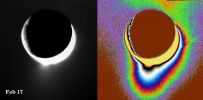
Enceladus-PIA07798.jpgEnceladus' active South Pole (1)60 visitePlumes of icy material extend above the Southern Polar Region of Enceladus, as imaged by the Cassini spacecraft in February 2005. The monochrome view is presented along with a color-coded version on the right. The latter reveals a fainter and much more extended plume component.
Images like these are being analyzed by scientists as they seek to explain the processes that could be producing such incredible features. As reported in the journal Science on March 10, 2006, imaging scientists believe that the plumes are geysers erupting from pressurized subsurface reservoirs of liquid water above 273 degrees Kelvin (0° C.).
Another plume view was taken 1 month earlier and looks broadside at the moon's prominent "Tiger Stripe" fractures. In the January view, the plume appears to have a single component. The February view looks along the Tiger Stripe fractures and reveals both a large and a small component to the plume; the smaller, fainter component is separated from the main plume by about 100 Km.
|
|
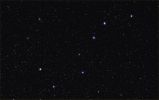
Big Dipper-1.jpgBig Dipper60 visite"...Solem e Mundo tollere videntur qui Amicitiam e Vita tollunt..."
(Cicerone)
"...Coloro che vogliono bandire l'Amicizia dalla Vita sono le stesse persone che vorrebbero cancellare il Sole dal Giorno..."
Caption originale:"A well-known asterism in Northern Skies, The Big Dipper is easy to recognize even when viewed upside down. Part of the larger constellation of Ursa Major, the bright dipper stars above are named Dubhe, Merak, Phecda, Megrez, Alioth, Mizar/Alcor and Alkaid.
Of course, stars in any given constellation are unlikely to be physically related. But surprisingly, most of the Big Dipper stars do seem to be headed in the same direction as they plough through space, a property they share with other stars spread out over an even larger area across the sky. Their measured common motion suggests that they all belong to a loose, nearby star cluster, thought to be on average only about 75 LY away and up to 30 LY across. The cluster is more properly known as the Ursa Major Moving Group".
|
|
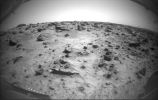
SOU-SOL024-24056.JPGMars Panorama - Sol 2460 visitenessun commento
|
|

SOU-SOL071-4.jpgMoe-Rock - Sol 7160 visitenessun commento
|
|

SOU-SOL080.jpgRocks and boulders - Sol 8060 visitenessun commento
|
|

Titan-PIA08137.jpgHaze-layers and a bright "spot", from 2,3 MKM!60 visiteLe nebbie di Titano sono ormai una realtà acquisita e consolidata, ma le Singolarità Atmosferiche (non sappiamo come altro chiamarle, per ora...) che la Sonda Cassini, di tanto in tanto, riesce a fotografare mentre si sporgono attraverso le nuvole di questo pianeta, costituiscono ancora un mistero. In questo frame, cerchiato in bianco, un "qualcosa" che emerge dalla densa atmosfera di Titano e che non è stato censurato dagli "Amici di Pasadena". Non si tratta, per ovvi motivi, di un rilievo superficiale e non è neppure un photoartifact (ormai avete anche Voi esperienza sufficiente per riconoscere "ictu oculi" un artefatto fotografico da un oggetto reale).
E' una Sonda Aliena in ricognizione? E' una "plume" vulcanica o magari una "nuvola colonnare" (evento più unico che raro nell'intero Sistema Solare)?
Che cosa stiamo guardando, in realtà?!?...
This composite of 24 images from the Cassini spacecraft shows multiple layers in Titan's stratospheric haze. The most prominent layer is located about 500 Km above the surface and is seen at all latitudes, encircling the moon. The material in this layer is probably a condensed substance, possibly water ice.
Several other layers are most apparent in the north polar hood (at top), but this view also shows some at other latitudes. The mechanisms that produce these layers are not understood, but waves in the atmosphere are thought to play a significant role.
The images in this composite were taken over a period of 23 minutes. The images were processed to enhance fine detail and then were combined to create this view. North on Titan (5,150 kilometers, or 3,200 miles across) is up.
The images were taken in visible light with the narrow-angle camera on Jan. 27, 2006 at a distance of approximately 2.3 million kilometers (1.4 million miles) from Titan and at a Sun-Titan-spacecraft, or phase, angle of 155 degrees. Image scale is 13 kilometers (8 miles) per pixel.
|
|
| 25353 immagini su 2113 pagina(e) |
 |
|
|
|
|
1233 | |
|
|
|
|





