| Piú viste |
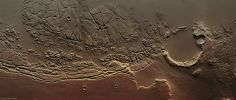
Kasei_Valles_and_Sacra_Fossae-448-20091007-6241-6-co-01_H1.jpgKasei Valles and Sacrae Fossae (Absolute Natural Colors; credits for the additional process. and color.: Dr Paolo C. Fienga - Lunexit Team)61 visiteCaption ESA:"Mars Express flew over the boundary between Kasei Valles and Sacra Fossae and imaged the Region, acquiring spectacular views of the Chaotic Terrain in the area.
The image is centred at about 12° North Latitude and 285° East Longitude and have a ground resolution of approx. 21 mt/pixel.
They cover about 225 x 95 Km (or 21.375 sq Km); an area roughly half the size of the Netherlands".MareKromium
|
|

Japetus-PIA12657.jpgLight and Darkness on Japetus (possible Natural Colors; credits for the additional process. and color.: Dr Paolo C. Fienga - Lunexit Team)61 visiteCaption NASA:"Light and Dark Terrain covers the Surface of Saturn's moon Japetus; Lit Terrain seen here is on the area between the Saturn-facing Side and Trailing Hemisphere of Japetus. North is up and rotated 4° to the right.
The image was taken in Visible Light with the Cassini Spacecraft narrow-angle camera on Dec. 1, 2009. The view was obtained at a distance of approx. 1,4 MKM (about 870.000 miles) from Japetus and at a Sun-Japetus-Spacecraft, or Phase, Angle of 100°.
Image scale is roughly 8 Km (approx. 5 miles) per pixel".MareKromium
|
|
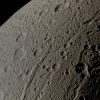
Dione-PIA12663.jpgDione (Absolute Natural Colors; credits for the additional process. and color.: Dr Paolo C. Fienga - Lunexit Team)61 visiteCaption NASA:"The Cassini Spacecraft swooped in for a close-up of the cratered, fractured surface of Saturn's moon Dione in this image taken during the Spacecraft's Jan. 27, 2010, non-targeted Fly-By.
Cassini came within about 45.000 Km (approx. 28.000 miles) of the moon during the Fly-By, and this image was acquired at a distance of approx. 46.000 Km (about 29.000 miles).
This view looks toward the Leading Hemisphere of Dione. North on Dione is up. The image was taken in Visible Light with the Cassini Spacecraft narrow-angle camera.
The view was acquired at a Sun-Dione-Spacecraft, or Phase, Angle of 108°. Image scale is roughly 270 meters (886 feet) per pixel".MareKromium
|
|
Saturnian_Space-N00156094-N00156177.gifCosmic Shower (GIF-Movie; credits: Dr Gianluigi Barca - Lunexit Team)61 visitenessun commentoMareKromium
|
|

SOL1788-EB-PCF5-LXTT.jpgRock Garden (3 - Absolute Natural Colors; credits for the additional process. and color.: Elisabetta Bonora & Paolo C. Fienga - Lunexit Team)61 visitenessun commentoMareKromium
|
|

SOL0392-2P161170457EFFA400P2369L7M1.jpgGusev's Skyline - Sol 392 (Absolute Natural Colors; credits for the additional process. and color.: Dr Paolo C. Fienga - Lunexit Team)61 visitenessun commentoMareKromium
|
|

SOL0398-2N161704422EFFA500P1775R0M1.jpgThe Brown-Orange Plain of Gusev Crater - Sol 398 (Absolute Natural Colors; credits for the additional process. and color.: Dr Paolo C. Fienga - Lunexit Team)61 visitenessun commentoMareKromium
|
|

Daphnis-N00156646-48-EB-LXTT.jpgGravitational Pulls from Daphnis (an Image-Mosaic in Natural Colors by Elisabetta Bonora - Lunexit Team)61 visitenessun commentoMareKromium
|
|
The_Rings-W00064666-W00064680-GB-LXTT.gifClosing-up on the Rings (a GIF-Movie by Dr Gianluigi Barca - Lunexit Team)61 visitenessun commentoMareKromium
|
|

Dunes-PIA13268-PCF-LXTT.jpgDunes in Richardson Crater (EDM - Natural Colors; credits for the additional process. and color.: Dr Paolo C. Fienga - Lunexit Team)61 visiteThis observation from NASA's Mars Reconnaissance Orbiter (MRO) is a view of the Sand Dunefield in Richardson Crater, still partually covered with seasonal frost.
This EDM is a close-up view of defrosting patterns on the Dunes. The frost is a combination of frozen CO2 and some water ice that covers the Dunes in the Winter and Spring. As the seasonal frost sublimes away, odd features such as spots, fans, and streaks form.
Small dark streaks on the dune slip-face slopes may be where recent avalanches of sand, or perhaps wind, has moved the dark sand underlying the frost, or where frost has been removed to expose the sand. Alternatively, the dark streaks may be patches of coarse-grained ice that are clear enough so that the dark material below the ice is visible.
The slip-faces indicate the general direction of sand transport.
It has been hypothesized that the Dark Spots and Fans may be "geysers" or "cold gas jets" that form when sublimation processes trap gas at the bottom of the ice. The gas is released through cracks in the ice, entraining dust from below the ice and scattering it onto the Surface to form the Dark Spots and Fans.MareKromium
|
|

SPLD-PIA13269-PCF-LXTT3.jpgSouth Polar Layered Deposits and Residual Cap (Natural Colors; credits for the additional process. and color.: Dr Paolo C. Fienga - Lunexit Team)61 visiteThis image from NASA's Mars Reconnaissance Orbiter (MRO) shows a variety of surface textures within the South Polar Residual Cap of Mars.
It was taken during the Southern Spring, when the Surface was covered by seasonal CO2 Frost, so that Surface relief is easily seen. Illumination is from the bottom left, highlighting long Troughs at to the right and round pits and irregular Mesas to the left of center.
These unique landforms are common in the South Polar Residual Cap, which is known from previous Mars Global Surveyor images to be eroding rapidly in places. Right of center, SPLDs are exposed on a Sun-facing Scarp. These Deposits are older than the Residual Ice Cap, and the Layers are thought to record climate variations on Mars similar to ice ages on Earth.MareKromium
|
|

Propeller-PIA12790-2.jpgSaturnian "Propeller": Blériot61 visiteNASA's Cassini Spacecraft captured a Propeller-shaped Disturbance in one of Saturn's Rings created by a moon that is too small to be seen here.
The moon, likely about 1 Km (a little more than half a mile) across, is invisible at the center of the image. However, it is larger than many other "Propeller" moons and has cleared ring material from the dark wing-like structures to its left and right in the image. Disturbed ring material closer to the moon reflects Sunlight brightly and appears like a white airplane propeller. This Propeller appears in the A-Ring, which is the outermost of Saturn's Main Rings.
Taken in 2006, this image is part of a growing catalogue of "Propeller Moons" that, despite being too small to be seen, enhance their visibility by creating larger disturbances in the surrounding fabric of Saturn's Rings. Cassini scientists now have tracked several of these individual Propeller Moons embedded in Saturn's disk over several years.
These images are important because they represent the first time scientists have been able to track the orbits of objects in space that are embedded in a disk of material. Continued monitoring of these objects may lead to direct observations of the interaction between a disk of material and embedded moons. Such interactions help scientists understand fundamental principles of how Solar Systems formed from disks of matter. Indeed, Cassini scientists have seen changes in the orbits of these moons, although they don't yet know exactly what causes these changes.
Imaging scientists nicknamed the Propeller shown here "Bleriot" after a French aviator named Louis Bleriot.
The Propeller's structure is about 5 Km (approx. 3 miles) in the radial dimension -- the dimension moving directly outward from Saturn. The dark wings appear approx. 1100 Km (about 700 miles) in the azimuthal (longitudinal) dimension, while the central propeller structure is roughly 110 Km (about 70 miles) long.
See PIA12792 to watch a movie of "Bleriot." PIA11672 shows the giant propeller "Earhart" named after another aviator, Amelia Earhart. See PIA07791 and PIA07792 to learn more about propeller shapes and to see smaller propellers.
This image has been re-projected so that orbiting material moves to the right and Saturn is down. The Propeller was seen at the edge of the camera's field of view when the image was taken, so some data were missing; the blank space at the top of the image was filled in with a gray color. Scale in the original image was approx. 2 Km (about 1,3 miles) per pixel. Image scale in this re-projected view is about 1 Km (a little more than half a mile) per pixel.
This view looks toward the Southern, Sunlit side of the Rings from about 30° below the Ring-Plane. The image was taken in Visible Light with the Cassini Spacecraft narrow-angle camera on Dec. 15, 2006. The view was acquired at a distance of approx. 463.000 Km (about 288.000 miles) from Saturn and at a Sun-Saturn-Spacecraft, or Phase, Angle of 15°.MareKromium
|
|
| 25353 immagini su 2113 pagina(e) |
 |
|
|
|
|
1232 | |
|
|
|
|





